

Plant · Solanaceae · Andes and Amazonia
Floripondio
Brugmansia spp.
Shrubs with large, hanging, bell-shaped flowers, from the Andes and neighbouring regions. They contain tropane alkaloids, and healers in Peru and Ecuador use them in rituals and cleansings.124
Also known asfloripondio · toé · borrachero · campana · misha · maricahua · angel's trumpet · Brugmansia suaveolens · Brugmansia aurea · Brugmansia sanguinea
- What it is
- Shrubs of the nightshade family with bell-shaped flowers
- Territory
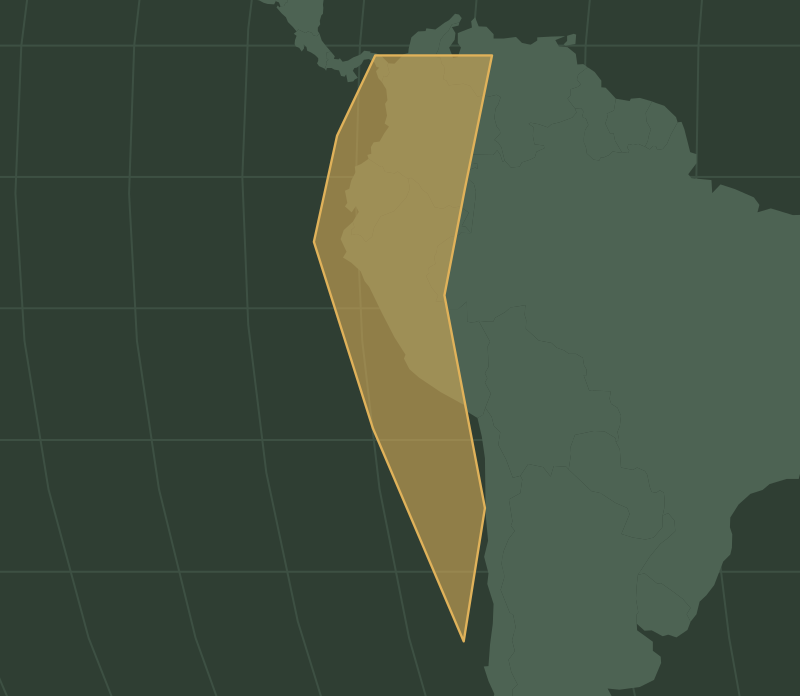
- The Andes, from Venezuela to Chile, and the upper Amazon
- Part used
- Mainly leaves and flowers
- Active principles
- Hyoscyamine, atropine and scopolamine
- Onset and duration
- No reliable data in the sources consulted
- Who keeps its memory
- Andean healers, Amazonian peoples and the Nahua of Mexico
Botany
The bells of the Andes
Brugmansia is a genus of the nightshade family, native to the tropical regions of South America and spread across the Andes, from Venezuela to Chile.7
Seven species are recognised, and many are now grown as ornamentals.78
Ecuador distinguishes the white floripondio (B. candida), the yellow (B. aurea), the red (B. sanguinea) and the pink (B. suaveolens).2
- Family
- Solanaceae
- Recognised species
- Seven
- Flower
- Hanging bell
- Alkaloids
- Hyoscyamine, atropine, scopolamine
Memory and tradition
Healers, cleansings and plant teachers
Healers in the northern Peruvian Andes, in the high-lake area running from Ayabaca to Laguna Prieta, use Brugmansia species in ritual healing practices.1
In southern Ecuador, the Saraguro yachakkuna use the yellow floripondio in cleansings against "bad air" or fright, making a bundle with other plants; the red is applied externally to people and animals, and the white is boiled with other leaves for rheumatic pain.2
Among other peoples of the upper Amazon, the use of Brugmansia is not rare, but it is usually secondary to that of yagé (Banisteriopsis) and is often combined with it.5
Among the Nahua of Mexico, floripondio is compared with the toloaches and sometimes identified with them.6
Andean and Amazonian peoples believe that the spirit of Toé is a wise and demanding teacher who can pass on knowledge and power if its use is mastered.7
Over time
Its names
- floripondio
- the most widespread name in Spanish
- toé
- Andean and Amazonian name
- borrachero, campana
- other regional names
- misha, maricahua
- Peruvian names
Floripondio or florifundio is sometimes used interchangeably with toloache.36
Territory and care
A genus of the Andes
What helps
- Know it as part of the knowledge of Andean healers.
- Do not cut it without permission in areas where it is scarce.
- Respect those who safeguard it.
What it contains
Tropane alkaloids
It contains the tropane alkaloids hyoscyamine, atropine and scopolamine, the last of which appears in the highest concentration.7
These are alkaloids that are toxic even in modest amounts.7
A review of B. suaveolens covers its botany, traditional uses, phytochemistry, pharmacology and toxicology.4
Appears in higher concentration than the other two.[7]
Present alongside hyoscyamine.[7]
Precursor of atropine.[7]
The experience
A delirium, not a vision
The sources describe that, when ingested, the plant stimulates the central nervous system and causes hallucinations and delirium.8
They give no reliable data on onset or duration.
Research
What has been studied
There are ethnobotanical studies in Peru, Ecuador and Mexico, and phytochemical and toxicological reviews of B. suaveolens.1246
The pharmacological review describes traditional uses as a hallucinogen, analgesic and muscle relaxant, and its modern therapeutic value has not been evaluated clinically.3
Scope of these dataGood ethnobotanical documentation; almost no clinical research.
With care
What it helps to know beforehand
Its three alkaloids are toxic even in modest amounts and call for great care.7
There have been poisonings from keeping it at home as decoration without knowing its toxicity.9
There are no clinical studies.
To follow
Books and related medicines
A close relative, sometimes confused with floripondio.
PlantThorn appleDatura stramoniumA nightshade with the same alkaloids.
PlantCup of goldSolandra spp.An American nightshade with tropane alkaloids.
PlantSan PedroEchinopsis pachanoiA plant that Andean healers use together with floripondio.
Sources
Where each piece of information comes from
- De Feo V. The ritual use of Brugmansia species in traditional Andean medicine in northern Peru. Economic Botany. 2004;58(Suppl):S221-S229. es.scribd.com/doc/70890182.
- Traditional medicine applied by the Saraguro yachakkuna: a preliminary approach to the use of sacred and psychoactive plant species in the southern region of Ecuador. J Ethnobiol Ethnomed. 2014;10:26. ethnobiomed.biomedcentral.com/articles/10.1186/1746-4269-10-26.
- Brugmansia suaveolens: botany, traditional uses, phytochemistry, pharmacology and toxicology (review). pmc.ncbi.nlm.nih.gov/articles/PMC7570077.
- Brugmansia suaveolens Bercht. & J. Presl: systematic review of botany, uses, phytochemistry and toxicology. pmc.ncbi.nlm.nih.gov/articles/PMC10343851.
- The ethnobotany of Brugmansia (chapter, pp. 147-164). knowledge-mapping.heig-vd.ch/view/2962.
- Lorente Fernández D. Hojas frías, flor de campana. Sobre el uso terapéutico del floripondio (Brugmansia) entre los nahuas. ceeol.com/search/article-detail?id=1111918.
- Fox News. Tree of the evil eagle: Amazonian plant yields medicines and powerful hallucinations. foxnews.com/health/tree-of-the-evil-eagle-amazonian-plant-yields-medicines-and-powerful-hallucinations.
- Herald to the angels' trumpets. sites.evergreen.edu/plantchemeco/herald-to-the-angels-trumpets-their-cacophony-abound.
- Basantes Mora EE. Trabajo sobre Brugmansia y sus efectos tóxicos. Universidad Técnica de Machala. repositorio.utmachala.edu.ec/bitstream/48000/16943/1/E-12169_BASANTES%20MORA%20EDGAR%20ELIAS.pdf.
- Map APDER, with data from Natural Earth · public domain
- Molecule drawings APDER
Last reviewed: 24 November 2026. If you spot a mistake, write to us at info@apder.org.