

Plant · Solanaceae · Mexico and south-western North America
Toloache
Datura innoxia Mill.
A member of the nightshade family with large white flowers, native to Mexico and south-western North America, with a long ritual and medical history. It is a deliriant, not a psychedelic, and the most dangerous plant in this encyclopedia.1256
Also known astoloache · toloatzin · tolguacha · white-flowered datura · devil's weed
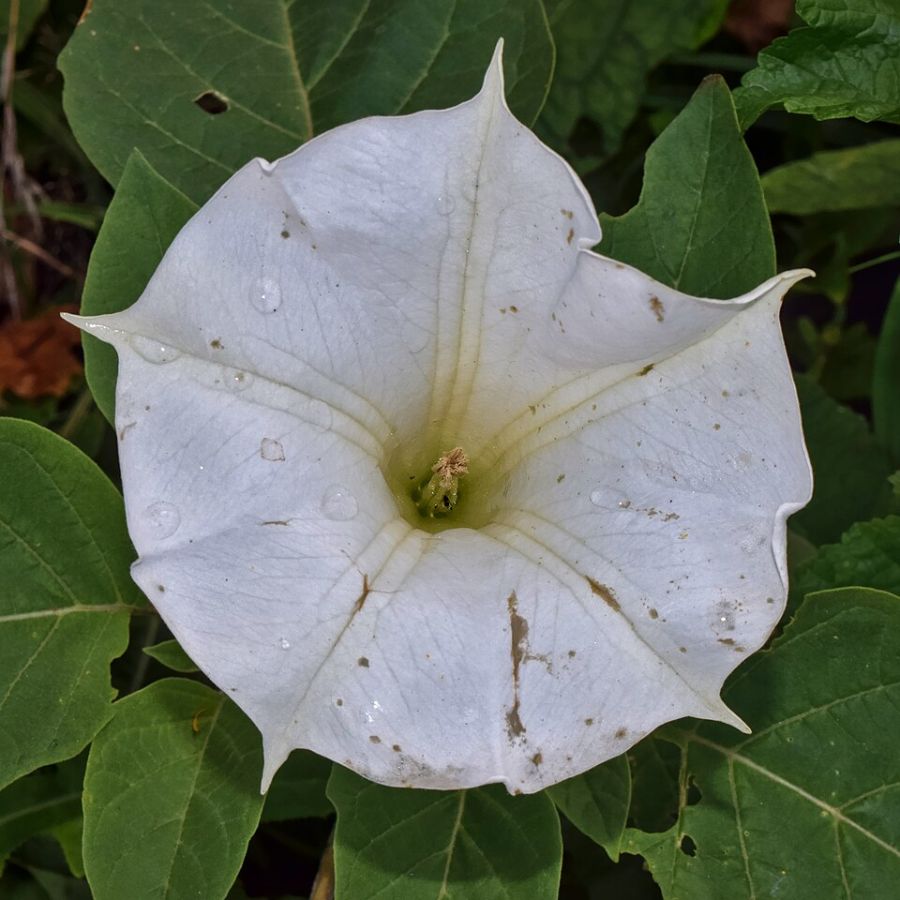
- What it is
- Greyish subshrub with large white trumpet-shaped flowers
- Territory
- South-western USA, Mexico and Central and South America
- Part used
- Leaf, flower, root and seed; all are toxic
- Active principles
- Scopolamine, atropine and hyoscyamine
- Onset and duration
- Hours · 24 to 48 hours or more
- Who keeps its memory
- Nahua peoples of Mexico and, in California, the Chumash
Botany
A white trumpet that opens at dusk
It is a subshrub with a tuberous root that usually measures between 0.6 and 1.5 metres. Stems and leaves bear short, soft hairs that give it a greyish appearance.4
Its flowers are white, trumpet-shaped, between 12 and 19 centimetres long. It flowers from early summer until late autumn.4
The fruit is a spiny capsule; its seeds live a long time, and sometimes the fruits travel caught in animals' fur.4
- Family
- Solanaceae
- Habit
- Subshrub, 0.6–1.5 m
- Flower
- White, trumpet-shaped, 12–19 cm
- Fruit
- Capsule with spines
Memory and tradition
A plant both sacred and feared
Among the Aztecs, the daturas called tlapatl and mixitl correspond to Datura stramonium and Datura innoxia, and they were used for medical and divinatory purposes and also harmful ones.5 The name toloache comes from its Nahuatl name, toloatzin.6
In southern California, the Chumash and other peoples developed a toloache cult, integrated into their visions and their ceremonial life.6 They took great care over the rules that applied to whoever drank it, including abstaining from meat and fat.6
That ritual tradition does not make it harmless: the plant still causes serious poisonings today.17
Over time
The Aztecs use the daturas for medical and divinatory purposes and also harmful ones.5
Philip Miller describes the species in 1768 under the name Datura innoxia.4
In Spain, accidental poisonings have been described from infusions of plants of this group.7
Its names
- toloache
- from the Nahuatl toloatzin
- tolguacha
- another Mexican name for the same plant and its relatives
- white-flowered datura
- because of its trumpets
- Datura innoxia
- "harmless": Miller misspelt the Latin adjective, and the name stuck
Datura innoxia resembles D. wrightii, the sacred datura of the south-western USA; in the older literature they are confused.46
Territory and care
A plant of roadsides and verges
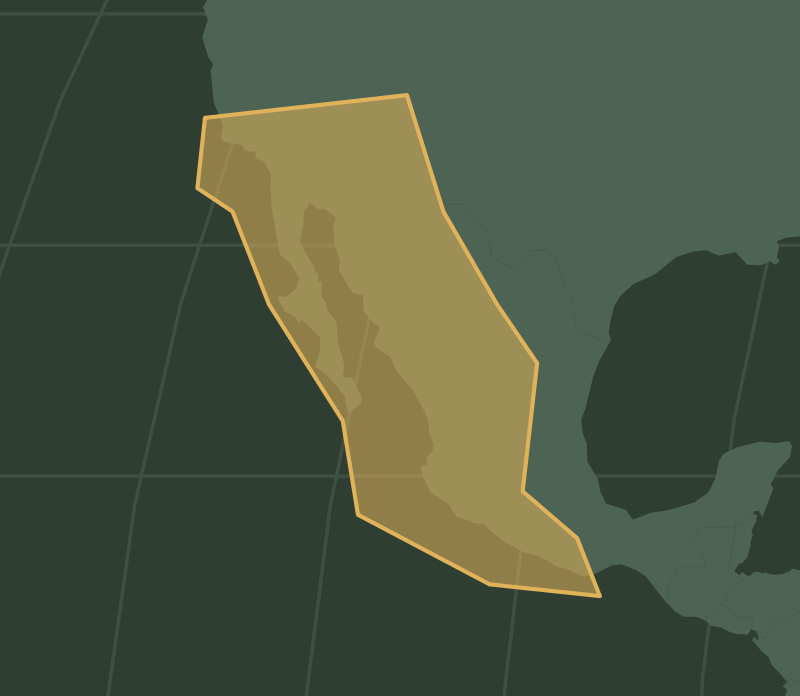
It is native to the south-western United States and Central and South America, and has been introduced to Africa, Asia, Australia and Europe.4
It grows on open ground, beside roads and in disturbed places. Like others of its family, it is also a garden plant, and so there are accidental poisonings in children and young adults.7
What helps
- Do not pick or consume wild plants of this group, not even "a little".
- If you have datura in your garden, label it and keep it out of the reach of children and animals.
- To respect toloache as a plant of the peoples who keep it, not as a medicine for consumption.
What it contains
Tropane alkaloids, poisons that block acetylcholine
It contains scopolamine, atropine and hyoscyamine, alkaloids known as tropanes. They are the same principles found in other toxic nightshades such as deadly nightshade, henbane or mandrake.1
They do not act on serotonin, as psychedelics do, but block acetylcholine: they are anticholinergics. That is why the picture is one of delirium and not of lucid vision.12 The amount of alkaloids varies greatly between plants, parts and seasons.3
It produces delirium, confusion and memory loss; it is one of the main alkaloids of the group.[1][2]
A tropane alkaloid concentrated mainly in the seeds, together with scopolamine.[1]
The experience
A delirium, not a journey
It is not an experience that can be remembered or understood: the person sees and hears things they believe are real, loses contact with reality and afterwards remembers almost nothing.12
It can last from 24 to 48 hours.12 In emergency departments it is described with dilated pupils, hallucinations and disorientation.7 For that reason it is not considered a path of exploration.
Indicative outline: it changes with the preparation, the amount and the person.
Research
What has been studied
What has been studied is the poisoning: how anticholinergic delirium is diagnosed and how it is treated.12
There are reports of accidental poisonings in Spain from infusions of flowers of plants of this group, and of its use to subdue another person's will, the so-called "burundanga".78
Scope of these dataThere are no studies supporting any therapeutic use of the raw plant, or as a psychoactive. Its alkaloids are used, isolated and in controlled doses, in specific medicines.
With care
What it helps to know beforehand
It is the most dangerous plant in this encyclopedia: serious poisonings with fever, convulsions or coma, and accidents caused by the delirium. There is no safe dose.1
Other anticholinergic drugs, such as some antihistamines, tricyclic antidepressants and antipsychotics, add their effects.9
Call emergency services: in Spain, 112. It is a medical emergency, and the person affected cannot decide for themselves.
The delirium of scopolamine has been used to override other people's will.8
To follow
Books and related medicines
Sources
Where each piece of information comes from
- Emergency Medicine Residents' Association (EMRA). Tripping off trumpets: diagnosis and management of jimson weed toxicity. EM Resident. emra.org.
- Dawson AH, Buckley NA. Pharmacological management of anticholinergic delirium: theory, evidence and practice. Br J Clin Pharmacol. 2016;81(3):516-524.
- EFSA Panel on Contaminants in the Food Chain (CONTAM). Scientific opinion on tropane alkaloids in food and feed. EFSA Journal. 2013. efsa.europa.eu.
- Wikipedia. "Datura innoxia". en.wikipedia.org (accessed 24 November 2026).
- Wikipedia. "Aztec use of entheogens". en.wikipedia.org (accessed 24 November 2026).
- Applegate RB. The Datura cult among the Chumash. Journal of California Anthropology. 1975;2(1):7-17. escholarship.org.
- Gomila Muñiz I, Sánchez de Muniain MS, Zuabi García LB, et al. Alucinaciones tras ingerir una infusión de una planta anticolinérgica con confirmación toxicológica. Emergencias. 2020;32(5):377-378.
- Fernández Alonso C, Descalzo Casado E, Quintela Jorge O, et al. Drug facilitated crimes by «burundanga» or scopolamine. Spanish Journal of Legal Medicine. 2022;48(2):74-77.
- NHS Scotland, Polypharmacy Guidance. Why are anticholinergics problematic? rightdecisions.scot.nhs.uk.
- Toloache (Datura innoxia) in flower. The Cosmonaut · CC BY-SA 4.0
- Map APDER, with data from Natural Earth · public domain
- Molecule drawings APDER
Last reviewed: 24 November 2026. If you spot a mistake, write to us at info@apder.org.