

Contents
- In brief
- What it is and where it comes from
- How it works
- The experience
- Dose
- Interactions
- Who should not take it
- How to reduce risks
- If something goes wrong
- Research and therapeutic use
- Integration and personal growth
- Ethics and sustainability
- Myths and facts
- History
- Frequently asked questions
- Further reading and related guides
- References
In brief
- What it is. Plants of the nightshade family, such as thorn apple (Datura) and angel's trumpet or toé (Brugmansia), which contain scopolamine, atropine and hyoscyamine.1
- What it does. It is not a psychedelic: it produces a delirium in which the person sees and hears things they believe are real, loses contact with reality and afterwards remembers almost nothing. It can last 24 to 48 hours.1,2
- The main risk. It is the most dangerous plant of all those on this website: severe poisoning with fever, seizures or coma, and accidents caused by the delirium. There is no safe dose.1
- The most dangerous interaction. With other anticholinergic drugs (sedating antihistamines, tricyclic antidepressants, some antipsychotics): their effects add up.5
What it is and where it comes from
Datura (Datura stramonium and other species) and its relative angel’s trumpet (Brugmansia) are plants of the nightshade family that grow all over the world, including as weeds and garden plants in Spain. They contain scopolamine, atropine and hyoscyamine, alkaloids known as tropane alkaloids.1 They are relatives of other toxic nightshades such as deadly nightshade, henbane and mandrake.
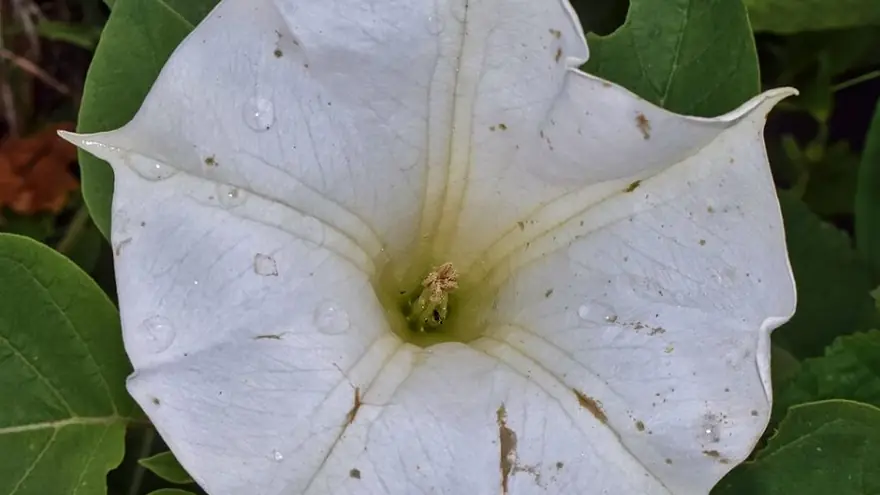
They are not psychedelics but deliriants. They do not produce a lucid experience: the person loses contact with reality, sees and hears things they believe are real, and afterwards remembers almost nothing. They are among the plants that cause the most severe poisonings.1
We advise against taking it under any circumstances. The amount of alkaloids varies enormously between plants, parts and seasons, and the difference between an active dose and a toxic one is minimal. Of all the substances on this website, it is the most dangerous.
Forms in which it is found
- Seeds: the part with the most atropine.1
- Flowers and leaves, as an infusion or smoked.3
- As a hidden additive: drinks sold as ayahuasca have been documented as adulterated with atropine and scopolamine, alkaloids found in plants such as toé or datura.6
In Spain, accidental poisonings have been described in children, teenagers and young adults. In a case published in 2020, a 17-year-old boy drank an infusion of angel’s trumpet flowers with a friend and arrived at the emergency department with hallucinations, disorientation and dilated pupils; the analysis confirmed scopolamine.3
| Type | Deliriant (anticholinergic) |
|---|---|
| Main action | Blocks muscarinic acetylcholine receptors |
| Routes | Oral (seeds, infusion), smoked3 |
| Starts to be noticed | Usually within the first hour1 |
| Duration | 24–48 hours or more1 |
| Toxicity | Very high |
How it works
Acetylcholine is a chemical messenger that the body uses for many things: in the brain, for attention and memory; in the rest of the body, to slow the heart, produce saliva and sweat, move the intestine, empty the bladder and constrict the pupil. Scopolamine and atropine block the muscarinic receptors of acetylcholine.2
This blockade explains the whole picture, which doctors call anticholinergic syndrome:1,2
- In the brain: confusion, delirium, hallucinations, agitation and amnesia.
- In the body: very dilated pupils and blurred vision, dry mouth and skin, flushing, rapid pulse, high blood pressure, urinary retention, fever.
Why it lasts so long. Returning to a normal mental state can take 24 to 48 hours, and blurred vision may continue afterwards.1,3 Because the intestine is also slowed down, absorption of the plant can be prolonged.
Why it is so unpredictable. The amount of alkaloids changes greatly from one plant to another, from one part of the plant to another and from one season to another.1 There is no way of knowing how much a particular seed or flower contains.
The experience
ExperienceRather than an ‘experience’, what the medical literature describes is a poisoning. Symptoms usually begin within the first hour.1 The person notices a very dry mouth, thirst, heat and blurred vision. Then the delirium arrives: they talk to people who are not there, look for objects that do not exist or make gestures such as smoking an imaginary cigarette, convinced that everything is real. They do not know where they are or what time it is, and may swing from calm to agitation or fear.
Unlike with psychedelics, there is no awareness of being under an effect: the person cannot ‘observe’ the experience. Afterwards they remember little or nothing of what happened.
Physical effects
- Very dilated pupils and blurred vision for days.1,3
- Very dry mouth and skin, flushing, thirst.1
- High temperature: the skin dries out and the body does not regulate its temperature well.1
- Rapid pulse, high blood pressure, nausea and vomiting.1
- Urinary retention.1
Mental effects
- Delirium: talking to people who are not there, looking for non-existent objects, not knowing where one is.
- Hallucinations that are experienced as real.
- Agitation, fear and, sometimes, violent behaviour.1
- Amnesia for what happened.4
Severe poisoning
In severe poisonings, seizures, coma, very high fever and, in rare cases, death can occur.1 Most people need hospital care.1 The delirium also exposes people to falls, drowning and road accidents.
Dose
We do not give dose figures, and there is no safe dose. The plant’s alkaloid content is highly variable, and the difference between an amount that produces effects and one that causes severe poisoning is minimal.1 For that reason, with this plant, any figure would be misleading.
Two facts explain why: the outcome depends on the amount of alkaloids ingested,1 and that amount cannot be known without a laboratory. In poisonings treated in emergency departments, the person rarely knows how much they have taken.3
Nor is there any way of checking what is being taken: substance-checking services work with synthetic drugs and do not identify the alkaloid content of a plant gathered in the wild.
Interactions
The greatest danger is the adding together of anticholinergic effects. Many commonly used medicines have them, and these effects accumulate.5 Listed from most to least dangerous:
| Combination | Risk | What can happen |
|---|---|---|
| Other anticholinergic drugs: sedating antihistamines, tricyclic antidepressants, some antipsychotics (clozapine, olanzapine), urinary antispasmodics, anti-Parkinson drugs | Very dangerous | Anticholinergic effects add up: more delirium, more fever, urinary retention and cardiac risk.5 |
| Stimulants (cocaine, amphetamines, MDMA) | Very dangerous | They add up to a fast heart rate, high blood pressure and heat when the body can no longer sweat: risk of heatstroke.1 |
| Alcohol | Dangerous | More confusion, vomiting and accidents; it makes it harder to judge how serious things are. It is a common mixture.3 |
| Cannabis and other psychedelics | Dangerous | More disorientation and agitation, and it is harder to tell delirium from poisoning.3 |
| Tramadol and opioids | Dangerous | Tramadol lowers the seizure threshold, which datura can already trigger; opioids slow the intestine even more.7,1 |
| Ayahuasca and other ceremonial drinks | Dangerous | Drinks adulterated with atropine and scopolamine have been documented, with a drop in blood pressure, high fever and respiratory failure.6 |
| MAOIs, SSRI and SNRI antidepressants, lithium | Caution | No specific data; several antidepressants also have an anticholinergic effect of their own.5 |
This table is not complete and does not replace consulting a health professional. Pending expert review.
Who should not take it
APDER advises against its use by anyone and under any circumstances. These situations multiply the danger:
- Mental health: a personal or family history of psychosis or bipolar disorder. The picture is, in itself, a delirium.
- Heart and blood pressure: arrhythmias, heart disease or hypertension. The pulse speeds up and blood pressure rises.1
- Epilepsy: seizures may occur.1
- Glaucoma, enlarged prostate or urinary problems: anticholinergics can cause urinary retention and make glaucoma worse.5
- Heat or physical exertion: with dry skin the body cannot shed heat; there is a risk of heatstroke.1
- Pregnancy and breastfeeding: there are no safety data. It should not be taken.
- Age: minors. Most of the poisonings described affect teenagers and young people.1,3
- Regular medication: anything with an anticholinergic or sedative effect; see the interactions table.
- Driving and working: neither during the effect nor in the following days while blurred vision or confusion remain.3
How to reduce risks
With datura there is no low-risk use: the plant’s very unpredictability is the risk. For that reason this section focuses on not ending up poisoned and on knowing how to act if it happens.
- The most effective measure is not to take it. Almost everything people look for in it (visions, introspection) is not what it produces: it produces delirium and amnesia.1
- Care at home and in the garden. It is an ornamental plant and a common weed in Spain. It is advisable to keep its flowers and seeds out of children’s reach.3
- Always ask what a ceremonial drink contains. Undeclared mixtures with toé or datura have been documented.6 Nobody should drink something whose composition they do not know.
- Do not mix it with medication, alcohol or other substances.
- Never alone. During the delirium the person cannot look after themselves: they need someone sober who can keep them away from danger and call 112.
- Keep the plant, the seeds or the drink. Identifying what has been taken helps a great deal in hospital.
The risk specific to datura: anticholinergic syndrome
This is what you need to recognise and name when calling 112. These are signs of anticholinergic poisoning: very dry skin and mouth, a flushed face, fever, very dilated pupils, rapid pulse, being unable to urinate and a delirium with agitation.1,2
What to do: call 112, do not leave the person alone, keep them away from water, traffic and heights, and keep them in a cool, quiet place; heat is part of the danger. Tell the medical staff that it may be an anticholinergic plant. In hospital there is an antidote, physostigmine, which can quickly improve the condition, but it is given only in hospital and after consulting a poison centre or a toxicologist, because it has risks of its own, including seizures in up to 2.5% of patients.1,2 The Toxicology Information Service is available 24 hours a day on 91 562 04 20.
If something goes wrong
Call 112 if the person:
- does not respond or has lost consciousness;
- has seizures;
- has difficulty breathing or chest pain;
- is very hot, with dry or red skin, or is confused;
- is so agitated that they may hurt themselves or others;
- talks about harming themselves or taking their own life.
112 is free and operates throughout the European Union. Asking for help in time matters more than fear of the consequences.
While help is on its way
- Do not leave the person alone.
- If they are unconscious but breathing, put them on their side, in the recovery position.
- Find a quiet, cool, dimly lit place.
- Do not give them any more substances, or other ones to ‘counteract’ the effect.
- If they are conscious, give water in sips; drinking a lot of water at once is also dangerous.
What to tell the health staff
What they have taken, how much, when, whether they have mixed it with anything and what medication they take regularly. If any remains or the packaging, take it with you. Telling the truth helps the person to be treated properly. For questions about a poisoning, the Toxicology Information Service is available 24 hours a day on 91 562 04 20.
If it is a challenging experience, with no physical warning signs
Support them with presence and a calm voice. Remind the person that what they feel is the effect of the substance and that it will pass. If it does not ease or a risk appears, ask for help. If someone has thoughts of harming themselves, the Ministry of Health’s 024 Line is free, open 24 hours a day and confidential.
Before taking anything
Testing a substance is the only way to know what it contains. In Spain this is done by Energy Control, with offices in Andalusia, Catalonia, Madrid and Mallorca and a postal service from other regions. Also read the interactions section of each guide.
Research and therapeutic use
ResearchThere is no research on the plant as a psychoactive substance for therapeutic purposes, and it is not plausible that there will be: the delirium and amnesia it produces are incompatible with psychological work, which needs the person to be present and able to remember.
Its isolated alkaloids, on the other hand, are widely used medicines in very controlled doses. Atropine and scopolamine are used, for example, to dilate the pupil in the ophthalmology clinic, against travel sickness or in anaesthesia. The product information sheets for these medicines describe the same toxic picture when the dose is exceeded: dry, flushed skin, blurred vision, irregular pulse, fever, seizures, hallucinations and, in severe cases, coma and respiratory failure.8
Tropane alkaloids also matter in food safety: the European authority EFSA set a very low acute reference dose for the sum of hyoscyamine and scopolamine, because their effects appear shortly after exposure, and pointed out that the intake of young children can exceed it when food is contaminated.9
Microdosing. There are no studies and no practice with any support. Given the plant’s variability, any regimen would be dangerous. APDER does not give regimens.
Integration and personal growth
InterpretationWhat follows is a reading from humanistic and transpersonal psychology, not a clinical fact. In work with non-ordinary states of consciousness, Stanislav Grof insisted that what is therapeutic is not the intensity of what is lived, but the possibility of being present in it and remembering it afterwards. Datura allows neither: it erases the witness. For that reason, from this perspective, it is neither a medicine nor a path to self-knowledge, even though it appears in accounts of initiation.
Someone who has been through a poisoning is often left with gaps in memory, with other people’s account of events and, at times, with shame or fear. What helps here is not reconstructing the visions, but attending to what pushed them to take it: curiosity, a search for intensity, distress, loneliness. From Carl Rogers’s approach, this material deserves to be listened to without judgement, because it is what can give rise to real change.
It is advisable to ask for professional support if fear or confusion remain, if it is hard to piece together what happened, if there was an accident or behaviour that is troubling, or if the urge to repeat it is still there.
Ethics and sustainability
Traditions. Nightshades with tropane alkaloids have been used in ritual contexts in the Americas, Asia and Europe, always with preparations and forms of support specific to each culture.10 Calling an individual, decontextualised use ‘ancestral’ does not make it any safer.
Consent. Adding toé or datura to a drink without telling the person who drinks it is a serious breach of trust, as well as a danger.6 Whoever facilitates a ceremony has an obligation to say exactly what it contains.
Criminal use. Scopolamine is associated in the media with the so-called ‘burundanga’, used to take away victims’ will. This needs qualifying with data: in a seven-year review at a hospital in Madrid, scopolamine was detected in 1 of 292 suspected cases of chemical submission (0.3%), and the authors conclude that its use is much less frequent than is claimed, although it is hard to detect because there is no rapid test and the detection window is short.4
Myths and facts
- ‘It is a natural psychedelic like mushrooms or ayahuasca.’
- No. It is an anticholinergic deliriant: there is no lucid experience, but a loss of contact with reality and amnesia.1,2
- ‘If it is a plant that grows in any roadside ditch, it cannot be that dangerous.’
- It is one of the plants that causes the most severe poisonings. Most poisoned people need hospital care.1
- ‘A small amount does no harm.’
- The alkaloid content varies so much between plants and parts that it is impossible to know what a given seed or flower contains: the same apparent amount may be harmless or toxic.1
- ‘An ayahuasca ceremony never contains datura.’
- Drinks adulterated with atropine and scopolamine have been documented, causing a drop in blood pressure, high fever and respiratory failure.6
- ‘Burundanga lets you control someone from a distance, with a piece of paper or a puff of air.’
- That image comes from the media. In forensic practice scopolamine appears only exceptionally in suspected cases, although it is hard to detect.4
History
- Ritual uses. Nightshades with tropane alkaloids appear in initiation rites of peoples of the Americas, in traditional medicine in India and in European witchcraft, where they were part of the so-called ‘flying ointments’.10
- Modern medicine. Atropine and scopolamine, isolated, became everyday medicines in ophthalmology, anaesthesia and against travel sickness, always in very controlled doses.8
- The 21st century. Poisonings from recreational use are described in teenagers and young people, including in Spain, along with the adulteration of ceremonial drinks.3,6
Frequently asked questions
Is datura a psychedelic?
No. It is an anticholinergic deliriant: it does not produce a lucid experience, but a loss of contact with reality, hallucinations that are experienced as real and amnesia afterwards.
How long do the effects last?
Returning to a normal mental state can take 24 to 48 hours, and blurred vision may continue for several more days.
What do I do if someone has been poisoned?
Call 112, do not leave them alone, keep them away from water, traffic and heights, and keep them in a cool place. Tell the medical staff that it may be an anticholinergic plant. The Toxicology Information Service can be reached on 91 562 04 20.
How do you recognise anticholinergic poisoning?
Very dry skin and mouth, a flushed face, fever, very dilated pupils, rapid pulse, being unable to urinate and a delirium with agitation.
Is there an antidote?
Yes, physostigmine, but it is given only in hospital and after consulting a toxicologist, because it has risks of its own, including seizures.
Why do you not give doses?
Because there is no safe dose: the alkaloid content varies enormously between plants and parts, and the difference between an active amount and a toxic one is minimal.
Can it be tested before taking it?
Not in a practical way. Substance-checking services do not determine the alkaloid content of a plant gathered in the wild.
Can there be datura in a ceremonial drink?
Drinks sold as ayahuasca and adulterated with atropine and scopolamine have been documented, causing a drop in blood pressure, high fever and respiratory failure. It is advisable always to ask what it contains.
Is what is said about ‘burundanga’ true?
Scopolamine is used in some crimes, but in forensic practice it appears only exceptionally: at a hospital in Madrid it was detected in 1 of 292 suspected cases. It is hard to detect because there is no rapid test.
Further reading and related guides
Books from the APDER Library:
- Plantas de los dioses, Richard Evans Schultes and Albert Hofmann, 1979. Spanish edition.
- Hexenmedizin, Claudia Müller-Ebeling, Christian Rätsch and Wolf-Dieter Storl, 1998. In German; a study of the nightshades of European witchcraft.
- Pharmako/Poeia: Plant Powers, Poisons, and Herbcraft, Dale Pendell, 1995. In English.
References
- Emergency Medicine Residents' Association (EMRA). Tripping off trumpets: diagnosis and management of jimson weed toxicity. EM Resident. emra.org.
- Dawson AH, Buckley NA. Pharmacological management of anticholinergic delirium: theory, evidence and practice. Br J Clin Pharmacol. 2016;81(3):516-524. doi:10.1111/bcp.12839. PMID 26589572.
- Gomila Muñiz I, Sánchez de Muniain MS, Zuabi García LB, et al. Alucinaciones tras ingerir una infusión de una planta anticolinérgica con confirmación toxicológica. Emergencias. 2020;32(5):377-378. revistaemergencias.org.
- Fernández Alonso C, Descalzo Casado E, Quintela Jorge O, Megía Morales C, Bravo Serrano B, Santiago-Sáez A. Drug facilitated crimes by «burundanga» or scopolamine. Spanish Journal of Legal Medicine. 2022;48(2):74-77. doi:10.1016/j.remle.2022.01.003.
- NHS Scotland, Polypharmacy Guidance. Why are anticholinergics problematic? (cumulative anticholinergic burden and the drugs involved). rightdecisions.scot.nhs.uk.
- Hamill J, Hallak J, Dursun SM, et al. Ayahuasca: psychological and physiologic effects, pharmacology and potential uses in addiction and mental illness. Curr Neuropharmacol. 2019;17(2):108-128. doi:10.2174/1570159X16666180125095902. PMID 29366418.
- AEMPS-CIMA. Ficha técnica de Tramadol/Paracetamol Cinfa 37,5 mg/325 mg comprimidos recubiertos con película, sections 4.4 and 4.5. cima.aemps.es.
- AEMPS-CIMA. Product information sheet for Colirofta Ciclopléjico 10 mg/ml eye drops, solution, section 4.9 (anticholinergic toxic picture). cima.aemps.es.
- EFSA Panel on Contaminants in the Food Chain (CONTAM). Scientific opinion on tropane alkaloids in food and feed. EFSA Journal. 2013. efsa.europa.eu.
- Müller-Ebeling C, Rätsch C, Storl WD. Hexenmedizin. 1998. In the APDER Library.
Last reviewed: 21 November 2026. Doses and interactions pending expert review.
Before you read on. This information is for general education. We prepare it carefully from scientific and harm reduction sources, but it may contain errors or become out of date. It is not medical advice and does not replace a health professional, especially if you take medication or have a health problem. APDER does not encourage the use of any substance and accepts no responsibility for how this information is used. If you spot an error, write to us at info@apder.org.
Canonical address: https://apder.org/sustancias/datura/