

Contents
- In brief
- What it is and where it comes from
- How it works
- The experience
- Dose
- Interactions
- Who should not take it
- How to reduce risks
- If something goes wrong
- Research and therapeutic use
- Integration and personal growth
- Ethics and sustainability
- Myths and facts
- History
- Frequently asked questions
- Further reading and related guides
- References
In brief
- What it is. The red mushroom with white spots from fairy tales. It is poisonous and is not a psilocybin mushroom: its active substances are ibotenic acid and muscimol.1,2
- What it does. After nausea and vomiting, it produces confusion, euphoria or agitation, hallucinations and then a deep sleep. It can last between 5 and 24 hours.5,6
- The main risk. Mistaking it for other amanitas, some of them deadly such as the death cap (Amanita phalloides), and the poisoning itself, which sometimes requires hospital admission.4,7
- The most dangerous interaction. With alcohol, benzodiazepines, GHB, opioids or other sedatives: deep sedation and a risk to breathing.9
What it is and where it comes from
Amanita muscaria, known in English as fly agaric, is the red mushroom with white scales that appears in so many stories and illustrations. It grows in autumn in pine, birch and fir woods across the whole northern hemisphere, including Spain. It lives in association with the roots of those trees: it is not easily cultivated, and almost all of what circulates is gathered in the wild.1
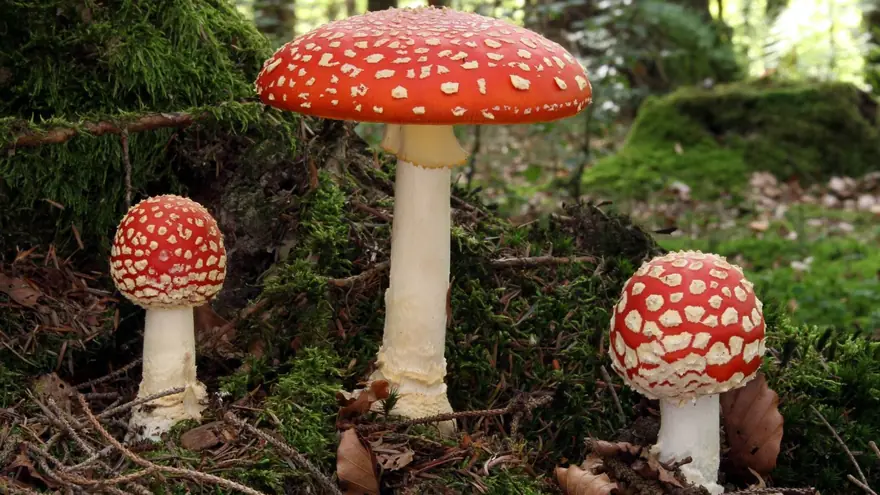
It is not a psilocybin mushroom or a classic psychedelic. Its main compounds are:1,2,3
- Ibotenic acid: it resembles glutamate and excites the nervous system. It is the most toxic compound.
- Muscimol: it resembles GABA and depresses it. It produces most of the sedative, dreamlike effect. When the mushroom is dried or heated, part of the ibotenic acid is converted into muscimol.
- Muscarine: it is present in small amounts in this species, even though its name comes from it.
The amount of each compound varies greatly between mushrooms, places and seasons.1 That is why there is no way of knowing what a particular mushroom contains.
Dangerous look-alikes
The genus Amanita includes some of the most dangerous mushrooms in the world. The death cap (Amanita phalloides) is implicated in most deaths from mushrooms.7 Its toxins, the amatoxins, damage the liver and kidney, and the first symptoms arrive hours after eating it, when the damage is already under way.6,7 The panther cap (Amanita pantherina) contains the same substances as muscaria and causes more intense poisonings: in a series from a poison centre in the United States, those who had eaten it had more vomiting, more sedation and more agitation.4
In addition, the species has varieties with a different appearance. In 2018, in Minnesota, a man ate Amanita muscaria believing it to be an edible mushroom from his country of origin; it was the variety guessowii, and he needed assisted breathing for four days.3 This guide gives no keys for identifying mushrooms. If in any doubt, it must not be eaten.
Commercial products
In recent years gummies, chocolates, tinctures and capsules “of amanita” or “of muscimol” have been sold. Their labels are not reliable: in the United States, products have been found that did not say which species they contained, or that contained psilocybin, caffeine, ephedrine or other undeclared substances.2
| Type | Deliriant / sedative (not a classic psychedelic) |
|---|---|
| Main action | Muscimol: activates the GABA-A receptor; ibotenic acid: activates glutamate receptors |
| Route | Oral |
| Starts to be noticed | After 30–120 minutes |
| Total duration | 6–10 hours, sometimes considerably longer5 |
| Toxicity | Moderate; it can cause poisonings that require hospital care4 |
Starts to be noticed: 30–120 minutesTotal duration: 6–10 hours, sometimes considerably longer
A rough diagram based on the table above; it varies with the dose, the route and the person.
How it works
The brain works through a balance between signals that excite and signals that slow down. The main accelerator is glutamate and the main brake is GABA. Amanita muscaria touches both at once:2,3
- Ibotenic acid activates glutamate receptors. It produces excitation: agitation, hallucinations and, sometimes, seizures.
- Muscimol activates the GABA-A receptor, the same one on which benzodiazepines and alcohol act, in a different way. It produces sedation, clumsiness, a feeling of drunkenness and deep sleep with vivid dreams.
That is why the experience mixes phases of agitation with phases of drowsiness, and is so hard to predict.
Why it lasts as long as it does. The effect begins between half an hour and three hours after eating it and goes on for many hours, with an average of 5 to 24 according to a review of cases and accounts.5,6 Part of the active substance passes into the urine, which explains a traditional Siberian practice described in the history section.1
Tolerance. It is not well studied in people. There are no reliable data on whether it develops with repeated use.
The experience
ExperienceThe poisoning usually follows a sequence. First come nausea, vomiting and sometimes diarrhoea. Then neurological changes appear: visual hallucinations, euphoria or agitation, difficulty speaking, dilated pupils and a fast pulse. At the end comes drowsiness, which can be a very deep sleep.6
Many people describe a state like a dream or intense drunkenness: changes in the apparent size of things and of one's own body, a sense of lightness, confusion and muscle spasms. Experiences vary enormously depending on the mushroom and the person, and are often unpleasant.
Physical effects
- Nausea, vomiting, abdominal pain, salivation and sweating.3,5
- Drowsiness and deep sleep; headache.5
- Dilated pupils and a fast pulse.6
- Muscle spasms and contractions; clumsiness when moving.
Mental effects
- Confusion, disorientation and, sometimes, agitation.
- Visual hallucinations and distortions in the size of objects and of one's own body.
- Euphoria or, on the contrary, fear and distress.
Poisoning and challenging experiences
In a poisoning, delirium, seizures and loss of consciousness can occur. In the US poison centre series, involving muscaria and panther cap mushrooms, five of the 34 people treated needed intubation.4 In children, seizures and muscle jerks have been described.6 Deaths from Amanita muscaria are rare.1,4 Even short of that, confusion and deep sleep expose a person to falls, knocks and choking on their own vomit.
Dose
We give no dose figures. The amount of ibotenic acid and muscimol varies enormously between mushrooms, places and seasons. The difference between a mild effect and a poisoning is hard to predict.
What changes the effect
- The particular mushroom: each specimen has a different proportion of compounds.1
- The actual species: if it is not Amanita muscaria, everything changes; the panther cap, for example, poisons more severely.4
- Drying or heat: they convert part of the ibotenic acid into muscimol, but they do not make the mushroom safe.2,3
- Weight and age: children are poisoned by much smaller amounts and with more severe symptoms.6
- Other sedative substances (alcohol, benzodiazepines, opioids) add sedation.
In commercial products, the label does not guarantee the contents: some contain other undeclared substances.2 The purity of what circulates outside healthcare control is unknown. Pending expert review.
Interactions
There are very few studies on interactions of Amanita muscaria. The table is based on how it acts and on harm-reduction sources. Ordered from most to least dangerous:
| Combination | Risk | What can happen |
|---|---|---|
| Alcohol, benzodiazepines, GHB/GBL, opioids and other sedatives | Dangerous | Deep sedation, vomiting with little consciousness and a risk to breathing. Muscimol acts on the same system as these sedatives.9 |
| Tramadol | Dangerous | It is an opioid that adds sedation and lowers the seizure threshold; amanita can also cause seizures.10,6 |
| Other psychedelics and dissociatives (ketamine, dextromethorphan) | Caution | More confusion and unpredictable effects. There are no studies. |
| Stimulants (cocaine, amphetamines, MDMA) | Caution | More agitation and a faster pulse, which amanita can already produce. There are no studies.6 |
| Cannabis | Caution | It can increase confusion and dizziness. There are no studies. |
| Antipsychotics, antihistamines and other drugs that cause drowsiness | Caution | They can add sedation. Consult whoever prescribed them. |
| MAOIs, SSRI and SNRI antidepressants, lithium | Caution | No data. Amanita does not act on serotonin, but its combination with these drugs has not been studied. |
This table is not complete and does not replace consulting a health professional. Pending expert review.
Who should not take it
- Anyone who cannot rule out another species. Mistaking it for the death cap can be fatal.7
- Mental health: people with a personal or family history of psychosis or bipolar disorder. The confusion, delirium and agitation can be very hard to bear.
- Epilepsy: ibotenic acid can cause seizures.3
- Heart and blood pressure: the pulse can speed up; take care with heart conditions.6
- Kidney and liver: kidney problems have been described, and studies are lacking on the effect on the liver and kidney.5
- Pregnancy and breastfeeding: there are no safety data. It should not be taken.
- Age: minors. In children the poisoning is more severe.6
- Medication: sedatives, opioids, tramadol and drugs that cause drowsiness; see the interactions table.
- Driving and working: never while under the effect. As it can last up to a whole day, you should not drive until you have slept and are fully alert.5
How to reduce risks
APDER does not encourage use and advises against eating wild mushrooms for psychoactive purposes. If you decide to do so anyway, these measures reduce the risks, although they do not eliminate them.
- Ask yourself what for and at what moment. If you are looking to sleep or to calm anxiety, talk to a professional first: there is no evidence that amanita works for that.2
- Do not trust your own identification or an app. If there is the slightest doubt about the species, do not eat it. A mycological society can identify specimens, but its being muscaria does not make it safe.
- Be wary of commercial products. The label may not match the contents.2 Testing a product is the only way of knowing what it contains: ask Energy Control whether they test that type of product.11 Reagent kits are not suitable for identifying mushrooms.
- With someone you trust who has not taken it, who knows how to put a person in the recovery position.
- At home, lying down or sitting, away from water, stairs and traffic.
- Do not mix it, above all with alcohol or other sedatives.
- Keep a piece of the mushroom or the packaging. If you have to go to hospital, it helps to know what was eaten.
- Rest afterwards and do not drive until you are fully alert.
The risk specific to mushrooms: delayed symptoms
With Amanita muscaria symptoms begin early, between half an hour and three hours after eating it. If someone has eaten wild mushrooms and the vomiting or diarrhoea begins more than six hours later, it may be a mushroom containing amatoxins, such as the death cap. That picture is the most serious and can be fatal; moreover, there is often an apparent improvement before the liver damage. Go to A&E even if the person feels better, and take the remains of the mushroom.6,7
If something goes wrong
Call 112 if the person:
- does not respond or has lost consciousness;
- has seizures;
- has difficulty breathing or chest pain;
- is very hot, with dry or red skin, or is confused;
- is so agitated that they may hurt themselves or others;
- talks about harming themselves or taking their own life.
112 is free and operates throughout the European Union. Asking for help in time matters more than fear of the consequences.
While help is on its way
- Do not leave the person alone.
- If they are unconscious but breathing, put them on their side, in the recovery position.
- Find a quiet, cool, dimly lit place.
- Do not give them any more substances, or other ones to ‘counteract’ the effect.
- If they are conscious, give water in sips; drinking a lot of water at once is also dangerous.
What to tell the health staff
What they have taken, how much, when, whether they have mixed it with anything and what medication they take regularly. If any remains or the packaging, take it with you. Telling the truth helps the person to be treated properly. For questions about a poisoning, the Toxicology Information Service is available 24 hours a day on 91 562 04 20.
If it is a challenging experience, with no physical warning signs
Support them with presence and a calm voice. Remind the person that what they feel is the effect of the substance and that it will pass. If it does not ease or a risk appears, ask for help. If someone has thoughts of harming themselves, the Ministry of Health’s 024 Line is free, open 24 hours a day and confidential.
Before taking anything
Testing a substance is the only way to know what it contains. In Spain this is done by Energy Control, with offices in Andalusia, Catalonia, Madrid and Mallorca and a postal service from other regions. Also read the interactions section of each guide.
Research and therapeutic use
ResearchThere are no proven therapeutic uses of Amanita muscaria, and clinical research is scarce.2 Muscimol is used in the laboratory to study the GABA-A receptor, but that is not equivalent to a treatment.
What exists on “therapeutic” uses comes from personal accounts. A 2023 study analysed comments from social media groups in favour of its use: those who used it said they were seeking relief from stress (29.6%), insomnia (22.4%), depressive symptoms (20.4%) or pain (18.4%). The most frequently cited adverse effects were drowsiness, abdominal pain, nausea and headache. The authors themselves point out the limits: a non-representative sample, self-reported data and no comparison group.5
Microdosing. There is no placebo-controlled trial on microdosing Amanita muscaria. What circulates are personal accounts and popular books, not evidence. APDER gives no guidelines.
Regulated accessThere is no authorised medicine based on Amanita muscaria or muscimol, nor any clinical trials under way that we know of. As a health warning, the US FDA concluded in December 2024 that its use in food may be harmful and recommended not consuming foods that contain it.8
Integration and personal growth
InterpretationWhat follows is a reading from humanistic and transpersonal psychology, with Jung's psychology as support, not a clinical finding. The experience with Amanita muscaria is more like a dream than a lucid vision: images that change size, drowsiness, blurred memories. Jung treated dreams as messages worth listening to without taking them literally, and that attitude is useful here too.
If something of what was lived remains, it helps to write it down soon, before it fades, and to ask yourself what emotion accompanied it rather than what it “means”. From Carl Rogers' approach, what matters is not the experience itself but what the person can recognise of themselves through it, at their own pace and without forcing conclusions.
It is advisable to seek professional support if persistent fear, insomnia or a sense of unreality appear afterwards, or if use is repeated in order to sleep or calm anxiety. In that case, the underlying distress deserves attention in its own right.
Ethics and sustainability
Traditions. The ritual use of Amanita muscaria belongs to peoples of Siberia, with their own forms of support and meaning.1 Calling a commercial product or individual use “shamanic” confuses a living tradition with a market object.
Market. Selling gummies and extracts as a substitute for other mushrooms has caused poisonings. In 2024, “mushroom” chocolates and gummies, some containing muscimol, were linked in the United States to 180 cases of illness in 34 states, 73 hospital admissions and three possible deaths; some contained undeclared substances.2
Gathering. The mushroom lives in symbiosis with the roots of birches, pines, firs and oaks.1 Gathering any mushroom without disturbing the soil, without tearing out the mycelium and without trampling the surroundings protects the forest and those who live from it.
Myths and facts
- “It's a magic mushroom, like the psilocybin ones.”
- It does not contain psilocybin. It acts on GABA and glutamate, and its effect is more sedating, confusing and toxic.2,3
- “If it's dried or cooked, it stops being dangerous.”
- Drying and heat convert part of the ibotenic acid into muscimol, but they do not remove the toxicity: cooking may not deactivate its toxins.2,3
- “Amanita gummies are a safe option.”
- In the United States they have been linked to poisonings and hospital admissions, and some contained undeclared substances.2
- “It's so well known that there's no risk of mistaking it.”
- The species has varieties with a different appearance, poisonings from mistaking one species for another have been described, and its genus includes some of the deadliest mushrooms.3,7
- “It works for sleep or anxiety.”
- There are personal accounts, but no clinical trial that shows it. Drowsiness is, in fact, its most frequently cited adverse effect.5,2
History
- Siberia. Peoples such as the Koryak used it in shamanic rituals. There are accounts that the urine of someone who had eaten it was drunk in order to feel the effect again, because part of the active substance remains in it.1
- The name. It is often said that “fly agaric” comes from a use for killing flies, but the reference review rules out that insecticidal effect; the name may come from old beliefs that associated flies with madness.1
- 1968. R. Gordon Wasson proposed that it was the soma of the Vedic texts of India, a much-debated theory.12
- 2024. After poisonings from gummies in the United States, the FDA recommends not consuming foods that contain the mushroom or its compounds.8
Frequently asked questions
Is it a magic mushroom?
Not in the usual sense. It does not contain psilocybin and its effect is very different: more sedating, confusing and toxic.
Is it fatal?
Deaths from Amanita muscaria are rare, but poisonings are frequent. The great danger is mistaking it for other deadly amanitas.
What do I do if someone has been poisoned?
Call 112 or the Toxicology Information Service (91 562 04 20) and, if possible, keep a piece of the mushroom so that it can be identified.
How long does the effect last?
It begins between half an hour and three hours after eating it and usually lasts 6 to 10 hours, sometimes considerably longer. Drowsiness can remain until the next day.
Does drying or cooking it make it safe?
No. Drying and heat convert part of the ibotenic acid into muscimol, but the mushroom is still toxic.
How do I tell Amanita muscaria from the death cap?
This guide gives no identification keys: isolated features are misleading and a mistake can be fatal. If in any doubt, no mushroom should be eaten.
Does it work in microdoses for sleep or anxiety?
There is no controlled trial that shows it. There are personal accounts, and drowsiness is its most frequently cited adverse effect. If there is insomnia or anxiety, it is advisable to consult a professional.
Are amanita gummies reliable?
No. In the United States, products have been found that did not say which species they contained or that contained other undeclared substances, and they have been linked to poisonings.
Further reading and related guides
Books from the APDER Library:
- El hongo y la génesis de las culturas, Josep Maria Fericgla, 1994. In Spanish.
- Plantas de los dioses, Richard Evans Schultes and Albert Hofmann, 1979. Spanish edition.
- Fly Agaric: A Compendium of History, Pharmacology, Mythology, & Exploration, Kevin Feeney (ed.), 2020. In English.
References
- Michelot D, Melendez-Howell LM. Amanita muscaria: chemistry, biology, toxicology, and ethnomycology. Mycol Res. 2003;107(2):131-146. doi:10.1017/S0953756203007305. PMID 12747324.
- Legislative Analysis and Public Policy Association (LAPPA). Fly agaric (Amanita muscaria): fact sheet. March 2026. legislativeanalysis.org.
- Taylor J, Holzbauer S, Wanduragala D, et al. Notes from the field: acute intoxications from consumption of Amanita muscaria mushrooms — Minnesota, 2018. MMWR Morb Mortal Wkly Rep. 2019;68(21):483-484. doi:10.15585/mmwr.mm6821a4.
- Moss MJ, Hendrickson RG. Toxicity of muscimol and ibotenic acid containing mushrooms reported to a regional poison control center from 2002–2016. Clin Toxicol (Phila). 2019. doi:10.1080/15563650.2018.1497169. PMID 30073844.
- Ordak M, Galazka A, Nasierowski T, Muszynska E, Bujalska-Zadrozny M. Reasons, form of ingestion and side effects associated with consumption of Amanita muscaria. Toxics. 2023;11(4):383. doi:10.3390/toxics11040383. PMID 37112610.
- Miranda Hidalgo MR. Manejo de las intoxicaciones por setas. Portal del Medicamento, Sacyl (Junta de Castilla y León); 22 October 2020. saludcastillayleon.es.
- Garcia J, Costa VM, Carvalho A, et al. Amanita phalloides poisoning: mechanisms of toxicity and treatment. Food Chem Toxicol. 2015;86:41-55. doi:10.1016/j.fct.2015.09.008. PMID 26375431.
- U.S. Food and Drug Administration. FDA alerts industry and consumers about use of Amanita muscaria or its constituents in food. 18 December 2024. fda.gov.
- PsychonautWiki. Amanita muscaria (secondary harm-reduction source). psychonautwiki.org.
- AEMPS-CIMA. Ficha técnica de Tramadol/Paracetamol Cinfa 37,5 mg/325 mg comprimidos recubiertos con película, sections 4.4 and 4.5. cima.aemps.es.
- Energy Control. Testing service. energycontrol.org.
- Wasson RG. Soma: Divine Mushroom of Immortality. 1968. In the APDER Library.
Last reviewed: 21 November 2026. Doses and interactions pending expert review.
Before you read on. This information is for general education. We prepare it carefully from scientific and harm reduction sources, but it may contain errors or become out of date. It is not medical advice and does not replace a health professional, especially if you take medication or have a health problem. APDER does not encourage the use of any substance and accepts no responsibility for how this information is used. If you spot an error, write to us at info@apder.org.
Canonical address: https://apder.org/sustancias/amanita-muscaria/