

Contents
- In brief
- What it is and where it comes from
- How it works
- The experience
- Dose
- Interactions
- Who should not take it
- How to reduce risks
- If something goes wrong
- Research and therapeutic use
- Integration and personal growth
- Myths and facts
- History
- Frequently asked questions
- Further reading and related guides
- References
In brief
- What it is. A tryptamine found in hundreds of plants and, in minute amounts, in the human body. It is the active principle of ayahuasca.
- What it does. It activates serotonin receptors. Smoked or vaporised, it produces within seconds a very intense experience lasting five to twenty minutes.1
- The main risk. Its suddenness: falls, burns, panic. And a sharp rise in pulse and blood pressure.2
- The most dangerous interaction. Combined with MAO inhibitors (changa, ayahuasca, Syrian rue), any antidepressant or stimulant can cause serotonin syndrome.3
- Therapeutic use. A first placebo-controlled trial in depression, small and promising. In Spain, only within clinical trials.4
What it is and where it comes from
DMT (N,N-dimethyltryptamine) is a tryptamine found in hundreds of plants and also, in small amounts, in the bodies of many animals, including humans. Smoked or vaporised, it produces within seconds one of the most intense experiences known, lasting only a few minutes.
Taken by mouth it has no effect, because the MAO enzyme destroys it. For that reason, to take it as a drink it is combined with plants that inhibit that enzyme, as in ayahuasca.
| Type | Classic psychedelic (tryptamine) |
|---|---|
| Main action | Activates the 5-HT2A receptor and other serotonin receptors |
| Routes | Vaporised or smoked; intravenous in research; oral only with MAO inhibitors |
| Starts to be noticed | Seconds (vaporised) |
| Total duration | 5–20 minutes (vaporised) |
| Addictive potential | Low |
Starts to be felt: seconds (vaporised)Total duration: 5–20 minutes (vaporised)
A rough diagram based on the table above; it varies with the dose, the route and the person.
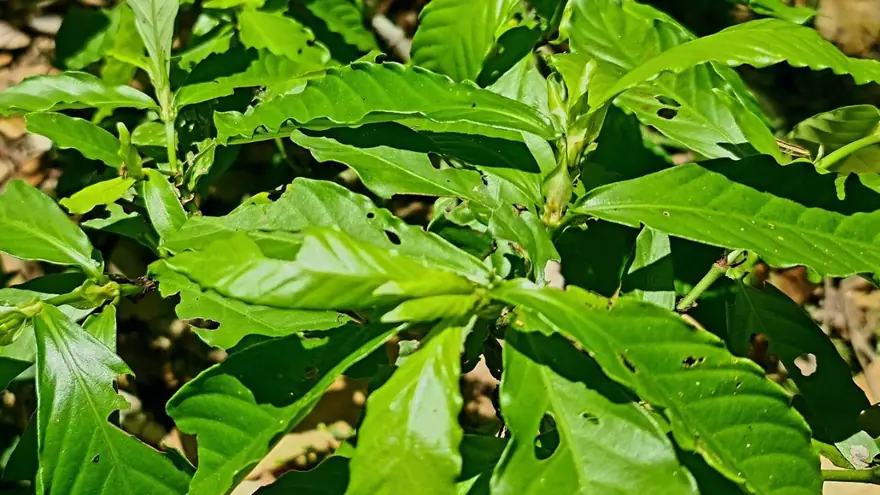
It is found in plants such as chacruna (Psychotria viridis), jurema (Mimosa tenuiflora) and some acacias, and in the seeds of Anadenanthera, from which traditional snuffs are prepared. Once extracted, it is usually a crystalline powder or a paste, white to orange in colour.
It should not be confused with other substances with a similar name or use:
- 5-MeO-DMT, the ‘toad’ one: a different molecule, with a different experience and greater risks.
- Changa: a smoking blend of DMT with herbs, often with ayahuasca vine, which lengthens the experience and adds the risks of MAO inhibitors.
- ‘Pharmahuasca’: DMT taken by mouth with a pharmaceutical MAOI or with Syrian rue. It has the same interaction risks as ayahuasca, or greater.
How it works
DMT activates the serotonin receptor 5-HT2A, like the other classic psychedelics, and also other serotonin receptors and the sigma-1 receptor.5
Studies using electroencephalography and MRI show that, during the experience, brain activity becomes more disordered and networks that normally work separately communicate more, especially in the high-level association areas.6,7
Why it lasts such a short time. The MAO enzyme destroys it very quickly. Inhaled or injected, it reaches the brain in seconds and is eliminated in minutes. By mouth it does not work, because MAO in the intestine and liver breaks it down first; it only takes effect if combined with an inhibitor of that enzyme, as in ayahuasca.
Tolerance. Unlike with other psychedelics, hardly any tolerance to DMT has been described with repeated doses on the same day in studies with volunteers.8 That does not make it safer: repeating increases the strain on the heart and on the mind.
Does our body produce it? Yes, in very small amounts. In rats it has been measured in the brain at concentrations similar to those of other neurotransmitters.9 That the pineal gland releases DMT during dreaming or at death is a hypothesis with no evidence in humans.
The experience
ExperienceWith a full vaporised dose, the experience arrives almost all at once: a buzzing or vibration, colours and very complex geometric shapes and, often, the sensation of ‘breaking through’ to another place. Many people describe encounters with presences or beings and a sense of reality greater than everyday reality.10
After five or ten minutes the return begins, and by twenty most people feel almost normal. Its brevity does not make it any less impactful: it can take days to integrate what was experienced.
Physical effects
- Rapid rise in pulse and blood pressure.2
- Dilated pupils.
- A sensation of pressure or vibration in the body.
- Coughing and throat irritation when smoked.
Emotional and mental effects
- Very complex visions, often described as impossible to explain.
- Complete loss of surroundings and of the sense of self at high doses.
- A sense of encountering entities.
- Intense fear or euphoria, sometimes both.
Challenging experiences
What is difficult about DMT is its suddenness: there is no build-up that allows you to adapt gradually. Very intense fear can appear, a feeling of dying or of losing your mind. It almost always passes within minutes. It helps to lie down in a safe place, with someone calm beside you who does not intervene more than necessary. What was experienced can go on resonating for days: it is worth giving yourself time and talking it over.
Dose
Approximate figures for vaporised DMT. It is very hard to dose precisely without a milligram scale, and the effect depends greatly on the method of vaporisation: the same amount can have very different effects.
Low (10–20 mg)
Visual and emotional changes, without losing contact with the surroundings.
Medium (20–40 mg)
Intense visions; the surroundings are transformed.
High (40–60 mg)
Complete disconnection from the surroundings (‘breaking through’). It is recommended to lie down with someone beside you.
Changa is a smoking blend of DMT with herbs, often with ayahuasca vine, which lengthens the experience and adds the risks of MAO inhibitors.
Interactions
Smoked or vaporised on its own, DMT has few known serious interactions. The danger appears when it is combined with MAO inhibitors, as in changa, ayahuasca or ‘pharmahuasca’. Listed from most to least dangerous:
| Combination | Risk | What can happen |
|---|---|---|
| MAOIs (changa, ayahuasca, Syrian rue, MAOI antidepressants) together with antidepressants, stimulants, MDMA, tramadol or other serotonergic drugs | Very dangerous | Serotonin syndrome (fever, rigidity, agitation, seizures) and hypertensive crisis. It can be fatal.3 We explain this in the ayahuasca guide. |
| Lithium | Very dangerous | Seizures and psychosis have been described with the classic psychedelics.3,11 Do not stop taking lithium on your own. |
| Tramadol | Strongly discouraged | Lowers the seizure threshold.3 |
| Stimulants (cocaine, amphetamines) | Caution | More strain on the heart, which DMT already speeds up suddenly. |
| Cannabis | Caution | More intensity and anxiety, in an unpredictable way. |
| SSRI and SNRI antidepressants (without MAOIs) | Reduces the effect | They usually dampen the experience. With MAOIs, however, they are very dangerous: see the first row. |
This table is not complete. If you take any medication, consult a healthcare professional.
Who should not take it
- Mental health: people with a personal or family history of psychosis, schizophrenia or bipolar disorder. Research with psychedelics excludes them.12
- Heart and blood pressure: hypertension, arrhythmias or heart disease. DMT raises pulse and blood pressure suddenly.2
- Lungs: asthma or other breathing problems, if it is to be smoked or vaporised.
- Pregnancy and breastfeeding: there are no safety data. It should not be taken.
- Age: not for minors.
- Medication: antidepressants, lithium, tramadol and any serotonergic drug, especially if MAOIs are involved; see the interactions table.
- A difficult time in life: a crisis or a lot of anxiety make a challenging experience more likely, and DMT leaves no time to prepare.
How to reduce risks
APDER does not encourage use. If you decide to go ahead, these measures reduce the risks, though they do not remove them.
Before
- Ask yourself why, and how you are. Mood matters as much as the amount.
- Test the substance. What is sold as DMT may contain traces of solvents or other tryptamines. In Spain this is done by Energy Control.13
- Check your medication, especially if the DMT is mixed with something that inhibits MAO.
- Prepare the place. A calm, safe space, with nothing to bump into.
During
- Always seated or lying down, never standing: the effect arrives in seconds.
- With someone beside you who is not taking anything, who will take away the pipe or vaporiser and keep watch.
- Be careful with fire. A lighter or a hot pipe in the hand in the middle of the experience can cause burns.
- Do not repeat again and again. Each dose raises the pulse and blood pressure again.
Afterwards
- Stay lying down for a while before getting up.
- Give yourself time and talk about what you experienced with someone you trust.
The risk specific to DMT: suddenness and MAOIs
Pure DMT, inhaled, has low physical toxicity. Its dangers lie in the sudden intensity (falls, burns, panic) and in mixtures with MAO inhibitors, which turn harmless combinations into dangerous ones. If, after taking DMT with changa, ayahuasca or Syrian rue, fever, rigidity, intense tremors, confusion or seizures appear, call 112.
If something goes wrong
Call 112 if the person:
- does not respond or has lost consciousness;
- has seizures;
- has difficulty breathing or chest pain;
- is very hot, with dry or red skin, or is confused;
- is so agitated that they may hurt themselves or others;
- talks about harming themselves or taking their own life.
112 is free and operates throughout the European Union. Asking for help in time matters more than fear of the consequences.
While help is on its way
- Do not leave the person alone.
- If they are unconscious but breathing, put them on their side, in the recovery position.
- Find a quiet, cool, dimly lit place.
- Do not give them any more substances, or other ones to ‘counteract’ the effect.
- If they are conscious, give water in sips; drinking a lot of water at once is also dangerous.
What to tell the health staff
What they have taken, how much, when, whether they have mixed it with anything and what medication they take regularly. If any remains or the packaging, take it with you. Telling the truth helps the person to be treated properly. For questions about a poisoning, the Toxicology Information Service is available 24 hours a day on 91 562 04 20.
If it is a challenging experience, with no physical warning signs
Support them with presence and a calm voice. Remind the person that what they feel is the effect of the substance and that it will pass. If it does not ease or a risk appears, ask for help. If someone has thoughts of harming themselves, the Ministry of Health’s 024 Line is free, open 24 hours a day and confidential.
Before taking anything
Testing a substance is the only way to know what it contains. In Spain this is done by Energy Control, with offices in Andalusia, Catalonia, Madrid and Mallorca and a postal service from other regions. Also read the interactions section of each guide.
Research and therapeutic use
ResearchBetween 1990 and 1995, the psychiatrist Rick Strassman administered intravenous DMT to 60 volunteers at the University of New Mexico, in the first study with psychedelics in the US in more than twenty years.1 More recently, Imperial College London has used electroencephalography to study how brain activity changes during the experience.6
Depression (phase 2a trial, published in 2026). Thirty-four people with moderate or severe depression received an intravenous infusion of DMT or placebo, with psychological support. DMT, with an experience of around twenty or thirty minutes, reduced symptoms more than placebo at two weeks.4 It is a small trial: larger studies are needed. Other companies are testing inhaled DMT.
Why it is of interest. Because the session is short, it would be easier to organise in a clinic than one with psilocybin or LSD.
Regulated accessAs of 23 November 2026, no medicine containing DMT is authorised in Spain. It can only be received within clinical trials.
Integration and personal growth
InterpretationWhat follows is a view from humanistic and transpersonal psychology, not a laboratory finding. The DMT experience often breaks the usual frames: spaces, presences, a sense of reality more intense than everyday reality. Many people cannot find words for it.10
From transpersonal psychology, the point is not to decide whether what was experienced ‘is real’ or not, but to ask what it means for the person who experienced it and what changes in their life. From Carl Rogers’s person-centred approach, it helps when someone listens without judging or interpreting; from Gestalt, returning to the body and to what is felt now. Brevity is deceptive: something that lasted ten minutes can call for weeks of digestion.
It is advisable to ask for professional support if anxiety, a sense of unreality or insomnia persist, or if what was experienced unsettles daily life.
Myths and facts
- ‘The pineal gland releases DMT when we die or dream’
- It is a widely repeated hypothesis, but there is no evidence in humans. In rats, DMT has been detected in the brain, not only in the pineal gland.9
- ‘Because it is short, it is mild’
- It is one of the most intense experiences known. What is short is the duration, not the impact.
- ‘Changa is the same as DMT’
- Changa usually contains ayahuasca vine, which inhibits MAO: it lengthens the effect and adds the dangerous interactions of ayahuasca.
- ‘DMT and 5-MeO-DMT are almost the same’
- They are different molecules, with different experiences. 5-MeO-DMT carries more risks.
- ‘What you see is proof of other worlds’
- It is an experience that can have great personal meaning; what science cannot do is confirm or refute it.
History
- Centuries of Indigenous use in snuffs made from Anadenanthera seeds (yopo, cebil) and in ayahuasca.
- 1931. The chemist Richard Manske synthesises it in Canada, unaware of its effects.
- 1956. The Hungarian doctor Stephen Szára discovers its psychedelic effects by injecting himself.
- 1990–1995. Studies by Rick Strassman and the book DMT: la molécula del espíritu.1
- 2019–2023. Imperial College London studies brain activity during the experience.6,7
- 2026. The first placebo-controlled trial of intravenous DMT in depression is published.4
Frequently asked questions
How long does DMT last?
Smoked or vaporised, between five and twenty minutes. In ayahuasca, between four and six hours.
Is it the same substance as 5-MeO-DMT?
No. They have similar names, but 5-MeO-DMT is a different molecule, with different effects and greater risks.
Does our body produce it?
Yes, in very small amounts. Its function in the human body is still unknown.
Why does it have no effect when taken by mouth?
Because the MAO enzyme in the intestine and liver destroys it. It only works by mouth if combined with an inhibitor of that enzyme, as in ayahuasca.
Can it be mixed with antidepressants?
On its own, antidepressants usually reduce its effect. But if a MAO inhibitor is involved (changa, ayahuasca, Syrian rue), mixing with antidepressants is very dangerous.
What is changa?
A smoking blend of DMT with herbs, often with ayahuasca vine. It lasts longer than DMT on its own and adds the risks of MAO inhibitors.
Further reading and related guides
- Rick Strassman, My Altered States (in English). In the Library.
- Jonathan Ott, Ayahuasca Analogues: Pangean Entheogens (in English). In the Library.
- José Carlos Bouso, Medicina psiquedélica: manual para pacientes, clínicos, usuarios y curiosos (2025). In the Library.
References
- Strassman RJ, Qualls CR, Uhlenhuth EH, Kellner R. Dose-response study of N,N-dimethyltryptamine in humans. II. Subjective effects and preliminary results of a new rating scale. Arch Gen Psychiatry. 1994;51(2):98-108. doi:10.1001/archpsyc.1994.03950020022002.
- Strassman RJ, Qualls CR. Dose-response study of N,N-dimethyltryptamine in humans. I. Neuroendocrine, autonomic, and cardiovascular effects. Arch Gen Psychiatry. 1994;51(2):85-97.
- TripSit. Combinations table, entries ‘DMT’ and ‘MAOIs’ (a secondary harm-reduction source). https://raw.githubusercontent.com/TripSit/drugs/main/combos.json
- A short-acting psychedelic intervention for major depressive disorder: a phase IIa randomized placebo-controlled trial. Nat Med. 2026;32(2):591-598. doi:10.1038/s41591-025-04154-z.
- Carbonaro TM, Gatch MB. Neuropharmacology of N,N-dimethyltryptamine. Brain Res Bull. 2016;126(Pt 1):74-88. doi:10.1016/j.brainresbull.2016.04.016.
- Timmermann C, Roseman L, Schartner M, et al. Neural correlates of the DMT experience assessed with multivariate EEG. Sci Rep. 2019;9:16324. doi:10.1038/s41598-019-51974-4.
- Timmermann C, Roseman L, Haridas S, et al. Human brain effects of DMT assessed via EEG-fMRI. Proc Natl Acad Sci U S A. 2023;120(13):e2218949120. doi:10.1073/pnas.2218949120.
- Strassman RJ, Qualls CR, Berg LM. Differential tolerance to biological and subjective effects of four closely spaced doses of N,N-dimethyltryptamine in humans. Biol Psychiatry. 1996;39(9):784-795.
- Dean JG, Liu T, Huff S, et al. Biosynthesis and extracellular concentrations of N,N-dimethyltryptamine (DMT) in mammalian brain. Sci Rep. 2019;9:9333. doi:10.1038/s41598-019-45812-w.
- Strassman R. DMT: The Spirit Molecule. Park Street Press; 2001.
- Nayak SM, Gukasyan N, Barrett FS, Erowid E, Erowid F, Griffiths RR. Classic psychedelic coadministration with lithium, but not lamotrigine, is associated with seizures: an analysis of online psychedelic experience reports. Pharmacopsychiatry. 2021;54(5):240-245. doi:10.1055/a-1524-2794. PMID 34348413.
- Johnson MW, Richards WA, Griffiths RR. Human hallucinogen research: guidelines for safety. J Psychopharmacol. 2008;22(6):603-620. doi:10.1177/0269881108093587. PMID 18593734.
- Energy Control. Analysis service. https://energycontrol.org/servicio-de-analisis/
Last reviewed: 23 November 2026. Doses and interactions pending expert review.
Before you read on. This information is for general education. We prepare it carefully from scientific and harm reduction sources, but it may contain errors or become out of date. It is not medical advice and does not replace a health professional, especially if you take medication or have a health problem. APDER does not encourage the use of any substance and accepts no responsibility for how this information is used. If you spot an error, write to us at info@apder.org.
Canonical address: https://apder.org/sustancias/dmt/