

Contents
- In brief
- What it is and where it comes from
- How it works
- The experience
- Dose
- Interactions
- Who should not take it
- How to reduce risks
- If something goes wrong
- Research and therapeutic use
- Integration and personal growth
- Myths and facts
- History
- Frequently asked questions
- Further reading and related guides
- References
In brief
- What it is. A substance produced by more than two hundred species of fungi. The body converts it into psilocin, which acts in the brain.
- What it does. It activates the serotonin 5-HT2A receptor. It changes perception, emotions and the sense of self for four to six hours, up to eight at high doses.1,2
- The main risk. Psychological and behavioural: challenging experiences, accidents and, in predisposed people, psychosis or mania. And, if they are gathered in the wild, mistaking deadly species.3,4
- The most dangerous interaction. Lithium (seizures and psychosis) and tramadol (seizures).5,6
- Therapeutic use. It is the most researched psychedelic in mental health, with advanced trials in treatment-resistant depression. In Spain, only within clinical trials.7,8
What it is and where it comes from
Psilocybin is a substance produced naturally by more than two hundred species of fungi, above all of the genus Psilocybe. On its own it has hardly any effect: when swallowed, the liver and gut remove a phosphate group from it and convert it into psilocin, which reaches the brain and produces the psychedelic experience.
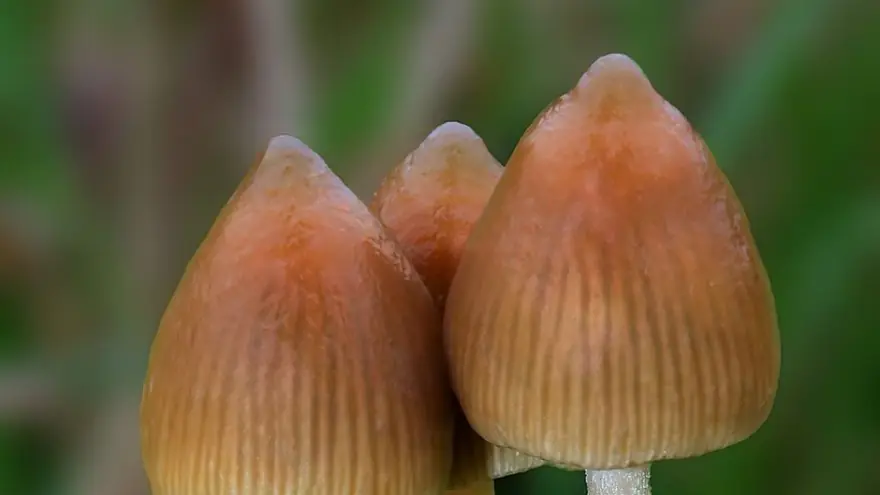
The mushrooms that contain it grow almost everywhere in the world, including the Iberian Peninsula. The best known in cultivation is Psilocybe cubensis. In European mountain meadows grows Psilocybe semilanceata, small and with a bell-shaped cap. The so-called “magic truffles” are not truffles: they are sclerotia, compact masses that some species form underground, such as P. tampanensis.
Today it is the most studied psychedelic in mental health. There are phase 3 trials for treatment-resistant depression, and in Australia accredited psychiatrists have been able to prescribe it since 2023.9 Trials do not use mushrooms but synthetic psilocybin in capsules, so that the exact dose is known.
| Type | Classic psychedelic (tryptamine) |
|---|---|
| Main action | Psilocin activates the serotonin 5-HT2A receptor |
| Route | Oral: dried or fresh mushrooms, truffles, tea |
| Starts to be noticed | After 20–60 minutes |
| Total duration | 4–6 hours (up to 8 at high doses) |
| Addictive potential | Low; tolerance appears very quickly |
Starts to be noticed: 20–60 minutesTotal duration: 4–6 hours, up to 8 at high doses
A rough diagram based on the table above; it varies with the dose, the route and the person.
Species
- Psilocybe cubensis: the most cultivated; medium potency.
- Psilocybe semilanceata: small, from mountain meadows in Europe, including the Iberian Peninsula; usually more potent.
- Psilocybe cyanescens and P. azurescens: grow on wood chips; very potent.
- Panaeolus cyanescens: grows on dung in warm regions.
- Truffles (sclerotia) of P. tampanensis and P. mexicana: usually less potent per gram.
Do not gather wild mushrooms to consume without the help of an expert. Features such as a bluish tinge when touched or the colour of the spores help, but are not enough to rule out deadly species such as Galerina marginata.
How it works
Psilocybin is a “prodrug”: on its own it hardly acts. In the gut and liver it loses a phosphate group and becomes psilocin, which crosses into the brain.
Psilocin has a shape very similar to serotonin, which is why it fits its receptors, above all 5-HT2A, which is very abundant in the cerebral cortex. When that receptor is blocked with a drug (ketanserin), the psychedelic experience almost disappears: it is the main pathway.1
Neuroimaging studies show that the default mode network (the areas that activate when we think about ourselves or ruminate) loses coordination, and that communication increases between areas that normally work separately.10 The former is linked to the feeling that the “self” dissolves; the latter, to synaesthesia and new associations of ideas.
Why it lasts as long as it does. Psilocin reaches its peak in the blood about an hour and a half or two hours after it is taken and is eliminated within a few hours. This is why the experience usually lasts four to six hours, somewhat longer at high doses, and sometimes leaves tiredness or residual effects until the next day.2
Tolerance. It appears almost immediately: if repeated the next day, the effect is much weaker. There is cross-tolerance with LSD, mescaline and other psychedelics that act on the same receptor. It halves in about three days and returns to normal in around one or two weeks.2
The experience
ExperienceNo two experiences are alike. What happens depends on the dose, the species and its potency, how you are feeling (what in English is called set) and the place and company (setting). The same person can experience the same dose very differently on two occasions.
Phases
Approximate timings with a medium dose taken orally:
- Come-up (20–60 min). Restlessness, yawning, sometimes nausea. The first changes in perception and mood begin.
- Peak (1–3 h). The effects are most intense. This is when strong emotions or difficulties are most likely to appear.
- Come-down (3–5 h, longer with high doses). The effects gradually lose strength. It is often a good time to talk and reflect.
- Afterwards (hours or days). Tiredness, sometimes a feeling of calm or clarity. It is advisable to rest and leave time to integrate the experience.
Physical effects
- Dilated pupils.
- Nausea or stomach discomfort, especially at the beginning.4
- Raised pulse and blood pressure, at times marked at high doses.4
- Feeling cold or hot, chills, yawning.
- Clumsiness when moving, tiredness afterwards.
- Headache on the same day or the next, in some people.4
Effects on perception
- More intense colours and surfaces that seem to “breathe” or undulate.
- Geometric patterns, especially with the eyes closed.
- More sensitivity to music, which can feel very emotional.
- Changes in the perception of time.
Emotional and mental effects
- Intense emotions, from joy and tenderness to sadness or fear.
- Introspection and memories that return with force.
- A feeling of connection with other people or with nature.
- At high doses, mystical-type experiences or loss of the sense of self.
- Anxiety, confusion, mistrust or paranoia may also appear.
Challenging experiences
A “bad trip” is an experience dominated by fear, distress, confusion or the feeling of losing control. It is more likely with high doses, with a poor emotional starting state, or in a noisy or unfamiliar environment.
If distress appears
- Remember that it is temporary and due to the substance: it will pass in a few hours.
- Change the surroundings, the light or the music. Sit or lie down somewhere comfortable.
- Breathe slowly. Seek the support of your sitter.
- Do not try to “fight” the experience: it usually helps more to accept what arises.
- If there is a risk to health or of self-harm, call 112 and explain what has been taken.
Many people who have had challenging experiences value them afterwards as meaningful, especially if they have been able to talk them through and integrate them. But some can leave discomfort for days or weeks. In that case it is advisable to seek professional support.
Dose
The amount of psilocybin varies greatly from one species to another, from one cultivation to another and even between mushrooms in the same bag. These figures are approximate and refer to dried Psilocybe cubensis. Fresh mushrooms weigh about ten times more because almost all of them is water. Other species, such as P. semilanceata or P. azurescens, tend to be more potent.
Microdose (0.05–0.25 g)
No evident effect: if you notice anything in perception, it is no longer a microdose. More information in the Microdosing section.
Low (0.5–1 g)
Slight changes in mood and the senses: more sensitivity to music and colours, some euphoria or introspection. Clarity is maintained and you can converse normally.
Medium (1–2.5 g)
Clear visual effects, intense emotions and a different way of thinking. This is no longer a state compatible with everyday tasks.
High (2.5–5 g)
An intense experience in which the usual references of time, space and self can be lost. It is the approximate range of the 25 mg of synthetic psilocybin used in the depression trials, always with preparation and professional support.
Very high (more than 5 g)
Very intense and hard to manage, with greater risk of challenging experiences and dangerous behaviour. Not recommended.
Tolerance appears very quickly: if repeated the next day, the effect is much weaker. There is also cross-tolerance with LSD and mescaline. It usually takes one or two weeks to disappear.
Interactions
Psilocybin combines poorly with anything that lowers the seizure threshold or destabilises mood. Other combinations are not dangerous but change the experience. Ordered from most to least dangerous:
| Combination | Risk | What can happen |
|---|---|---|
| Lithium | Very dangerous | High risk of seizures and psychosis. In an analysis of 62 accounts from people who mixed it with a psychedelic, almost half described seizures.5,6 Do not stop lithium on your own: withdrawing it requires medical supervision. |
| Tramadol | Strongly discouraged | Tramadol lowers the seizure threshold.5 |
| MAOIs (MAOI antidepressants, ayahuasca, Syrian rue) | Caution | They can greatly intensify and prolong the effects, in ways that are hard to predict.5 |
| Cannabis | Caution | It can intensify the experience unpredictably and increase anxiety or paranoia.5 |
| Stimulants (cocaine, amphetamines) | Caution | More strain on the heart, more anxiety and thought loops.5 |
| Alcohol | Discouraged | It worsens coordination and judgement and makes nausea and vomiting more likely.11 |
| SSRI and SNRI antidepressants | Reduces the effect | They tend to dampen the experience, which pushes people to take more.5 Do not stop medication without discussing it with your doctor: withdrawing it abruptly has its own risks. |
| Antipsychotics | Reduces the effect | Those that block the 5-HT2A receptor, such as risperidone, reduce or cancel the effects.1 |
This table is not complete. If you take any medication, consult a healthcare professional.
Who should not take it
- Mental health: people with a personal or family history of psychosis, schizophrenia or bipolar disorder. Psilocybin trials exclude them because of the risk of triggering an episode.3
- Heart and blood pressure: uncontrolled hypertension, arrhythmias or heart disease. Psilocybin raises blood pressure and pulse for hours.4
- Epilepsy or previous seizures: above all if lithium or tramadol is also being taken.6
- Pregnancy and breastfeeding: there are no safety data. It should not be taken.
- Age: not for minors. The adolescent brain is still developing.
- Medication: lithium, tramadol, MAOIs and antidepressants; see the interactions table.
- A difficult time in life: a crisis, a recent bereavement or a great deal of anxiety make a challenging experience more likely.
- Driving and working: you should not drive or operate machinery under its effects. It is advisable to let at least the rest of the day and a night's sleep pass.
How to reduce risks
APDER does not encourage use. If you decide to go ahead, these measures reduce the risks, though they do not remove them.
Before
- Ask yourself what it is for and how you are. Choose a calm moment in your life, not a period of crisis. Mood influences as much as the dose.
- Know what you have. Potency varies greatly between species, cultivations and even between mushrooms in the same bag. Truffles and mushrooms are not comparable gram for gram.
- Have it tested if possible. In Spain this is done by Energy Control, with offices in Andalusia, Catalonia, Madrid and Mallorca and postal service from other regions.12 It is useful above all with products sold as “psilocybin” in capsules, chocolates or gummies, whose real content is unknown.
- Check your medication against the interactions table.
- Choose the place and the company. A safe, familiar place, with no obligations in the following hours, and someone you trust who is not taking anything.
During
- Start with a little. The same amount can be very different from one occasion to another.
- Wait. The come-up can take more than an hour, especially on a full stomach. Taking more because it is “not coming up” adds the two doses together.11
- Do not mix with alcohol, other drugs or medicines without checking first.
- If distress appears, change the surroundings, breathe slowly and lean on your sitter. Further down, under “If something goes wrong”, what to do if it does not ease.
Afterwards
- Rest, eat and sleep. Do not drive until the next day or make important decisions in the heat of the moment.
- Set aside time to write or talk about what you lived. We explain this under “Integration and personal growth”.
- Leave time before repeating: tolerance means that repeating soon gives less effect and pushes you to take more.
The specific risk of mushrooms: mistaking species
Psilocybin has a very low physical toxicity.4 The most serious physical danger is not psilocybin itself, but gathering the wrong mushroom. Some highly toxic wild species, such as Galerina marginata, grow in similar places and can cause fatal liver damage that gives no symptoms until many hours later. If someone has vomiting, diarrhoea or severe stomach pain hours after eating wild mushrooms, call 112 even if they feel better.
The other risks are psychological and behavioural: accidents through disorientation, especially when alone; episodes of psychosis or mania in predisposed people; and, rarely, visual disturbances that persist for weeks or months (halos, trails).
If something goes wrong
Call 112 if the person:
- does not respond or has lost consciousness;
- has seizures;
- has difficulty breathing or chest pain;
- is very hot, with dry or red skin, or is confused;
- is so agitated that they may hurt themselves or others;
- talks about harming themselves or taking their own life.
112 is free and operates throughout the European Union. Asking for help in time matters more than fear of the consequences.
While help is on its way
- Do not leave the person alone.
- If they are unconscious but breathing, put them on their side, in the recovery position.
- Find a quiet, cool, dimly lit place.
- Do not give them any more substances, or other ones to ‘counteract’ the effect.
- If they are conscious, give water in sips; drinking a lot of water at once is also dangerous.
What to tell the health staff
What they have taken, how much, when, whether they have mixed it with anything and what medication they take regularly. If any remains or the packaging, take it with you. Telling the truth helps the person to be treated properly. For questions about a poisoning, the Toxicology Information Service is available 24 hours a day on 91 562 04 20.
If it is a challenging experience, with no physical warning signs
Support them with presence and a calm voice. Remind the person that what they feel is the effect of the substance and that it will pass. If it does not ease or a risk appears, ask for help. If someone has thoughts of harming themselves, the Ministry of Health’s 024 Line is free, open 24 hours a day and confidential.
Before taking anything
Testing a substance is the only way to know what it contains. In Spain this is done by Energy Control, with offices in Andalusia, Catalonia, Madrid and Mallorca and a postal service from other regions. Also read the interactions section of each guide.
Research and therapeutic use
ResearchIn clinical trials psilocybin is not given on its own: it is part of a process with preparation (sessions to get to know the team and learn what may happen), the session (six to eight hours in a comfortable room, with an eye mask, music and one or two therapists present) and integration (later sessions to make sense of what was lived).
Depression and anxiety
In 2016, two trials at Johns Hopkins (51 people) and New York University (29 people) found rapid and lasting reductions in anxiety and depression in cancer patients after a single dose.13,14 In 2021, a trial with 24 people with major depression showed that more than half were in remission at four weeks.15
That same year, Imperial College London compared psilocybin with escitalopram in 59 patients: on the main measure there were no clear differences, although several secondary measures favoured psilocybin.16 In 2022, a trial with 233 people with treatment-resistant depression found that 25 mg reduced symptoms more than 1 mg at three weeks. Suicidal thoughts were recorded in all groups, a reminder of the importance of follow-up.7 In 2023, another trial with 104 participants confirmed an improvement over placebo for six weeks.8
Addictions
In a pilot study with 15 smokers, 12 were still not smoking at six months after two or three sessions combined with cognitive behavioural therapy, although it had no control group.17 In 2022, a trial with 95 people with alcohol dependence found fewer heavy drinking days with psilocybin than with an active placebo.18
Cluster headache
Some people with cluster headache, one of the most intense pains known, report that low doses of psilocybin interrupt their attacks. In the first placebo-controlled trial (Yale, 2022; 14 people analysed), the reduction in attacks was not statistically significant.19 When the protocol was repeated in an extension phase, they did fall clearly.20 These are very small studies: there is still not enough evidence.
Does it change the brain?
In mice, a single dose increases the connections between neurons in the frontal cortex for weeks.21 It is thought that something similar could open a “window” in people in which it is easier to change habits of thought, and that this is why the psychotherapy that accompanies the session is so important. It has yet to be confirmed in humans.
The studies have limits: many are small, and almost everyone knows whether they have taken the substance, which makes it hard to compare with placebo. The phase 3 trials under way are trying to settle these doubts.
What has been found, in brief
- Rapid improvement in depression symptoms in clinical trials, sometimes after one or two sessions.7,15
- Less anxiety and distress in people with advanced cancer.13,14
- Promising results in alcohol and tobacco dependence.17,18
- Experiences that many people consider among the most meaningful of their lives.22
Microdosing
Microdosing consists of taking an amount so small that it does not change perception, several times a week. One very well-known scheme is that of the psychologist James Fadiman: one day of taking and two of rest.
Many people say it helps them with mood, creativity or concentration. But when compared with placebo in a controlled way, the differences are small or do not appear. In a 2021 study with almost 200 participants, those taking placebo improved almost as much as those taking microdoses, which suggests that expectations weigh heavily.23 Long-term studies on its safety when taken over months are lacking.
We deal with this in depth, with mushrooms, LSD, ayahuasca, DMT and ibogaine, in the microdosing guide.
Regulated accessAs of 23 November 2026, in Spain psilocybin can only be received within clinical trials. In Australia, since 1 July 2023, authorised psychiatrists can prescribe it for treatment-resistant depression.9 Be wary of offers of psilocybin “therapy” without healthcare oversight.
What a therapeutic process is like, step by step, we explain in Psilocybin-assisted therapy.
Integration and personal growth
InterpretationWhat follows is a view from humanistic and transpersonal psychology, not laboratory data. Many people describe their experience with mushrooms as among the most meaningful of their lives.22 But meaning does not arrive on its own: it is built in the days and weeks that follow.
From Carl Rogers's person-centred approach, what helps is listening to what was lived with acceptance and without judgement, without rushing to interpret it from the outside. From Gestalt, the useful question is what has become present — an emotion, a memory, a relationship — and what it asks for now. Stanislav Grof spoke of states that expand consciousness and can touch the biographical, the perinatal and the transpersonal; he also reminded us that their value depends on the work done afterwards.
Writing down the experience as soon as possible, talking it over with someone you trust, walking in nature or expressing it through drawing or movement all help to give it a place. Clinical trials devote several sessions to this integration because it is part of the effect, not an add-on.
It is advisable to ask for professional support if, after a few weeks, anxiety, insomnia, a feeling of unreality or changes in vision persist; if thoughts of self-harm appear; or if use is repeated to escape from something. Integration promises nothing: it is personal work, sometimes slow.
Myths and facts
- “Mushrooms drive you mad for ever”
- There is no evidence that psilocybin causes mental illness in people with no predisposition. A study of more than 135,000 adults in the United States found no more mental health problems among those who had taken psychedelics.24 The real risk is concentrated in people with a history of psychosis or bipolar disorder.
- “They are poisonous”
- Psilocybin has a very low physical toxicity.4 The real danger lies in mistaking species: some wild mushrooms are indeed deadly.
- “If it is natural, it is safe”
- That a substance comes from a fungus does not make it harmless. Potency varies greatly, and psychological risks, interactions with medicines and accidents exist just the same.
- “It does nothing with antidepressants, so nothing can happen”
- SSRIs usually reduce the effect, but lithium and tramadol are dangerous with it.5,6 And stopping medication abruptly in order to “feel it” has its own risks.
- “Microdosing has been proven”
- When compared with placebo, the differences are small or do not appear; expectations weigh heavily.23
History
Psilocybin mushrooms have been used for centuries in Mesoamerica. The Mexica called them teonanácatl, a Nahuatl word usually translated as “flesh of the gods”. After the conquest, the Church persecuted their use, which continued discreetly in Indigenous communities in Oaxaca.
- 1955–1957. R. Gordon Wasson takes part in an evening with the Mazatec healer María Sabina in Huautla de Jiménez and recounts it in the magazine Life.
- 1958. Albert Hofmann isolates and synthesises psilocybin and psilocin. Sandoz distributes it for research.
- 1960–1962. The Harvard Psilocybin Project and Walter Pahnke's “Good Friday Experiment”.
- 1970s. Research almost stops for decades.
- 2006. Johns Hopkins reports that a high dose can provoke mystical-type experiences whose meaning endures.22
- 2018–2019. The FDA designates it a “breakthrough therapy” for treatment-resistant depression and major depression.
- 2020–2023. Oregon and Colorado open psilocybin services for adults; in Australia, accredited psychiatrists begin to prescribe it.
Frequently asked questions
Is psilocybin addictive?
Its addictive potential is low. It does not usually lead to compulsive use, and tolerance appears so quickly that taking it repeatedly has hardly any effect. That does not mean it cannot be misused.
How long does the effect last?
Between four and six hours in total, up to eight at high doses, with the most intense moment between the first and third hour. The tiredness can last until the next day.
Does it show up in a drug test?
Standard urine tests do not usually look for it, but specific tests exist. Psilocin is eliminated within a day or two.
Are truffles the same as mushrooms?
They contain the same substances, but they usually have less per gram and the potency varies. This is why the amounts are not comparable.
Can I take psilocybin if I take antidepressants?
SSRIs usually reduce its effects, and some medicines, such as lithium or tramadol, can be dangerous with it. Do not change or stop your medication on your own: always talk to your doctor.
Where can I have psilocybin therapy?
In Spain, for now, within clinical trials. Be wary of offers of psilocybin “therapy” outside them: they have no healthcare oversight.
What do I do if someone is having a hard time?
Stay with them in a quiet place, with a calm voice, and remind them that it is the effect and that it will pass. If there are seizures, chest pain, loss of consciousness or a risk that they may harm themselves, call 112.
Further reading and related guides
- José Carlos Bouso, Medicina psiquedélica: manual para pacientes, clínicos, usuarios y curiosos (2025). In the Library.
- Jonathan Ott and Jeremy Bigwood (eds.), Teonanácatl (1978, in English). In the Library.
- R. Gordon Wasson and others, María Sabina and Her Mazatec Mushroom Velada (1974, in English). In the Library.
- Paul Stamets, Psilocybe Mushrooms & Their Allies (1978, in English). In the Library.
References
- Vollenweider FX, Vollenweider-Scherpenhuyzen MF, Bäbler A, Vogel H, Hell D. Psilocybin induces schizophrenia-like psychosis in humans via a serotonin-2 agonist action. NeuroReport. 1998;9(17):3897-3902. doi:10.1097/00001756-199812010-00024.
- PsychonautWiki. Psilocybin mushrooms (secondary harm reduction source). https://psychonautwiki.org/wiki/Psilocybin_mushrooms
- Johnson MW, Richards WA, Griffiths RR. Human hallucinogen research: guidelines for safety. J Psychopharmacol. 2008;22(6):603-620. doi:10.1177/0269881108093587. PMID 18593734.
- Breeksema JJ, Kuin BW, Kamphuis J, et al. Adverse events in clinical treatments with serotonergic psychedelics and MDMA: a mixed-methods systematic review. J Psychopharmacol. 2022;36(10):1100-1117. https://pmc.ncbi.nlm.nih.gov/articles/PMC9548934
- TripSit. Combinations chart, entry “Mushrooms” (secondary harm reduction source). https://raw.githubusercontent.com/TripSit/drugs/main/combos.json
- Nayak SM, Gukasyan N, Barrett FS, Erowid E, Erowid F, Griffiths RR. Classic psychedelic coadministration with lithium, but not lamotrigine, is associated with seizures: an analysis of online psychedelic experience reports. Pharmacopsychiatry. 2021;54(5):240-245. doi:10.1055/a-1524-2794. PMID 34348413.
- Goodwin GM, Aaronson ST, Alvarez O, et al. Single-dose psilocybin for a treatment-resistant episode of major depression. N Engl J Med. 2022;387(18):1637-1648. doi:10.1056/NEJMoa2206443.
- Raison CL, Sanacora G, Woolley J, et al. Single-dose psilocybin treatment for major depressive disorder. JAMA. 2023;330(9):843-853. doi:10.1001/jama.2023.14530.
- Therapeutic Goods Administration (Australia). Access to MDMA or psilocybine for consumers. https://www.tga.gov.au/products/unapproved-therapeutic-goods/mdma-and-psilocybine-hub/access-mdma-or-psilocybine-consumers
- Carhart-Harris RL, Erritzoe D, Williams T, et al. Neural correlates of the psychedelic state as determined by fMRI studies with psilocybin. Proc Natl Acad Sci U S A. 2012;109(6):2138-2143. doi:10.1073/pnas.1119598109.
- Energy Control. Leaflet “Setas” (2004). https://energycontrol.org/wp-content/uploads/2020/08/FolletoSetas.pdf
- Energy Control. Analysis service. https://energycontrol.org/servicio-de-analisis/
- Griffiths RR, Johnson MW, Carducci MA, et al. Psilocybin produces substantial and sustained decreases in depression and anxiety in patients with life-threatening cancer. J Psychopharmacol. 2016;30(12):1181-1197. doi:10.1177/0269881116675513.
- Ross S, Bossis A, Guss J, et al. Rapid and sustained symptom reduction following psilocybin treatment for anxiety and depression in patients with life-threatening cancer. J Psychopharmacol. 2016;30(12):1165-1180. doi:10.1177/0269881116675512.
- Davis AK, Barrett FS, May DG, et al. Effects of psilocybin-assisted therapy on major depressive disorder. JAMA Psychiatry. 2021;78(5):481-489. doi:10.1001/jamapsychiatry.2020.3285.
- Carhart-Harris R, Giribaldi B, Watts R, et al. Trial of psilocybin versus escitalopram for depression. N Engl J Med. 2021;384(15):1402-1411. doi:10.1056/NEJMoa2032994.
- Johnson MW, Garcia-Romeu A, Cosimano MP, Griffiths RR. Pilot study of the 5-HT2AR agonist psilocybin in the treatment of tobacco addiction. J Psychopharmacol. 2014;28(11):983-992. doi:10.1177/0269881114548296.
- Bogenschutz MP, Ross S, Bhatt S, et al. Percentage of heavy drinking days following psilocybin-assisted psychotherapy vs placebo in the treatment of adult patients with alcohol use disorder. JAMA Psychiatry. 2022;79(10):953-962. doi:10.1001/jamapsychiatry.2022.2096.
- Schindler EAD, Sewell RA, Gottschalk CH, et al. Exploratory investigation of a patient-informed low-dose psilocybin pulse regimen in the suppression of cluster headache. Headache. 2022;62(10):1383-1394. doi:10.1111/head.14420. PMID 36416492.
- Schindler EAD, Sewell RA, Gottschalk CH, et al. Psilocybin pulse regimen reduces cluster headache attack frequency in the blinded extension phase of a randomized controlled trial. J Neurol Sci. 2024;460:122993. doi:10.1016/j.jns.2024.122993. PMID 38581739.
- Shao LX, Liao C, Gregg I, et al. Psilocybin induces rapid and persistent growth of dendritic spines in frontal cortex in vivo. Neuron. 2021;109(16):2535-2544. doi:10.1016/j.neuron.2021.06.008.
- Griffiths RR, Richards WA, McCann U, Jesse R. Psilocybin can occasion mystical-type experiences having substantial and sustained personal meaning and spiritual significance. Psychopharmacology. 2006;187(3):268-283. doi:10.1007/s00213-006-0457-5.
- Szigeti B, Kartner L, Blemings A, et al. Self-blinding citizen science to explore psychedelic microdosing. eLife. 2021;10:e62878. doi:10.7554/eLife.62878.
- Johansen PØ, Krebs TS. Psychedelics not linked to mental health problems or suicidal behavior: a population study. J Psychopharmacol. 2015;29(3):270-279. doi:10.1177/0269881114568039. PMID 25744618.
Last reviewed: 23 November 2026. Doses and interactions pending expert review.
Before you read on. This information is for general education. We prepare it carefully from scientific and harm reduction sources, but it may contain errors or become out of date. It is not medical advice and does not replace a health professional, especially if you take medication or have a health problem. APDER does not encourage the use of any substance and accepts no responsibility for how this information is used. If you spot an error, write to us at info@apder.org.
Canonical address: https://apder.org/sustancias/psilocibina/