

Plant · Legumes · Northern Mexico and southern United States
Frijolillo
Dermatophyllum secundiflorum (Ortega) Gandhi & Reveal
A shrub of south-western North America whose seeds, called mescal beans, were used in ceremonies of Native peoples. Chemical analysis found no tryptamines, but alkaloids of another family, among them cytisine.134
Also known asfrijolillo · frijolito · frijol de mescal · mescalbean · Texas mountain laurel · Sophora secundiflora · Calia secundiflora
- What it is
- Leguminous shrub with red seeds
- Territory
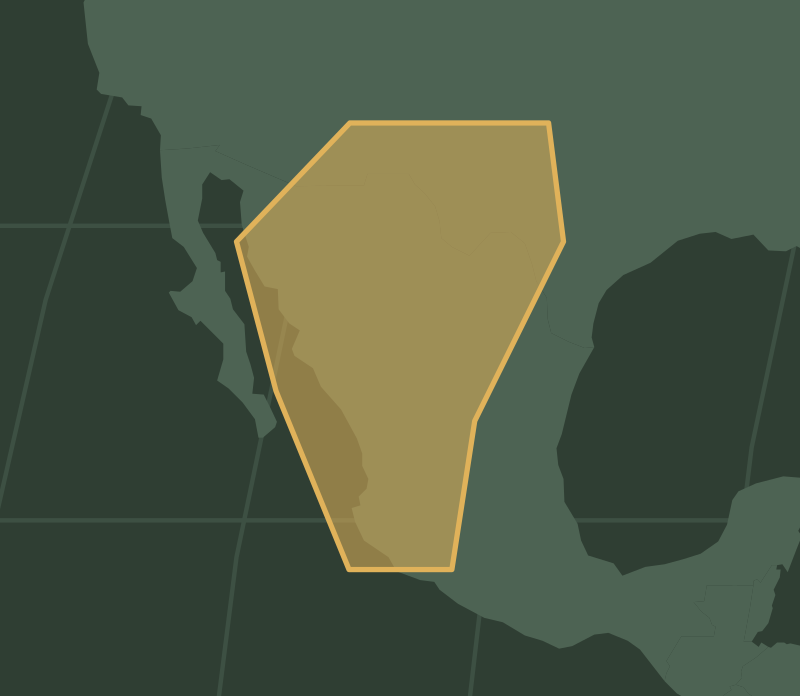
- From west Texas and New Mexico to northern Mexico, as far as Hidalgo, Puebla and Querétaro
- Part used
- The seed
- Active principles
- Quinolizidine alkaloids, above all cytisine
- Onset and duration
- No reliable data in the sources consulted
- Who keeps its memory
- Native peoples of south-western North America
Botany
An evergreen shrub with red seeds
Dermatophyllum secundiflorum is a shrub or small tree of the legume family, native to the south-western United States (Texas and New Mexico) and to Mexico, from Chihuahua and Coahuila to Hidalgo, Puebla and Querétaro.3
Its common names include "Texas mountain laurel", "Texas mescalbean", "frijolito" and "frijolillo".3 The English name "mountain laurel" is misleading, because it is not related to the true mountain laurel.3
For years it was classified as Sophora secundiflora, but recent genetics show that the mescal beans are only distantly related to the other species of Sophora.4
- Family
- Fabaceae
- Height
- 1 to 11 m depending on the genus
- Leaves
- Evergreen, leathery, pinnate
- Part used
- Seed
Memory and tradition
The mescal beans
A hallucinogenic effect was attributed to the seeds because of their past use in certain ceremonies of Native North American peoples, in which visions were experienced.1
In ethnobotanical databases it is listed with uses as a hallucinogen, an intoxicant and a poison, and as an insecticide.5
The names "mescal beans", "red beans" and "big drunk beans" appear in the ethnobotanical literature for the ripe seeds.2
Over time
Hatfield and colleagues publish the chemical analysis of the seeds.1
Keller and Hatfield isolate other minor alkaloids from unripe fruits.2
Its names
- frijolillo, frijolito
- Mexican names
- mescalbean
- English name
- Texas mountain laurel
- popular English name
The seeds are known in English as "mescal beans", "red beans" and "big drunk beans".2
Territory and care
A shrub of the desert and the sierra
What helps
- Know it as part of the ritual plants of northern Mexico and the southern United States.
- Do not collect seeds without knowledge or permission.
- Respect the peoples who safeguard it.
What it contains
Quinolizidine alkaloids
Chemical analysis of the seeds detected no tryptamines; two additional quinolizidine alkaloids were isolated, epilupinine and delta5-dehydrolupanine.1
Until then seven quinolizidine alkaloids had been detected, the main one being cytisine, at around 0.25%.1
Cytisine is chemically related to nicotine and is used in medicine to help people stop smoking.34
In unripe fruits, 11-allylcytisine and other minor alkaloids were also identified.2
Main alkaloid of the seed; related to nicotine.[1][3]
Isolated from unripe fruits.[2]
The experience
Between vision and toxicity
The visions of the ancient ceremonies have not been clearly attributable to any component of the seed.1
The sources give no reliable data on onset or duration.
Research
What has been studied
The phytochemical analysis of the seeds in 1977 did not confirm the ethnobotanical reports of hallucinogenic action, and the toxicity in mice is only partly explained by the known alkaloids.1
There is no clinical research on this plant.
Scope of these dataBasic chemistry and ethnobotanical data; no clinical research.
With care
What it helps to know beforehand
To follow
Books and related medicines
Sources
Where each piece of information comes from
- Hatfield GM, Valdes LJ, Keller WJ, Merrill WL, Jones VH. An investigation of Sophora secundiflora seeds (mescalbeans). Lloydia. 1977;40(4):374-383. katalog.lib.cas.cz/KNAV/EdsRecord/cmedm,895398.
- Keller WJ, Hatfield M. 11-Allylcytisine and other minor alkaloids from unripe Sophora secundiflora fruits. Phytochemistry. 1979;18:2068-2069. deepblue.lib.umich.edu/bitstream/handle/2027.42/23759/0000732.pdf.
- Wikipedia. Dermatophyllum secundiflorum. en.wikipedia.org/wiki/Calia_secundiflora.
- Wikipedia. Dermatophyllum. en.wikipedia.org/wiki/Dermatophyllum.
- USDA. Ethnobotanical Plant Sophora secundiflora. phytochem.nal.usda.gov/phytochem/ethnoplants/show/10640.
- Map APDER, with data from Natural Earth · public domain
- Molecule drawings APDER
Last reviewed: 24 November 2026. If you spot a mistake, write to us at info@apder.org.