

Cactus · Cactaceae · Andes of Ecuador and Peru
San Pedro
Echinopsis pachanoi (Britton & Rose) H.Friedrich & G.D.Rowley
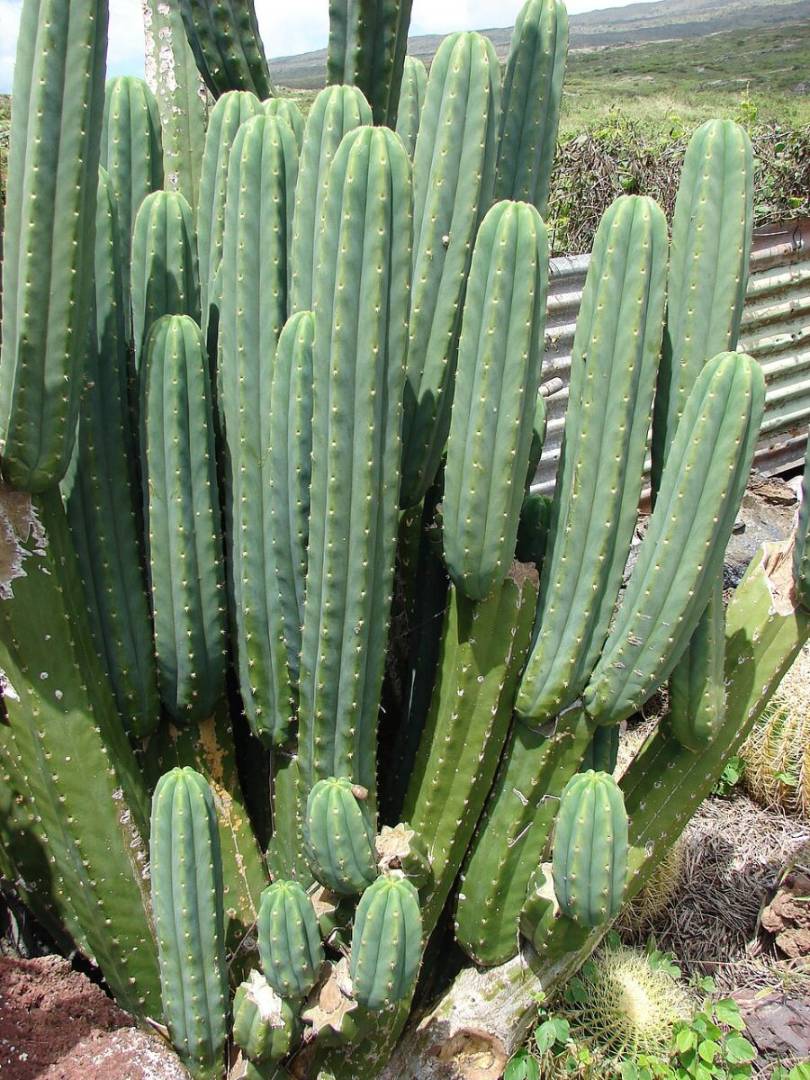
A columnar cactus of three to six metres that grows on the Andean slopes. It is called wachuma or San Pedro, and its oldest images, on pottery from the north coast of Peru, are up to 3,500 years old.3
Also calledwachuma · huachuma · achuma · aguacolla · gigantón · San Pedro cactus
- What it is
- Columnar, branching cactus that grows quickly
- Territory
- Southern Ecuador and Peruvian Andes
- Part used
- The stem, boiled or as an infusion
- Active principles
- Mescaline and other alkaloids
- Onset and duration
- 45–90 min · 8–12 h, sometimes more
- Who keeps its memory
- Healers (curanderos) and Andean communities of northern Peru
Botany
A green column rising up the hillside
It is a columnar, branching cactus that usually reaches between three and six metres. The stems, green and sometimes bluish, have between six and eight ribs, and in cultivated specimens the spines are short or almost absent.2
Its flowers are white, fragrant and enormous, about twenty centimetres across. They open at night and last about two days. An elongated, dark green fruit then forms, which splits open to reveal white pulp with small seeds.2
It grows in the dry Andean scrub, at around 2,000–3,000 metres, and can gain up to thirty centimetres a year. It propagates easily from cuttings.12
- Family
- Cactaceae
- Habit
- Columnar, 3 to 6 m
- Flower
- White, nocturnal and fragrant
- Fruit
- Elongated, with white pulp
Memory and tradition
A cactus that spans three thousand years
The oldest images of San Pedro are on pottery of the Cupisnique culture, on the north coast of Peru, between 1500 and 500 BC: the cactus appears alone or alongside felines and stepped scrolls.3 On the central coast, remains of the cactus itself have also been found at archaeological sites.4
At Chavín de Huántar, in the highlands of Áncash, a stela in the circular plaza shows a figure carrying a columnar cactus.6 Analyses of bone tubes from this ceremonial centre, active around 1200–400 BC, detected traces of vilca and wild tobacco (Nicotiana).5
Today the tradition is still alive in northern Peru. In the Huancabamba region, a 1981 field study describes nightly healing sessions in which the healer and the patients drink the cactus, and the healer looks for the origin of the illness.7
Over time
Cupisnique pottery from the north coast of Peru depicting the cactus, the oldest known images.3
Chavín de Huántar, in the highlands of Áncash, endures as a ceremonial centre; vilca and Nicotiana appear in its bone tubes.5
Britton and Rose describe it as Trichocereus pachanoi.2
The stela of the cactus bearer appears at Chavín de Huántar.6
Friedrich and Rowley move it to the genus Echinopsis.1
Albesiano and Kiesling treat it as a variety of Trichocereus macrogonus; Kew keeps Echinopsis pachanoi as the accepted name.1
Its names
- wachuma
- Andean name; also huachuma and achuma
- aguacolla
- Andean name
- gigantón
- Spanish
- San Pedro
- Spanish; it has been linked to the keys of heaven held by the saint
The Christian name has been linked to the idea of reaching heaven without leaving the earth, according to the botanist Edward Anderson.2
Territory and care
A hillside cactus, easy to grow
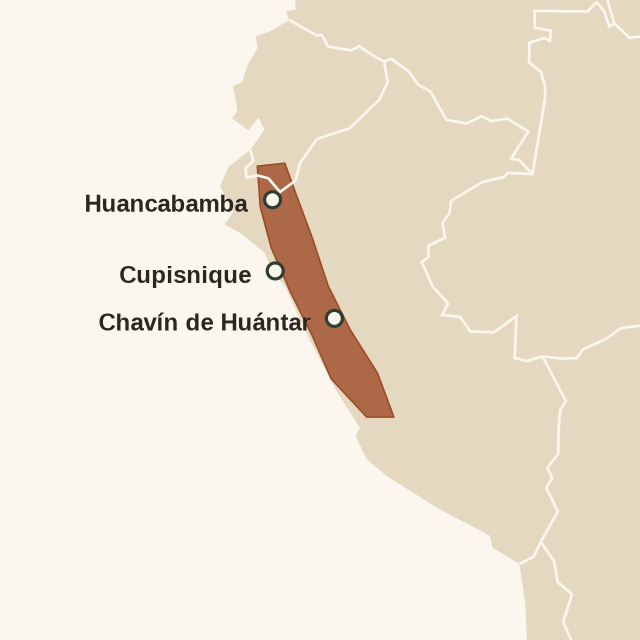
Kew places its native range from southern Ecuador to Peru, in an area of seasonally dry tropical vegetation. Outside it, it has been introduced to Bolivia, Colombia, central Chile, the Canary Islands and Spain.1
It is easily cultivated and is common as an ornamental plant, so it does not depend on harvesting from the wild.2
What helps
- Respect its use among healers (curanderos) and Andean communities, who have kept it for millennia.
- Prefer cultivated plants to those gathered from the wild.
- Learn about the context of the tradition before speaking of it: it is the living medicine of specific peoples.
What it contains
Mescaline, and a cactus that distributes it unevenly
It contains mescaline, the same phenethylamine as peyote, which activates the serotonin 5-HT2A receptor.89 It also has other alkaloids in smaller amounts.2
The amount of mescaline varies greatly from one plant to another and also within the same plant, which is why clinical trials use pure mescaline of a known dose.212
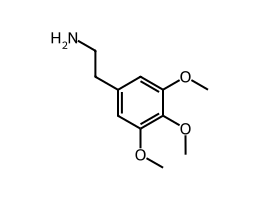 MescalinePhenethylamine · main alkaloid
It activates the serotonin 5-HT2A receptor. In a 2024 trial, a drug that blocks that receptor cancelled almost all of its effects.
The experience
A whole day
It begins to be noticed between 45 and 90 minutes in and lasts between eight and twelve hours, sometimes longer. In trials with mescaline it is described as an experience similar to that of LSD or psilocybin, with very intense colours, patterns and strong emotions. The main difference is the duration.8
With the cactus, nausea and vomiting are common, especially as the effects come on. In many traditions this purging is part of the path.12
Indicative outline: it changes with the preparation, the amount and the person.
Research
What has been studied
In 2023, a trial in Basel compared mescaline, LSD and psilocybin in healthy people: 500 mg of mescaline produced an experience very similar to that of 100 µg of LSD and 20 mg of psilocybin.8 In 2024, another showed that its effects increase with the dose and depend on the 5-HT2A receptor.9
Scope of these dataThose trials were carried out with pure mescaline, in healthy people and under medical supervision. They did not evaluate a treatment, nor San Pedro, nor the Andean ceremony, and there is no medicine containing mescaline.
With care
What it helps to know beforehand
A very long and, at times, difficult experience; in predisposed people, episodes of psychosis or mania.10
Lithium is the most dangerous combination: seizures and psychosis have been described.11
It is the medicine of healers (curanderos) and Andean communities. It is worth learning about that context and treating it with respect.7
To follow
Books and related medicines
 Cactus of MysteryRoss Heaven · 2012In the APDER library →
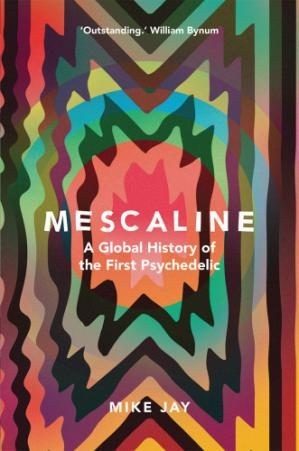 MescalineMike Jay · 2019In the APDER library →
The cactus of the Chihuahuan desert, with the same mescaline.
MoleculeMescaline3,4,5-trimethoxyphenethylamineThe active principle of the mescaline-containing cacti.
CactusPeruvian torchEchinopsis peruvianaA columnar cactus similar to San Pedro.
PlantTobaccoNicotiana tabacumThe genus Nicotiana appears in the bone tubes of Chavín, alongside vilca.
Sources
Where each piece of information comes from
- Royal Botanic Gardens, Kew. Plants of the World Online: Echinopsis pachanoi (Britton & Rose) H.Friedrich & G.D.Rowley. powo.science.kew.org.
- Wikipedia. "Trichocereus macrogonus var. pachanoi". en.wikipedia.org (accessed 24 November 2026). It gathers data from Anderson EF, The Cactus Family, 2001, and Rätsch C, 2002.
- Sharon D. Sacred Sanpedro in Ethnoarchaeological Context (abstract). British Library electronic document catalogue, eld.bl.uk.
- Chapter on archaeological evidence of the use of psychoactive plants (citing Fung 1972 and Polia Meconi 1996). Taylor & Francis, taylorfrancis.com.
- Rick JW, Lema VS, Echeverría J, Alva Valverde G, Contreras DA, Arias Espinoza O, Rosenfeld SA, Sayre MP. Pre-Hispanic ritual use of psychoactive plants at Chavín de Huántar, Peru. Proc Natl Acad Sci USA. 2025;122(19). doi:10.1073/pnas.2425125122.
- Wikipedia. "Stela of the cactus bearer". Stela VI-NW12, circular plaza of Chavín de Huántar, found in 1972 by Luis Guillermo Lumbreras. en.wikipedia.org (accessed 24 November 2026).
- Ethnobotanical observations in the Huancabamba region (Peru), 1981 fieldwork. MAPS Bibliography, bibliography.maps.org, resource 13373.
- Ley L, Holze F, Arikci D, et al. Comparative acute effects of mescaline, lysergic acid diethylamide, and psilocybin in a randomized, double-blind, placebo-controlled cross-over study in healthy participants. Neuropsychopharmacology. 2023;48(11):1659-1667.
- Klaiber A, Schmid Y, Becker AM, et al. Acute dose-dependent effects of mescaline in a double-blind placebo-controlled study in healthy subjects. Transl Psychiatry. 2024;14:395.
- Johnson MW, Richards WA, Griffiths RR. Human hallucinogen research: guidelines for safety. J Psychopharmacol. 2008;22(6):603-620.
- Nayak SM, Gukasyan N, Barrett FS, Erowid E, Erowid F, Griffiths RR. Classic psychedelic coadministration with lithium, but not lamotrigine, is associated with seizures: an analysis of online psychedelic experience reports. Pharmacopsychiatry. 2021;54(5):240-245.
- Cassels BK, Sáez-Briones P. Dark classics in chemical neuroscience: mescaline. ACS Chem Neurosci. 2018;9(10):2448-2458.
- San Pedro (Echinopsis pachanoi) with its ribs and areoles. Forest & Kim Starr · CC BY 3.0
- Map APDER, with data from Natural Earth · public domain
- Molecule drawings APDER
Last reviewed: 24 November 2026. If you spot a mistake, write to us at info@apder.org.