

Contents
- In brief
- What it is and where it comes from
- How it works
- The experience
- Dose
- Interactions
- Who should not take it
- How to reduce risks
- If something goes wrong
- Research and therapeutic use
- Integration and personal growth
- Myths and facts
- History
- Frequently asked questions
- Further reading and related guides
- References
In brief
- What it is. The active principle of peyote, San Pedro and other American cacti, with more than 5,000 years of use.1
- What it does. It activates the serotonin 5-HT2A receptor. It intensifies colours, beauty and emotions for eight to twelve hours or more.2,3
- The main risk. A very long experience, nausea and vomiting with the cactus, and a rise in blood pressure. In predisposed people, psychosis or mania.3,4
- The most dangerous interaction. Lithium (seizures and psychosis) and tramadol (seizures).5,6
- Therapeutic use. There is no medicine containing mescaline; only studies with healthy people and surveys.2,7
What it is and where it comes from
Mescaline is the active principle of several American cacti. It is the only classic psychedelic of the phenethylamine family, and one of those with the oldest history of use: there are archaeological remains of peyote more than 5,000 years old.1
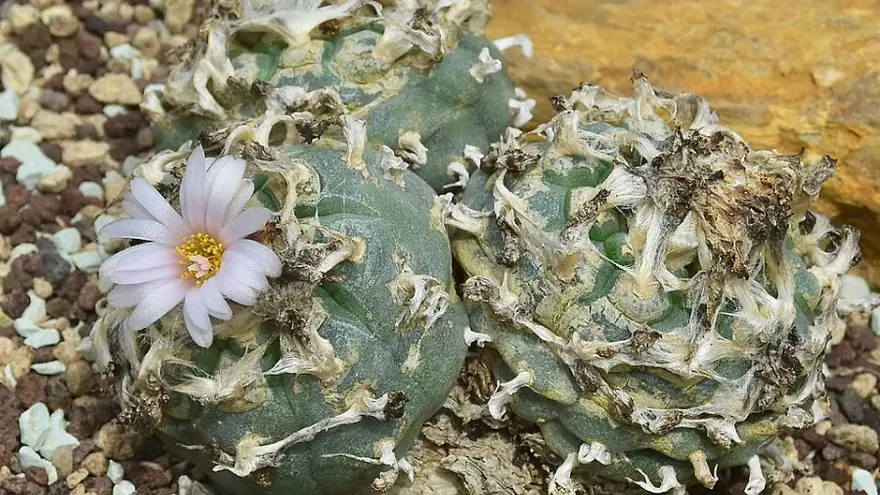
The best-known cacti are:
- Peyote (Lophophora williamsii): small, spineless, from Mexico and Texas. It grows very slowly and is listed as ‘vulnerable’ on the IUCN Red List.8
- San Pedro or huachuma (Echinopsis pachanoi): columnar, from the Andes. It is easily cultivated and common as an ornamental plant.
- Peruvian torch (Echinopsis peruviana): similar to San Pedro.
| Type | Classic psychedelic (phenethylamine) |
|---|---|
| Main action | Activates the 5-HT2A receptor |
| Route | Oral (dried or fresh cactus, infusion or pure mescaline) |
| Starts to be noticed | At 45–90 minutes |
| Total duration | 8–12 hours, sometimes up to 14 |
| Addictive potential | Low |
Starts to be felt: 45–90 minutesTotal duration: 8–12 hours, sometimes up to 14
A rough diagram based on the table above; it varies with the dose, the route and the person.
Mescaline is also made in the laboratory, in the form of a salt (sulphate or hydrochloride). This is what is used in clinical studies, because it makes it possible to know the exact amount. In cacti, by contrast, the amount varies enormously from one plant to another.9
Peyote, San Pedro and pure mescaline share the active principle, but they are not the same: peyote also contains other alkaloids and has a long ceremonial history of its own; San Pedro is the traditional medicine of the Andes; pure mescaline is an isolated substance, without the plant.
How it works
Mescaline activates the serotonin receptor 5-HT2A, just like psilocybin and LSD. In a 2024 trial, ketanserin, which blocks that receptor, cancelled almost all of its effects: it is the main pathway.3
It is a psychedelic of low potency: hundreds of milligrams are needed, about thirty times more than psilocybin and thousands of times more than LSD.2 Its chemical structure is that of a phenethylamine, a relative of 2C-B, and not that of a tryptamine like mushrooms or DMT.
Why it lasts as long as it does. Mescaline takes a while to reach its peak in the blood, which is why the come-up is slow. Its half-life is about three and a half hours, similar to that of LSD; its effect lasts longer because it takes longer to reach the peak.2 In studies with volunteers, the effects lasted ten to twelve hours or more with high doses.2,3
Tolerance. Repeating the next day gives much less effect. There is cross-tolerance with psilocybin and LSD.
The experience
ExperienceThe mescaline experience is usually described as warm, luminous and closely tied to colours and to the beauty of things. It is long and its come-up is slow, often with nausea or vomiting at the start, above all with the cactus.
- Come-up (1–2 h). Nausea, restlessness, a feeling of heat.
- Peak (2–6 h). Very intense colours, patterns, strong emotions, a sense of connection with nature.
- Come-down (6–12 h, sometimes up to 14). Calm, reflection. It may be hard to sleep.
- Afterwards. In studies, somewhat more tiredness and headache the next day than with LSD or psilocybin.2
In a trial that compared the three substances, 500 mg of mescaline produced an experience very similar to that of 100 µg of LSD or 20 mg of psilocybin. The main difference was the duration.2
Physical effects
- Nausea and vomiting, frequent with the cactus.
- Dilated pupils, sweating, chills.
- Moderate rise in pulse and blood pressure, greater the higher the dose.3
Emotional and mental effects
- Extremely intense colours and geometric patterns.
- More sensitivity to beauty, to music and to nature.
- Introspection and intense emotions.
- Anxiety or confusion in some experiences.
Challenging experiences
Because it lasts so long, a challenging experience can also become long. There may be fear, confusion or a feeling that it will never end. It almost always eases with the passing of the hours, a quiet place and the company of someone calm. The vomiting with San Pedro and peyote is seen in many traditions as part of the ‘cleansing’, but it is also exhausting: it is advisable to have water to hand and not to force it.
Dose
The amount of mescaline in cacti varies enormously according to the species, age, part of the plant and cultivation. The figures are approximate.
Pure mescaline
In clinical studies, between 100 and 800 mg of mescaline salt have been used. A medium dose is usually between 200 and 400 mg.
Cactus
There is no reliable equivalence between the weight of cactus and mescaline. For that reason it is recommended to start with a small amount and wait at least two hours before taking more, since the come-up is slow.
Interactions
Mescaline combines badly with anything that lowers the seizure threshold or loads the heart. Listed from most to least dangerous:
| Combination | Risk | What can happen |
|---|---|---|
| Lithium | Very dangerous | High risk of seizures and psychosis with the classic psychedelics.5,6 Do not stop taking lithium on your own: withdrawing it requires medical supervision. |
| Tramadol | Strongly discouraged | Tramadol lowers the seizure threshold.5 |
| MAOIs (MAOI antidepressants, ayahuasca, Syrian rue) | Caution | More intense and unpredictable effects. |
| Stimulants (cocaine, amphetamines, MDMA) | Caution | More strain on the heart and more anxiety for many hours. |
| Cannabis | Caution | It can intensify the experience unpredictably and increase anxiety. |
| Alcohol | Discouraged | More nausea and worse judgement. |
| SSRI and SNRI antidepressants | Reduces the effect | They usually dampen the experience. Do not stop your medication without talking to your doctor. |
This table is not complete. If you take any medication, consult a healthcare professional.
Who should not take it
- Mental health: people with a personal or family history of psychosis, schizophrenia or bipolar disorder. Research with psychedelics excludes them.4
- Heart and blood pressure: uncontrolled hypertension, arrhythmias or heart disease. Mescaline raises blood pressure for many hours.3
- Stomach: with an ulcer, severe reflux or other digestive problems, the vomiting caused by the cactus can be a problem.
- Pregnancy and breastfeeding: there are no safety data. It should not be taken.
- Age: not for minors. The adolescent brain is still developing.
- Medication: lithium, tramadol, MAOIs and antidepressants; see the interactions table.
- A difficult time in life: a crisis, a recent bereavement or a lot of anxiety make a challenging experience more likely, and here it lasts many hours.
- Driving and working: do not drive or operate machinery under its effects. It is advisable to let the rest of the day and a night’s sleep pass.
How to reduce risks
APDER does not encourage use. If you decide to go ahead, these measures reduce the risks, though they do not remove them.
Before
- Ask yourself what for and how you are. The moment in life and your mood influence the experience as much as the dose.
- Set aside a whole day. Between the slow come-up and the duration, the experience can take twelve hours or more. Leave the next day free too.
- Test mescaline powder. Outside the medical setting, a powder sold as mescaline may be another, more potent phenethylamine. In Spain this is done by Energy Control.10
- Eat lightly a few hours beforehand: it reduces nausea.
- Check your medication against the interactions table.
- Choose the place and the company. A quiet place, if possible with access to nature, and someone you trust who has not taken anything.
During
- Wait. The come-up is slow and can take two hours. Taking more because it ‘is not coming on’ is one of the most frequent mistakes.
- Drink water in sips, above all if there is vomiting, and rest if you notice your heart racing or you feel very hot.
- Do not mix it with alcohol, stimulants or other drugs.
Afterwards
- Rest, eat and sleep. Do not make important decisions in the following hours.
- Let time pass before repeating.
What is particular to mescaline: respect for peyote
Peyote takes more than ten years to flower, is listed as vulnerable and harvesting is depleting it.8 For the Wixárika people and for the Native American Church it is a sacrament. If you do not belong to a tradition that uses it, the most respectful thing is not to consume wild peyote. San Pedro, by contrast, grows quickly and is easily cultivated.
If something goes wrong
Call 112 if the person:
- does not respond or has lost consciousness;
- has seizures;
- has difficulty breathing or chest pain;
- is very hot, with dry or red skin, or is confused;
- is so agitated that they may hurt themselves or others;
- talks about harming themselves or taking their own life.
112 is free and operates throughout the European Union. Asking for help in time matters more than fear of the consequences.
While help is on its way
- Do not leave the person alone.
- If they are unconscious but breathing, put them on their side, in the recovery position.
- Find a quiet, cool, dimly lit place.
- Do not give them any more substances, or other ones to ‘counteract’ the effect.
- If they are conscious, give water in sips; drinking a lot of water at once is also dangerous.
What to tell the health staff
What they have taken, how much, when, whether they have mixed it with anything and what medication they take regularly. If any remains or the packaging, take it with you. Telling the truth helps the person to be treated properly. For questions about a poisoning, the Toxicology Information Service is available 24 hours a day on 91 562 04 20.
If it is a challenging experience, with no physical warning signs
Support them with presence and a calm voice. Remind the person that what they feel is the effect of the substance and that it will pass. If it does not ease or a risk appears, ask for help. If someone has thoughts of harming themselves, the Ministry of Health’s 024 Line is free, open 24 hours a day and confidential.
Before taking anything
Testing a substance is the only way to know what it contains. In Spain this is done by Energy Control, with offices in Andalusia, Catalonia, Madrid and Mallorca and a postal service from other regions. Also read the interactions section of each guide.
Research and therapeutic use
ResearchMescaline was the first psychedelic to be isolated (1897) and one of the first studied in psychiatry, in the 1920s and 1950s. Afterwards attention turned to LSD and psilocybin. Today there are studies in Switzerland comparing its acute effects with those of other psychedelics2 and surveys of people who use it in natural settings.7
Comparative trial (Basel, 2023). Thirty-two healthy volunteers received, on different days and without knowing what they were taking, mescaline (300 or 500 mg), LSD (100 µg), psilocybin (20 mg) and placebo. At 500 mg, mescaline produced effects of similar intensity and quality to those of LSD and psilocybin, but they lasted longer. Tolerability was similar, with somewhat more discomfort the next day.2
Dose study (Basel, 2024). Sixteen healthy volunteers received from 100 to 800 mg. Above 100 mg, the effects and the rise in blood pressure increased with the dose. Ketanserin, which blocks the 5-HT2A receptor, prevented almost all the effects.3
Use in natural settings (survey, 2021). Among 452 people who had taken mescaline, many described improvements in depression, anxiety or alcohol and drug use that they attributed to the experience.7 It is a survey: it does not let us know whether the improvement is due to mescaline.
Limits. There are no trials of mescaline in any disorder. Studies with healthy people say nothing about its use as a treatment.
Regulated accessAs of 23 November 2026, no medicine containing mescaline is authorised in Spain or, as far as we know, in any other country.
What a therapeutic process is like, step by step, is explained in Mescaline therapy.
Integration and personal growth
InterpretationWhat follows is a view from humanistic and transpersonal psychology, not a laboratory finding. In the Andean traditions and those of northern Mexico, San Pedro and peyote are not taken in order to ‘have an experience’, but within a ceremony with an intention, a song, a community and a return. That structure fulfils the function that psychotherapy calls integration.
Aldous Huxley wrote that mescaline showed him things ‘as they are’, with a beauty that everyday sight no longer sees. From transpersonal psychology, that experience of the sacred in the everyday is valuable if it returns to daily life: in how we look at nature, at other people, at ourselves. From Carl Rogers’s person-centred approach, what helps is to listen to what was lived with acceptance and without judgement; from Gestalt, to ask what has become present and what it asks for now.
Writing, talking it over with someone you trust or returning to the same landscape a few days later help to give it a place. It is advisable to ask for professional support if anxiety, insomnia or a sense of unreality persist, or if thoughts of harming yourself appear.
Myths and facts
- ‘Mescaline is milder than LSD or mushrooms’
- At equivalent doses, the experience is very similar; what changes is that it lasts longer.2
- ‘If it is an ornamental plant, it does nothing’
- San Pedro sold in garden centres contains mescaline, in very variable amounts.
- ‘Peyote is an inexhaustible resource’
- It grows very slowly and is classed as vulnerable because of harvesting and habitat loss.8
- “Vomiting means something is going wrong”
- With the cactus, nausea and vomiting are common and usually pass during the come-up. They are a warning sign if they do not stop, if there is blood, or if the person is very weak.
- “Just once can drive you mad”
- In people with no predisposition, population studies have not found more mental disorders among those who have taken psychedelics, mescaline included.11
History
- More than 5,000 years ago. Remains of peyote in caves in northern Mexico and Texas.1
- Chavín culture (Peru, about 3,000 years ago). Depictions of San Pedro in temples.
- Huichol (Wixárika) peoples. An annual pilgrimage to Wirikuta to gather peyote, a living tradition.
- 1897. Arthur Heffter isolates mescaline.
- 1919. Ernst Späth synthesises it.
- 1918. The Native American Church, which uses peyote as a sacrament, is founded in the United States.
- 1954. Aldous Huxley publishes Las puertas de la percepción about his experience with mescaline.
- 2023–2024. The first modern trials of mescaline in healthy people are published in Basel.2,3
Frequently asked questions
How long does it last?
Between eight and twelve hours, sometimes up to fourteen. The come-up is slow: it can take up to two hours to be fully noticeable.
Are San Pedro and peyote the same thing?
Both contain mescaline, but they are different cacti. Peyote is small, grows very slowly and is under threat; San Pedro is a columnar cactus from the Andes and is easy to cultivate.
Why is wild peyote not recommended?
Because it takes more than ten years to grow, is classed as vulnerable, and is sacred to several Indigenous peoples.
Is it normal to vomit?
With the cactus, yes, especially during the come-up. It helps to eat lightly beforehand and to keep water within reach. If the vomiting does not stop or there is blood, ask for help.
Can it be mixed with antidepressants?
With lithium it is very dangerous and with tramadol, very strongly advised against. SSRIs usually reduce the effect. Do not stop your medication on your own: talk to your doctor.
Does it have a medical use?
There is no medicine containing mescaline, and no trials in specific disorders. There are only studies with healthy people and surveys.
Further reading and related guides
- Aldous Huxley, The Doors of Perception & Heaven and Hell (in English; in Spanish, Las puertas de la percepción). In the Library.
- Javier Regueiro, San Pedro Huachuma. In the Library.
- Omer C. Stewart, Peyote Religion (1987, in English). In the Library.
- Alexander and Ann Shulgin, PiHKAL: una historia química de amor. In the Library.
References
- Bruhn JG, De Smet PAGM, El-Seedi HR, Beck O. Mescaline use for 5700 years. Lancet. 2002;359(9320):1866.
- Ley L, Holze F, Arikci D, et al. Comparative acute effects of mescaline, lysergic acid diethylamide, and psilocybin in a randomized, double-blind, placebo-controlled cross-over study in healthy participants. Neuropsychopharmacology. 2023;48(11):1659-1667. doi:10.1038/s41386-023-01607-2. PMID 37231080.
- Klaiber A, Schmid Y, Becker AM, et al. Acute dose-dependent effects of mescaline in a double-blind placebo-controlled study in healthy subjects. Transl Psychiatry. 2024;14:395. doi:10.1038/s41398-024-03116-2.
- Johnson MW, Richards WA, Griffiths RR. Human hallucinogen research: guidelines for safety. J Psychopharmacol. 2008;22(6):603-620. doi:10.1177/0269881108093587. PMID 18593734.
- TripSit. Combinations chart, entry “Mescaline” (secondary harm reduction source). https://raw.githubusercontent.com/TripSit/drugs/main/combos.json
- Nayak SM, Gukasyan N, Barrett FS, Erowid E, Erowid F, Griffiths RR. Classic psychedelic coadministration with lithium, but not lamotrigine, is associated with seizures: an analysis of online psychedelic experience reports. Pharmacopsychiatry. 2021;54(5):240-245. doi:10.1055/a-1524-2794. PMID 34348413.
- Agin-Liebes G, Haas TF, Lancelotta R, et al. Naturalistic use of mescaline is associated with self-reported psychiatric improvements and enduring positive life changes. ACS Pharmacol Transl Sci. 2021;4(2):543-552. doi:10.1021/acsptsci.1c00018.
- Terry M. Lophophora williamsii (corrected version of the 2013 assessment). The IUCN Red List of Threatened Species 2017: e.T151962A121515326. doi:10.2305/IUCN.UK.2017-3.RLTS.T151962A121515326.en.
- Cassels BK, Sáez-Briones P. Dark classics in chemical neuroscience: mescaline. ACS Chem Neurosci. 2018;9(10):2448-2458. doi:10.1021/acschemneuro.8b00215.
- Energy Control. Analysis service. https://energycontrol.org/servicio-de-analisis/
- Johansen PØ, Krebs TS. Psychedelics not linked to mental health problems or suicidal behavior: a population study. J Psychopharmacol. 2015;29(3):270-279. doi:10.1177/0269881114568039. PMID 25744618.
Last reviewed: 23 November 2026. Doses and interactions pending expert review.
Before you read on. This information is for general education. We prepare it carefully from scientific and harm reduction sources, but it may contain errors or become out of date. It is not medical advice and does not replace a health professional, especially if you take medication or have a health problem. APDER does not encourage the use of any substance and accepts no responsibility for how this information is used. If you spot an error, write to us at info@apder.org.
Canonical address: https://apder.org/sustancias/mescalina/