

Contents
In brief
- What it is. An American plant, sacred to many Indigenous peoples, that often accompanies ayahuasca in the form of mapacho or rapé.1
- What it does. Nicotine stimulates, raises pulse and blood pressure, and releases dopamine.2
- The main risk. A very strong dependence and, when drunk, nicotine poisoning. Smoked regularly, cancer and heart and lung disease.3,4
- The most dangerous interaction. With stimulants and with oestrogen-containing contraceptives; and smoking changes the levels of some medicines.5
- Therapeutic use. None; psilocybin, however, is being researched as a way to quit smoking.6,7
What it is and where it comes from
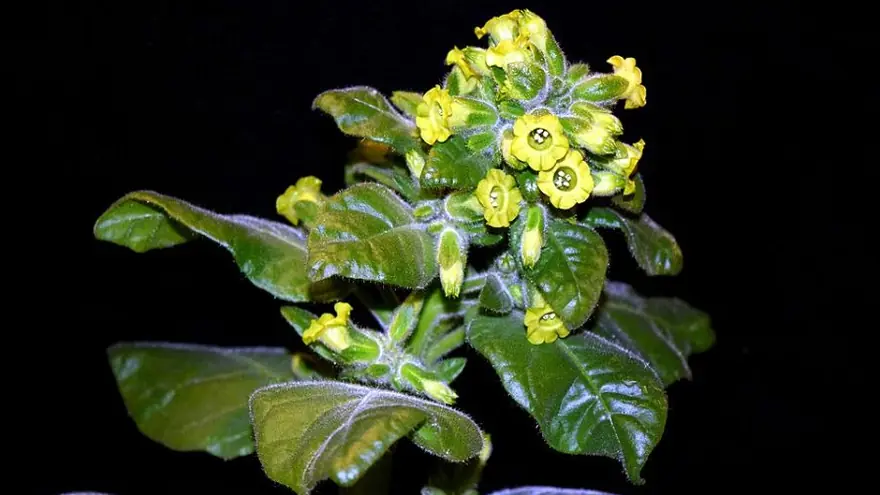
Tobacco is native to the Americas and was for millennia one of the most sacred plants of many Indigenous peoples.1 In the Amazon, mapacho (Nicotiana rustica) is mostly used, with much more nicotine than commercial tobacco. It appears in ayahuasca ceremonies, as smoke blown over people, and in rapé: powdered tobacco mixed with ashes and other plants, which is blown into the nose.
| Type | Stimulant |
|---|---|
| Main action | Nicotine activates nicotinic acetylcholine receptors |
| Routes | Smoked, rapé (nasal), chewed, as a tea (very dangerous) |
| Addictive potential | Very high |
The two main species are commercial tobacco (Nicotiana tabacum) and mapacho (Nicotiana rustica). Their traditional forms of use are very different from a cigarette:
- Mapacho: strong tobacco cigars, without additives, which are smoked or whose smoke is blown over people in ceremonies.
- Rapé: powdered tobacco, often mixed with ashes of barks and other plants, which another person blows into the nose with a tube.
- Tobacco drunk or sniffed in water: in some Amazonian traditions, as part of purging diets. It is the most dangerous form.
Why it is on this website: it frequently accompanies ayahuasca and other ceremonies, and it is sold as a “sacred plant” without explaining that its active principle, nicotine, is highly addictive and can poison.
How it works
Nicotine activates the nicotinic acetylcholine receptors in the brain and the rest of the body. It releases dopamine in the reward circuits, which explains its enormous capacity to create dependence, and activates the sympathetic nervous system: pulse and blood pressure rise.2
Why it is so addictive. Smoked, nicotine reaches the brain in seconds, and its effect is short: the body quickly learns to ask for the next dose.2
A little-known effect. Tobacco smoke, not nicotine, speeds up the liver's elimination of some medicines, such as clozapine, olanzapine or theophylline. When you stop smoking their levels can rise: it is advisable to tell your doctor.5
The effects
ExperienceIn ceremonial use, tobacco is not sought for visions but for focus, “cleansing” and grounding. In everyday use, the feeling is one of relief, because it calms the withdrawal from the previous cigarette.
Effects
- With rapé or mapacho: an intense come-up, dizziness, sweating, watering eyes, a feeling of “cleansing” and focus.
- Nausea and vomiting with high amounts.
- Raised pulse and blood pressure.
- With little experience, dizziness, pallor, cold sweats and nausea: this is mild nicotine poisoning.
Dose
We give no dose figures. The amount of nicotine varies greatly between commercial tobacco and mapacho, and between one rapé and another. What changes the risk most is the route: drunk or sniffed in liquid, nicotine is absorbed in large quantities and can cause serious poisoning.
Interactions
Ordered from most to least dangerous:
| Combination | Risk | What can happen |
|---|---|---|
| Stimulants (cocaine, amphetamines, MDMA) | Dangerous | They add their load on the heart and blood vessels. |
| Oestrogen-containing contraceptives | Dangerous | Smoking increases the risk of thrombosis, especially from the age of 35.5 |
| Clozapine, olanzapine, theophylline and other medicines eliminated by the enzyme CYP1A2 | Caution | Smoke lowers their levels; when you stop smoking they can rise suddenly. Tell your doctor.5 |
| Ayahuasca and other psychedelics | Caution | Mapacho and rapé raise pulse and blood pressure and can increase nausea and dizziness during the ceremony. |
| Alcohol | Caution | Each pushes you to consume more of the other, and together they multiply the risk of some cancers. |
This table is not complete. If you take any medication, consult a healthcare professional.
Who should not take it
- Heart and blood pressure: hypertension, arrhythmias, coronary disease, or a history of heart attack or stroke.
- Lungs: asthma, COPD or other respiratory diseases, if smoked.
- Pregnancy and breastfeeding: nicotine harms the foetus and passes into milk. It must not be used.
- Age: not for people under 18; the adolescent brain becomes hooked more easily.
- People who have stopped smoking: rapé or ceremonial mapacho can reactivate the dependence.
- Medication: see the interactions table.
How to reduce risks
APDER does not encourage use. If you decide to go ahead, especially in a ceremonial context, these measures reduce the risks, although they do not eliminate them.
In ceremony
- Ask what will be used and how. Smoked or as rapé carries one risk; drunk or sniffed in water, a much greater one.
- Do not drink tobacco outside a context with people who know the practice well and can deal with poisoning.
- You can say no to rapé or mapacho. A serious ceremony respects that.
- Tell whoever guides the ceremony about your medication and health problems.
In everyday life
- If you smoke and want to stop, your health centre offers free help and treatments that double the chances of succeeding.
- Frequent rapé irritates and damages the lining of the nose.
The specific risk of tobacco: nicotine poisoning
Its signs are nausea and vomiting, cold sweats, pallor, dizziness, salivation, tremors and a very fast or, later, very slow pulse. In severe cases, seizures, fainting and difficulty breathing. If these severe signs appear, especially after drinking tobacco, call 112.4
In the long term, smoking is one of the main preventable causes of death in the world: cancer, and heart and lung disease.3
If something goes wrong
Call 112 if the person:
- does not respond or has lost consciousness;
- has seizures;
- has difficulty breathing or chest pain;
- is very hot, with dry or red skin, or is confused;
- is so agitated that they may hurt themselves or others;
- talks about harming themselves or taking their own life.
112 is free and operates throughout the European Union. Asking for help in time matters more than fear of the consequences.
While help is on its way
- Do not leave the person alone.
- If they are unconscious but breathing, put them on their side, in the recovery position.
- Find a quiet, cool, dimly lit place.
- Do not give them any more substances, or other ones to ‘counteract’ the effect.
- If they are conscious, give water in sips; drinking a lot of water at once is also dangerous.
What to tell the health staff
What they have taken, how much, when, whether they have mixed it with anything and what medication they take regularly. If any remains or the packaging, take it with you. Telling the truth helps the person to be treated properly. For questions about a poisoning, the Toxicology Information Service is available 24 hours a day on 91 562 04 20.
If it is a challenging experience, with no physical warning signs
Support them with presence and a calm voice. Remind the person that what they feel is the effect of the substance and that it will pass. If it does not ease or a risk appears, ask for help. If someone has thoughts of harming themselves, the Ministry of Health’s 024 Line is free, open 24 hours a day and confidential.
Before taking anything
Testing a substance is the only way to know what it contains. In Spain this is done by Energy Control, with offices in Andalusia, Catalonia, Madrid and Mallorca and a postal service from other regions. Also read the interactions section of each guide.
Research and therapeutic use
ResearchParadoxically, one of the most promising lines of research with psilocybin is for quitting smoking: in a pilot study, most participants were still not smoking six months later.6 See the psilocybin guide.
In the long term, in the follow-up of that same group, a significant proportion were still not smoking more than a year later.7 These are small studies, without a comparison group; larger trials are under way.
Regulated accessTo quit smoking there are authorised treatments (nicotine replacement, varenicline, bupropion and psychological support), available in the health system. Psilocybin for quitting smoking can only be received within clinical trials.
Integration and personal growth
InterpretationWhat follows is a view from humanistic and transpersonal psychology, not laboratory data. For many Amazonian and North American peoples, tobacco is a teacher, a protector and a messenger of prayers. The industrial cigarette is almost the opposite: a relationship without intention, repeated dozens of times a day.
From Carl Rogers's person-centred approach, the useful question is not “am I able to quit?”, but “what does tobacco do for me and what need lies behind it?”. From Gestalt, becoming aware of each act of smoking already changes something. Recovering the respect that the traditions had for the plant can be, for some people, a way of letting go of it.
Myths and facts
- “Ceremonial tobacco is not addictive”
- The nicotine is the same: mapacho has even more. That the context is sacred does not change its capacity to create dependence.
- “Mapacho is healthier because it has no additives”
- It has no additives, but it has more nicotine, and the smoke of any tobacco contains carcinogenic substances.
- “Rapé is not tobacco”
- Most rapés contain tobacco, often mapacho, and therefore nicotine.
- “Drinking tobacco cleanses the body”
- Drunk, nicotine is absorbed in large quantities and can cause serious poisoning.4
History
Tobacco was domesticated in the Americas thousands of years ago and was used in rituals, healing and diplomacy. After the arrival of the Europeans it spread across the world as a consumer product and became one of the main preventable causes of death.
- Thousands of years ago. Domestication of tobacco in the Americas; use in rituals, healing and diplomacy.1
- 16th century. Europeans carry it across the world.
- 20th century. The industrial cigarette becomes one of the main preventable causes of death.3
- 2014. First pilot study with psilocybin for quitting smoking.6
Frequently asked questions
Does rapé contain nicotine?
Almost always, because most rapés are made with tobacco, often mapacho, which has a lot of nicotine.
Is it dangerous to drink tobacco?
Yes. Drunk, nicotine is absorbed in large quantities and can cause vomiting, tremors, seizures and heart and breathing problems.
Can psilocybin help with quitting smoking?
A small pilot study gave promising results, but there is not enough evidence and it can only be received in clinical trials. There are authorised treatments that do work.
Why is tobacco used in ayahuasca ceremonies?
In many Amazonian traditions it is a teacher and protector plant: its smoke is blown over people or it is taken as rapé to centre and “cleanse”.
If I stop smoking, does my medication change?
It may. Smoke speeds up the elimination of some medicines, such as clozapine or olanzapine, and when you stop smoking their levels can rise. Tell your doctor.
Related guides
References
- Wilbert J. Tobacco and Shamanism in South America. Yale University Press; 1987.
- Benowitz NL. Pharmacology of nicotine: addiction, smoking-induced disease, and therapeutics. Annu Rev Pharmacol Toxicol. 2009;49:57-71. doi:10.1146/annurev.pharmtox.48.113006.094742.
- World Health Organization. Tobacco: fact sheet. https://www.who.int/news-room/fact-sheets/detail/tobacco
- Mayer B. How much nicotine kills a human? Tracing back the generally accepted lethal dose to dubious self-experiments in the nineteenth century. Arch Toxicol. 2014;88(1):5-7. doi:10.1007/s00204-013-1127-0.
- Kroon LA. Drug interactions with smoking. Am J Health Syst Pharm. 2007;64(18):1917-1921. doi:10.2146/ajhp060414.
- Johnson MW, Garcia-Romeu A, Cosimano MP, Griffiths RR. Pilot study of the 5-HT2AR agonist psilocybin in the treatment of tobacco addiction. J Psychopharmacol. 2014;28(11):983-992. doi:10.1177/0269881114548296.
- Johnson MW, Garcia-Romeu A, Griffiths RR. Long-term follow-up of psilocybin-facilitated smoking cessation. Am J Drug Alcohol Abuse. 2017;43(1):55-60. doi:10.3109/00952990.2016.1170135.
Last reviewed: 23 November 2026. Doses and interactions pending expert review.
Before you read on. This information is for general education. We prepare it carefully from scientific and harm reduction sources, but it may contain errors or become out of date. It is not medical advice and does not replace a health professional, especially if you take medication or have a health problem. APDER does not encourage the use of any substance and accepts no responsibility for how this information is used. If you spot an error, write to us at info@apder.org.
Canonical address: https://apder.org/sustancias/tabaco/