

Plant · Convolvulaceae · New World tropics
Morning glory
Ipomoea tricolor Cav.
A climbing vine with blue flowers that open at dawn, whose seeds contain ergolines such as ergine or LSA. The Mexica knew it as tlitliltzin, and its scientific identification is a story of botanists and of Albert Hofmann.124
Also known asmorning glory · campanilla · tlitliltzin · Ipomoea violacea · morning glory seeds
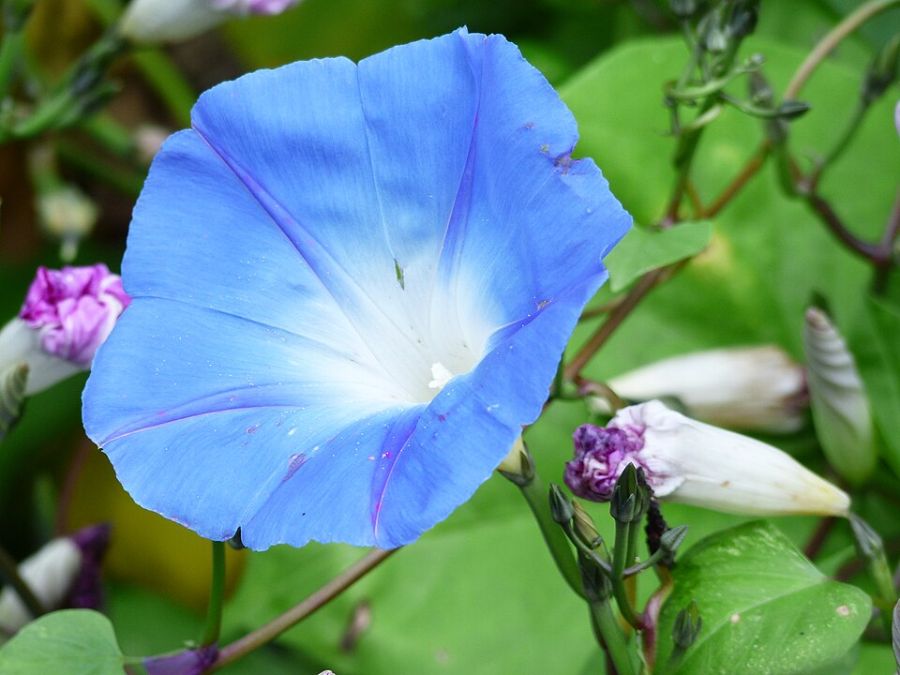
- What it is
- Annual or perennial vine with funnel-shaped flowers
- Territory
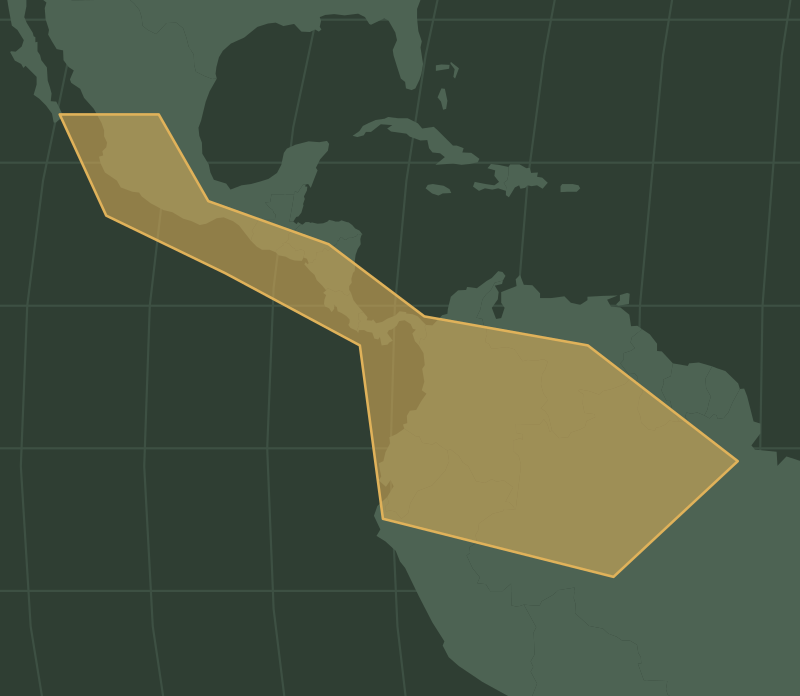
- New World tropics, now found worldwide
- Part used
- The seed
- Active principles
- Ergine (LSA) and isoergine, ergolines
- Onset and duration
- No reliable data
- Who keeps its memory
- Peoples of Mexico, especially the Zapotec
Botany
A bellflower that opens at dawn
It is a species of morning glory native to the New World tropics, now cultivated and naturalised in many parts of the world.5
It belongs to the Convolvulaceae, the family of vines with funnel-shaped flowers. It is a relative of other plants with ergoline-rich seeds, such as Rivea corymbosa, the ololiuqui plant.27
There is confusion among the scientific names: Ipomoea tricolor and I. violacea are often mixed up and some authors consider them the same.4
- Family
- Convolvulaceae
- Habit
- Climbing vine
- Flower
- Funnel-shaped, blue
- Seed
- Black, elongated and angular
Memory and tradition
The revered "black one" of the Mexica
The Mexica knew these seeds as tlitliltzin, from the Nahuatl word for "black" with a shade of respect.5 They are credited with divinatory and medicinal use.2
Botanists were slow to recognise them. In 1939, Schultes and Reko collected in Oaxaca a convolvulaceous plant that was used as a divinatory narcotic and identified it with ololiuqui, and later MacDougall and Wasson showed that the Zapotec also used another morning glory.23
In 1960, Albert Hofmann isolated from the seeds of ololiuqui and of Ipomoea tricolor alkaloids of the ergoline type: ergine, isoergine and chanoclavine.1
Over time
The Mexica use tlitliltzin and ololiuqui for divinatory and medicinal purposes.2
Schultes and Reko collect the ololiuqui plant in Oaxaca.3
MacDougall makes known its use among the Zapotec; Hofmann and Tscherter isolate the ergolines.12
It is discovered that many garden varieties contain alkaloids of the ergine class.6
Its names
- morning glory
- for its flowers, which open at dawn
- tlitliltzin
- in Nahuatl, "the black one", said with respect
- ololiuqui
- another, distinct plant, Rivea corymbosa, of similar use
- campanilla
- common name for several convolvulaceous plants
Tlitliltzin and ololiuqui are different plants, although related and often used together.2
Territory and care
A widely cultivated vine
What helps
- Treat it as a garden plant and a plant of history, not as a product to consume.
- Take care with garden seeds at home: children and animals must not eat them.
- Respect the memory of the Zapotec and Mexica peoples who have safeguarded it.
What it contains
Ergine, a cousin of LSD
The seeds contain alkaloids of the ergoline type. The main ones are ergine, also called lysergic acid amide or LSA, and its isomer, isoergine.16
They are chemical relatives of LSD, a semi-synthetic derivative, and of the ergot alkaloids.6 Unlike the toxic ergot alkaloids, ergine dissolves in cold water.4
Lysergic acid amide; the main alkaloid of the seeds of several convolvulaceous plants.[1][6]
Isomer of ergine that accompanies the main alkaloid.[1][6]
The experience
Subtler, and more uncomfortable, than LSD
Ergine is a psychedelic of the lysergic family. It is held to be less potent and more uncomfortable than LSD, but that comparison rests on accounts, not on studies.6
There are no reliable measurements of when it starts or how long it lasts, and the content of the seeds varies greatly from one variety to another.3
Indicative outline: it changes with the preparation, the amount and the person.
Research
What has been studied
Best documented are the chemistry and botany: the isolation of the ergolines in 1960 and the study of commercial varieties.13
A 1963 study found ergine-type and clavine alkaloids in the seeds of commercial varieties of morning glory.3
Scope of these dataThere are no clinical trials with these seeds. What is known of their effects comes from accounts and from chemical studies decades old.
With care
What it helps to know beforehand
The alkaloid content varies greatly between varieties and seeds, and there is no way of knowing how much is in those that are bought.3
The ergolines are related to those of ergot, some of which are toxic.6
They are sold for planting, not for consumption; the information on the packet says nothing about alkaloids.3
For the peoples who have safeguarded it, it is a plant of divination and medicine.2
To follow
Books and related medicines
Sources
Where each piece of information comes from
- Hofmann A, Tscherter H. Isolierung von Lysergsäure-Alkaloiden aus der mexikanischen Zauberdroge Ololiuqui (Rivea corymbosa (L.) Hall. f.). Experientia. 1960;16:414.
- Hofmann A. The active principles of the seeds of Rivea corymbosa and Ipomoea violacea. Botanical Museum Leaflets, Harvard University. 1963;20:194-212.
- Taber WA, Vining LC, Heacock RA. Clavine and lysergic acid alkaloids in varieties of morning glory. Phytochemistry. 1963;2:65-70.
- ICEERS. Basic info: ergot, LSA and morning glory. iceers.org.
- Chemeurope. Ipomoea tricolor. chemeurope.com/en/encyclopedia.
- Wikipedia. "Ergoline". en.wikipedia.org (accessed 24 November 2026).
- Wikipedia. "Ipomoea corymbosa". en.wikipedia.org (accessed 24 November 2026).
- Morning glory (Ipomoea tricolor). Evas-naturfotografie · CC BY-SA 4.0
- Map APDER, with data from Natural Earth · public domain
- Molecule drawings APDER
Last reviewed: 24 November 2026. If you spot a mistake, write to us at info@apder.org.