

Plant · Celastraceae · Horn of Africa and Arabia
Khat
Catha edulis Forssk.
A shrub or tree of East Africa and the south of the Arabian Peninsula, whose leaves and tender shoots have been chewed for centuries for their mild stimulant effect. Its use is above all social and is concentrated in Yemen, Somalia, Ethiopia and Kenya.123
Also known askhat · qat · chat · miraa · jimaa · qaad · Abyssinian tea · Catha edulis
- What it is
- A shrub with tender leaves that are chewed
- Territory
- East and south-east Africa and the south of the Arabian Peninsula
- Part used
- Tender leaves and shoots, fresh
- Active principles
- Cathinone, cathine and norephedrine
- Onset and duration
- No reliable data in the sources consulted
- Who keeps its memory
- Peoples of Ethiopia, Somalia, Yemen and Kenya
Botany
An evergreen shrub
- Family
- Celastraceae
- Height
- 1 to 25 m
- Leaf
- Perennial
- Part used
- Tender leaves and shoots
Memory and tradition
A social use of centuries
It is cultivated from the Harar area in eastern Ethiopia, and from there it spread at different times to Somalia, Djibouti, Yemen, Kenya, Madagascar, Tanzania and other regions.1
Chewing khat predates the use of coffee and takes place in a similar social context.2
Its use spread among the occultist, spiritual and upper classes of Yemen in the 16th century.4
The oldest reference appears to be that of Al-Biruni, around 973-1053, who spoke of a khat imported from Turkestan.6
In Yemen it is a mainly male habit and is rooted in sociocultural tradition.27
In Africa and the Middle East its use is more a social phenomenon than a stimulant; it tends to be moderate and often takes place in rooms designed for it.8
Over time
First known reference, by Al-Biruni.6
It spreads among the spiritual and upper classes of Yemen.4
Forsskål identifies it as Catha edulis.4
Its names
- khat, qat, chat
- most widespread names
- miraa
- Kenya
- jimaa
- Oromo
- qaad
- Somali
There are dozens of names depending on the language: qat in Yemen, chat in Ethiopia, miraa in Kenya.24
Territory and care
From the Horn of Africa to Arabia
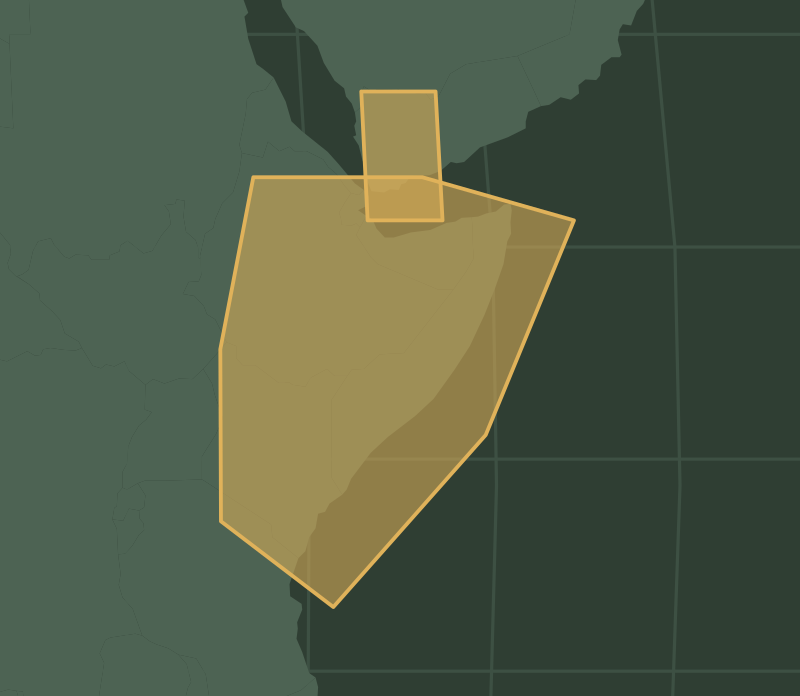
It is native to East and south-east Africa and is cultivated in Ethiopia, Kenya, Yemen and other countries.1
The biggest consumers are East Africans, in particular Somalis, and Yemenis; the biggest producers are Ethiopia and Kenya.1
In Yemen its cultivation takes up a good part of the country's agriculture.2
What helps
- Know it as the social custom of particular peoples.
- Understand the economic dimension of its cultivation.
- Respect the cultural context.
What it contains
Cathinone and cathine
The fresh leaves contain cathinone, cathine and norephedrine, which are sympathomimetic compounds.4
Cathinone, the main active ingredient of the fresh leaves, resembles amphetamine in structure and pharmacology.7
It brings greater sociability, excitement, a slight loss of appetite and mild euphoria.1
Main active compound of the fresh leaf.[7]
A milder form than cathinone.[3]
Third sympathomimetic compound.[4]
The experience
Sociability and gentle energy
It is chewed for hours at gatherings and produces sociability, excitement and a mild euphoria.1
There are no reliable data on onset or duration.
Research
What has been studied
There are medical, microbiological and pharmacokinetic reviews of its consumption and its effects on health.579
Most research focuses on the risks and effects of habitual use, not on therapeutic use.
Scope of these dataGood sociocultural and toxicological documentation; no established therapeutic use.
With care
What it helps to know beforehand
High doses and chronic use are associated with neurological, psychiatric, cardiovascular, dental, digestive and urinary effects.6
In Yemen, where its use is very widespread, reviews consider it a public health problem.7
It is a social custom with its own rooms, timetables and rules.8
Clinical studies on its use in therapeutic contexts are lacking.
To follow
Books and related medicines
Sources
Where each piece of information comes from
- Wikipedia. Khat. wikipedia.com/wiki/Khat.
- Encyclopedia of Life. Khat: names and use (api). api.eol.org/pages/405237/articles.
- Encyclopedia.com. Catha edulis. encyclopedia.com/medicine/encyclopedias-almanacs-transcripts-and-maps/catha-edulis.
- Khat: a study of its kinetics and toxicology. pmc.ncbi.nlm.nih.gov/articles/PMC8875844.
- Al-Hebshi NN, Skaug N. Khat (Catha edulis): an updated review. bibliography.maps.org/resources/download/17022.
- Khat: effects and earliest historical reference. pmc.ncbi.nlm.nih.gov/articles/PMC3377054.
- Khat (Catha edulis): health aspects of khat chewing. East Mediterr Health J. 2007;13(3):706-718. pubmed.ncbi.nlm.nih.gov/17687845/.
- Encyclopedia.com. Catha edulis (social use). encyclopedia.com/science/applied-and-social-sciences-magazines/catha-edulis.
- Khat use: WHO review (EMHJ). 2017;23(3):236-244. applications.emro.who.int/EMHJ/V23/03/EMHJ_2017_23_03_236_244.pdf.
- Map APDER, with data from Natural Earth · public domain
- Molecule drawings APDER
Last reviewed: 24 November 2026. If you spot a mistake, write to us at info@apder.org.