

Plant · Rubiaceae · South-East Asia
Kratom
Mitragyna speciosa (Korth.) Havil.
A tropical tree of South-East Asia, a relative of coffee, whose leaves are chewed by workers to endure fatigue. It is not a psychedelic: it stimulates in small amounts and sedates in large ones, because its alkaloids act on opioid receptors.1257
Also known askratom · ketum · biak-biak · thom · kakuam
- What it is
- Evergreen tropical tree, of the coffee family
- Territory
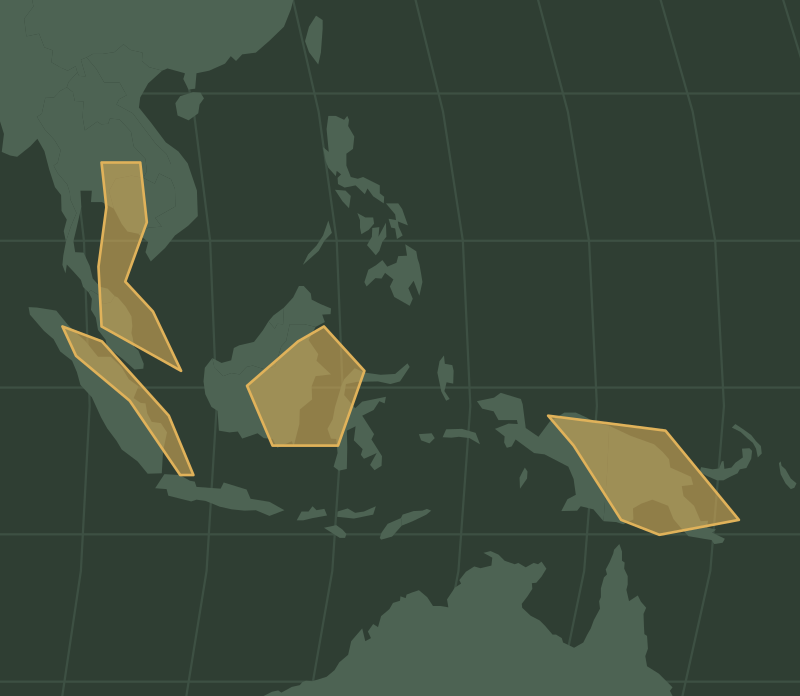
- Thailand, Malaysia, Sumatra, Borneo and New Guinea
- Part used
- The leaf, fresh or dried
- Active principles
- Mitragynine and 7-hydroxymitragynine
- Onset and duration
- 10–30 min · 2–5 h
- Who keeps its memory
- Workers and communities of Thailand, Malaysia and Indonesia
Botany
A tree with glossy leaves, of the coffee family
It is an evergreen tropical tree that can reach 25 metres. Its leaves are large, dark green and glossy, and the flowers form yellow balls.57
It belongs to the Rubiaceae, the coffee family. Unlike the coffee plant, it is a facultatively deciduous tree, native to South-East Asia.6
It grows in the humid forests of central and southern Thailand, northern peninsular Malaysia, Sumatra, Borneo, the Philippines and New Guinea.6
- Family
- Rubiaceae, the coffee family
- Habit
- Tree of up to 25 m
- Leaf
- Large, dark and glossy
- Flower
- Yellow balls, with many tiny florets
Memory and tradition
The leaf of those who work from dawn to dusk
In South-East Asia, manual workers chewed fresh leaves to improve their performance and ease fatigue.78 It was also used as a substitute for opium: this use was reported in Malaysia in 1836, and in Thailand in the 19th century.5
It has been used in traditional medicine for muscle pain and to increase energy and appetite, in a similar way to khat or coca.5 The leaves have been taken chewed, smoked and as tea.5
The "chewers", as those who chew it daily are called, sought above all less fatigue and more endurance in the heat while working.7
Over time
It is reported that in Malaysia it was used as a substitute for opium.5
The Dutch botanist Pieter Korthals describes the species.5
In Thailand it was also used as a substitute for opium.5
It is sold as powder, capsules, extracts and concentrates of 7-hydroxymitragynine.12
Its names
- kratom
- Thai name of the leaf and the tree
- ketum
- Malay name
- biak-biak
- another Malay name
- Maeng Da
- trade name under which it is sold in the West today
The varieties advertised by colour, "red", "green" or "white", have no clear chemical basis.2
Territory and care
A forest tree that is now cultivated
What helps
- Prefer products of traceable origin and with lab analysis.
- Avoid concentrates of 7-hydroxymitragynine, which are much more potent than the leaf.
- Think about who grows and harvests it: demand changes the lives of entire communities.
What it contains
Mitragynine, an alkaloid that brushes against opioid receptors
Its main alkaloids are mitragynine and 7-hydroxymitragynine. They bind to the μ opioid receptors, those of morphine, but activate them only partially.12
7-hydroxymitragynine is much more potent and is present in the leaf in small amounts; the body also forms it from mitragynine.2 Mitragynine also inhibits liver enzymes that clear many drugs, so it can raise their levels in the blood.2
It is the most abundant alkaloid in the leaf.[1][2]
Much more potent than mitragynine at the opioid receptors.[2]
The experience
A strong coffee or a heavy calm
It produces no visions or changes in perception. In small amounts it stimulates, with more energy, concentration and sociability; in large amounts it sedates, relieves pain and gives an opioid-type euphoria.12
It usually starts to be noticed after 10–30 minutes and lasts between two and five hours.12 With daily use, tolerance appears, and on stopping, withdrawal symptoms can appear, similar to, but milder than, those of other opioids.3
Indicative outline: it changes with the preparation, the amount and the person.
Research
What has been studied
Most of what is known comes from laboratory studies and surveys of people who use it.23
Cases of liver injury associated with its use have been described.4 Its efficacy and safety are unclear.5
Scope of these dataThere are no clinical trials proving kratom as a treatment for pain or for coming off other opioids, although some people use it for that.
With care
What it helps to know beforehand
Dependence with daily use, and concentrates of 7-hydroxymitragynine, which are much more potent.23
With alcohol, benzodiazepines, gabapentinoids or other opioids, breathing can be weakened.9
Cases of liver damage have been described; if you notice yellow eyes or dark urine, seek medical advice.4
The content varies greatly between products: independent lab analysis gives more information.2
To follow
Books and related medicines
Sources
Where each piece of information comes from
- Prozialeck WC, Jivan JK, Andurkar SV. Pharmacology of kratom: an emerging botanical agent with stimulant, analgesic and opioid-like effects. J Am Osteopath Assoc. 2012;112(12):792-799.
- Kruegel AC, Grundmann O. The medicinal chemistry and neuropharmacology of kratom: a preliminary discussion of a promising medicinal plant and analysis of its potential for abuse. Neuropharmacology. 2018;134(Pt A):108-120.
- Grundmann O. Patterns of kratom use and health impact in the US—results from an online survey. Drug Alcohol Depend. 2017;176:63-70.
- Schimmel J, Dart RC. Kratom (Mitragyna speciosa) liver injury: a comprehensive review. Drugs. 2020;80(3):263-283.
- Wikipedia. "Mitragyna speciosa". en.wikipedia.org (accessed 24-11-2026).
- University of Florida IFAS Extension. Kratom (Mitragyna speciosa). EP653. edis.ifas.ufl.edu.
- Drugs.com. Kratom. drugs.com/ingredient/kratom.html.
- University of Florida, College of Pharmacy. Kratom resources. csp.pharmacy.ufl.edu.
- TripSit. Combinations chart, entry "Kratom" (secondary harm-reduction source). tripsit.me.
- Map APDER, with data from Natural Earth · public domain
- Molecule drawings APDER
Last reviewed: 24 November 2026. If you spot a mistake, write to us at info@apder.org.