

Plant · Ephedraceae · Arid regions of Asia and elsewhere
Ephedra
Ephedra spp.
A shrub of arid regions known in China as “ma huang”, used in traditional medicine for millennia. Its main alkaloid, ephedrine, was isolated in the 19th century and was key in the history of pharmacology.12
Also calledephedra · ma huang · mahuang · Ephedra sinica · Ephedra equisetina · Ephedra intermedia · Ephedrae herba
- What it is
- Leafless shrubs of desert regions, of the Ephedraceae family
- Territory
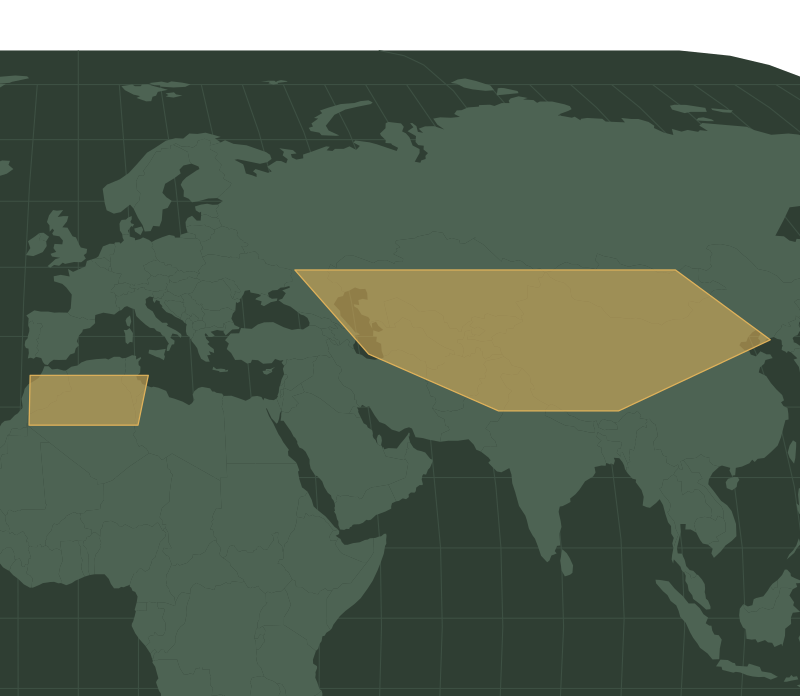
- Arid regions; mainly in China
- Part used
- The dried stems
- Active principles
- Ephedrine, pseudoephedrine and other alkaloids
- Onset and duration
- No reliable data in the sources consulted
- Who keeps its memory
- Traditional Chinese medicine; also India
Botany
Desert stems
Ephedra, called “ma huang” in China, grows mainly in dry desert environments.1
The Pharmacopoeia of the People’s Republic of China, in its 2020 edition, lists as ephedra the dried stems of Ephedra sinica, E. intermedia or E. equisetina.1
The plant can exceed a metre in height, with a strong smell of pine and an astringent taste.7 The Chinese term “ma huang” is loosely translated as “yellow astringent”, “yellow horsetail” or “yellow hemp”.7
- Family
- Ephedraceae
- Habit
- Shrub of arid regions
- Height
- Can exceed 1 m
- Part used
- Dried stems
Memory and tradition
Five thousand years of “ma huang”
It has been used in traditional Chinese medicine for more than 5,000 years.1 Other reviews speak of around 5,000 years, making it one of the oldest medicinal plants.45
It was originally recorded in the classic herbal of Sheng Nong and has been used as both medicine and food.3
It has been used as a stimulant and anti-asthmatic, and traditionally for colds, bronchial asthma, cough, fever, influenza, headache, oedema and allergies.4
Ephedra and its main alkaloid were perhaps the first remedy of Chinese medicine to see significant use in Western medicine; E. gerardiana was used in India.6
The pure alkaloid, ephedrine, was isolated and characterised by Nagai in 1885; it was then forgotten until Chen and Schmidt rediscovered it in the early 1920s.2 It became a very popular and effective treatment for asthma.2
Over time
Nagai isolates and characterises ephedrine.2
Chen and Schmidt rediscover ephedrine.2
The Chinese Pharmacopoeia lists three species of ephedra.1
Its names
- ma huang
- Chinese: “yellow astringent”
- efedra
- Spanish name, from the genus Ephedra
- Ephedrae herba
- pharmacopoeial name for the dried stems
“Ma huang” refers more specifically to the aerial parts of E. sinica, E. equisetina or E. intermedia.7
Territory and care
A desert shrub
What helps
- Know it for its place in Chinese medicine.
- Do not treat it as a supplement without information.
- Respect the frameworks of use of each tradition.
What it contains
Ephedrine and company
The most common compounds are ephedrine and pseudoephedrine, along with a great diversity of other alkaloids and non-alkaloid compounds.5
Three pairs of stereoisomers are usually considered the active ingredients of ephedra and are known collectively as ephedrines.1
Main alkaloid, isolated in 1885.[2][5]
Accompanying stereoisomer.[5]
The experience
A stimulant with adrenergic action
It is used as a stimulant and anti-asthmatic.4
Its actions on adrenoceptors were classified into alpha and beta effects, a milestone in the history of autonomic pharmacology.2
Research
What has been studied
There are systematic reviews of its traditional use, chemical constituents, pharmacological effects, clinical applications, quality control, toxicology and pharmacokinetics.3
The non-alkaloid components of ephedra could be used in place of ephedrine extracts to treat some diseases, and reasonable use may ensure their safety.1
A randomised, double-blind clinical trial tested a herbal supplement containing ma huang and guarana for weight loss.5
Scope of these dataThere is a great deal of pharmacology and clinical work on ephedrine; the plant as a product has described risks.
With care
What it helps to know beforehand
There is a growing body of evidence of possible risks from misuse or abuse of the plant.7
Reviews devote a section of their own to the toxicity of its alkaloids.1
The resurgence of ephedra as a dietary supplement has brought regulation and debate.7
Studies on the whole plant are lacking.
To follow
Books and related medicines
Sources
Where each piece of information comes from
- Ephedrae herba: a review of its phytochemistry, pharmacology, clinical application, and alkaloid toxicity. Molecules. 2023. pmc.ncbi.nlm.nih.gov/articles/PMC9863261.
- The history of Ephedra (ma-huang). Royal College of Physicians of Edinburgh. rcpe.ac.uk/taxonomy/term/777.
- Ephedrae herba: traditional use, chemical constituents, pharmacological effects, clinical applications, quality control, toxicology and pharmacokinetics. J Ethnopharmacol. 2023. pubmed.gov/36641108.
- A review of Ephedra sinica: traditional uses and pharmacotherapy. pmc.ncbi.nlm.nih.gov/articles/PMC7210547.
- Medicinal and therapeutic properties of Ephedra. Rev Bras Farmacogn. 2022. doi:10.1007/s43450-022-00304-3.
- Chapter on ephedra (ma huang) in Western medicine. Taylor & Francis. taylorfrancis.com.
- Ephedra in perspective: a current review. University of Mississippi. typeset.io/pdf/ephedra-in-perspective-a-current-review-xb92flvhjt.pdf.
- Map APDER, with data from Natural Earth · public domain
- Molecule drawings APDER
Last reviewed: 24 November 2026. If you spot a mistake, write to us at info@apder.org.