

Plant · Piperaceae · Malaysia, South Asia and South-East Asia
Betel
Piper betle L.
A perennial climber with glossy, heart-shaped leaves, central to Hindu culture and to the social and religious ceremonies of Asia. It is the leaf of the paan, in which the areca nut is wrapped.124
Also calledbetel · betel leaf · paan · sirih · betle · Piper betle · Piper betel
- What it is
- Perennial climber of the pepper family
- Territory
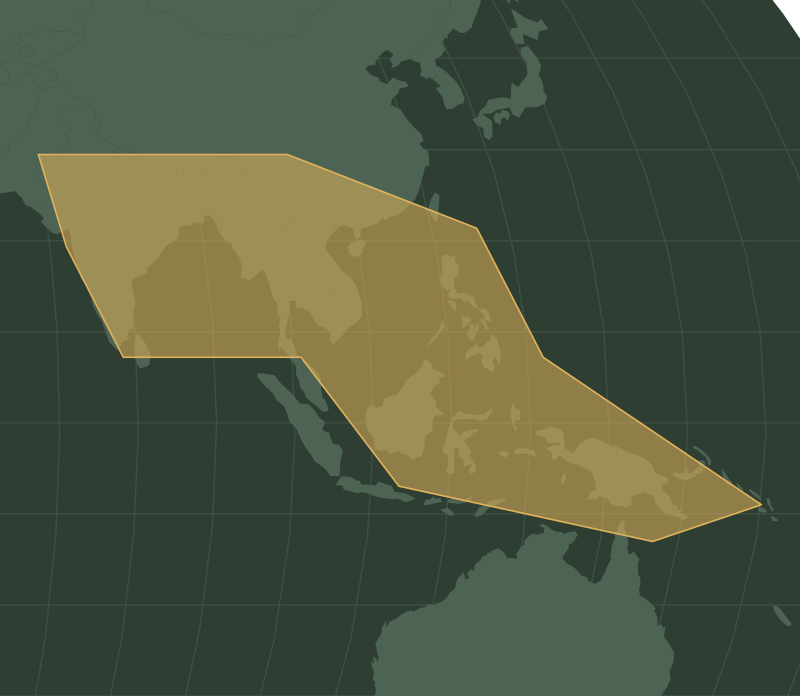
- Originally from Malaysia; spread across South Asia, South-East Asia and East Africa
- Part used
- The leaf
- Active principles
- Hydroxychavicol, chavicol and chavibetol, among others
- Onset and duration
- Not applicable as a plant on its own
- Who keeps its memory
- Many peoples of Asia, with a central role in Hindu culture
Botany
A climber with heart-shaped leaves
Piper betle L. is a perennial climbing plant of the pepper family, native to the central and eastern part of the Malay peninsula and distributed as far as East Africa and the tropics.2
It is a climber with simple, alternate, ovate, heart-shaped leaves of a glossy green.6 It prefers warm, humid climates.6
In India there are between 125 and 150 cultivars of the plant.6
- Family
- Piperaceae
- Habit
- Perennial climber
- Leaf
- Glossy green, heart-shaped
- Part used
- The leaf
Memory and tradition
The paan leaf
The betel leaf and the areca nut play a central role in Hindu culture, where they are used in social, cultural and religious ceremonies.2
The most widespread name for the plant in India, Pakistan, Nepal and Bangladesh is paan.2
Its use appears in many systems of traditional medicine: Indian Ayurveda, traditional Chinese medicine and the folk medicine of the Caribbean and Latin America.2 In Ayurveda, the leaf juice is often used as an adjuvant in herbal combinations.2
In traditional medicine, the leaves are used in Indonesia for vaginal washes, in India and Thailand as a mouthwash, and in Malaysia for dental problems, headaches, arthritis and joint pain.7
There are also uses as a fish poison, bait, insecticide, ornament, oils, perfumes and hallucinogens.2
Over time
The betel quid has been used for a few thousand years.5
Its names
- paan
- India, Pakistan, Nepal and Bangladesh
- sirih
- Malaysia and Indonesia
- phlu
- Thailand
- betel
- English and Spanish name
Names get mixed up between the nut and the leaf: betel is the leaf, not the areca nut.3
Territory and care
A plant of the humid forest
What helps
- Know it for its place in the ceremonies of Asia.
- Tell the betel leaf apart from the areca nut.
- Find out about the risks of the quid before any use.
What it contains
Hydroxychavicol and phenols
Hydroxychavicol is the most important bioactive compound among the phytoconstituents of the leaf's essential oil and extracts.2
Chavicol, chavibetol, hydroxychavicol acetate, allylpyrocatechol, piperbetol, methylpiperbetol and others have also been identified.26
Main bioactive compound of the leaf.[2][4]
Components of the essential oil.[2]
The experience
The mild stimulant of the paan
The leaf is used as a medicinal and recreational plant, almost always with the areca nut.6
The stimulant effect of the quid is associated above all with the arecoline in the nut, not with the leaf.5
Research
What has been studied
There are reviews of its religious and traditional uses, its phytochemical composition and its pharmacological properties.12
A 2022 review of hydroxychavicol indicates that it has antiproliferative activity at micromolar doses on several cancer cell lines.4 That is laboratory research, not treatment.
Another review notes that the extract and the essential oil inhibit the growth of microbes.8
Scope of these dataThere is a great deal of laboratory research and little clinical trial work; the reviews themselves call for more studies.
With care
What it helps to know beforehand
Some studies have pointed to betel leaves as contributing to oral cancer; the leaf is almost always used together with the nut and lime.4
The leaf should not be confused with the areca nut, whose main alkaloid is toxic.3
Effects described in vitro cannot be taken as proven in people.4
There are no clinical trials on the leaf as such.
To follow
Books and related medicines
Sources
Where each piece of information comes from
- Review of the religious, traditional, phytochemical and pharmacological uses of Piper betel. Chin J Integr Med. link.springer.com/article/10.1007/s11655-013-1334-1.
- Betelvine (Piper betle L.): a comprehensive insight into its ethnopharmacology, phytochemistry, and pharmacological, biomedical and therapeutic attributes. J Cell Mol Med. 2022. doi:10.1111/jcmm.17323.
- Wikipedia. «Areca nut». wikipedia.org/wiki/Supari (accessed 24 November 2026).
- Mohamad NA, Abdul Rahman A, Sheikh Abdul Kadir SH. Hydroxychavicol as a potential anticancer agent (review). Oncol Lett. 2022;25(1):34. doi:10.3892/ol.2022.13620.
- Pawar S, Bhane P, Jha U. Review on betel pepper leaf for anti-inflammatory activity. World J Pharm Res. wisdomlib.org.
- Phytochemistry, pharmacological profile and therapeutic uses of Piper betle Linn: an overview. cdn.shopify.com.
- Review of the betel leaf: phytochemical profile, safety and products. pmc.ncbi.nlm.nih.gov/articles/PMC8073370.
- Review of the antimicrobial activity of betel leaf extract. Appl Biochem Biotechnol. 2022. doi:10.1007/s12010-022-03912-w.
- Map APDER, with data from Natural Earth · public domain
- Molecule drawings APDER
Last reviewed: 24 November 2026. If you spot a mistake, write to us at info@apder.org.