

Plant · Solanaceae · South-eastern Europe
Scopolia
Scopolia carniolica Jacq.
A nightshade of the damp beech woods of south-eastern Europe, poisonous because of its tropane alkaloids. It belongs to the group of European “witches’ herbs”, alongside deadly nightshade, henbane, mandrake and thorn apple.24
Also calledscopolia · Carniolan nightshade · Scopolia carniolica · henbane bell · European scopolia
- What it is
- Poisonous nightshade with tropane alkaloids
- Territory
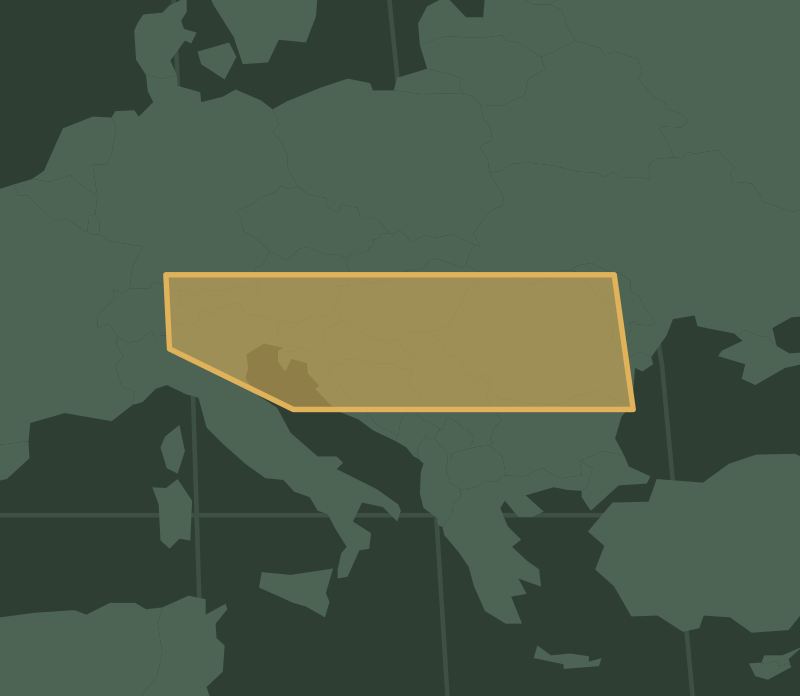
- Damp beech woods between the eastern Alps and the eastern Carpathians
- Part used
- Mainly the root; the leaves also contain alkaloids
- Active principles
- Atropine or hyoscyamine and scopolamine
- Onset and duration
- No reliable data in the sources consulted
- Who keeps its memory
- Folk and medical traditions of central and eastern Europe
Botany
A shade-loving nightshade
Scopolia carniolica is a poisonous plant of the nightshade family, with brownish-purple flowers hanging on long, slender stalks, reaching about 60 centimetres in height.2
It grows in damp soils of beech woods in south-eastern Europe, from the lowlands to mountain areas; it is native to a region running from the eastern Alps to the eastern Carpathians and has become naturalised further east, in south-western Russia.2
Linnaeus described it as Hyoscyamus scopolia in honour of the physician Giovanni Antonio Scopoli, and Jacquin later moved it to the genus Scopolia.2 Mattioli had already mentioned it in 1563 under another name.3
- Family
- Solanaceae
- Height
- Up to about 60 cm
- Flowers
- Brownish-purple, hanging
- Habitat
- Damp beech woods of south-eastern Europe
Memory and tradition
One of the “witches’ herbs”
In Europe, the nightshades with anticholinergic alkaloids, represented by the genera Atropa, Datura, Hyoscyamus, Mandragora and Scopolia, have played an important role in the history of many plant-use customs.4
Their alkaloids made it possible to use them as medicines, as poisons and as intoxicants.4
Scopolia also has a record of medicinal use: in Slovenia it was used for skin problems and in the Baltic countries as an antiparalytic and abortifacient.1
In the early 20th century it was considered official and its root was accepted as a substitute for belladonna to obtain mydriatic alkaloids.3
Over time
Its names
- escopolia
- common name in Spanish
- henbane bell
- English name
- European scopolia
- another English name
The synonymy of the genus is long and came to be applied to plants of other families.3
Territory and care
Between the Alps and the Carpathians
What helps
- Know it as part of Europe’s botanical heritage.
- Do not gather it without knowledge and permission.
- Respect the woodlands where it grows.
What it contains
Tropane alkaloids
Its toxicity comes from its high content of tropane alkaloids, in particular atropine, whose concentration is highest in the root.2
A phytochemical database of the United States Department of Agriculture lists atropine and total alkaloids in the rhizome.5
In a study of folk preparations, the alkaloid content was much higher in the leaves than in the roots, especially that of scopolamine.1
Main alkaloid of the plant, more concentrated in the root.[2]
More abundant in the leaves than in the roots according to a study of folk preparations.[1]
The experience
A delirium, not a vision
These plants are, strictly speaking, toxic and anticholinergic.2 Their alkaloids can cause a strong state of delirium.1
The sources give no reliable data on onset or duration.
Research
What has been studied
There are ethnobotanical studies on the European “witches’ herbs” and laboratory work on how folk preparations extract their alkaloids.14
There is no clinical research to support its use as a medicine of consciousness.
Scope of these dataGood ethnobotanical and chemical documentation; no clinical research.
With care
What it helps to know beforehand
To follow
Books and related medicines
Sources
Where each piece of information comes from
- Pipes and Potions: Testing the Efficacy of European Folk Preparation Methods for Anticholinergic Solanaceae Plants. Plants. 2022;11(1):126. pmc.ncbi.nlm.nih.gov/articles/PMC8747641.
- Wikipedia. Scopolia carniolica. en.wikipedia.org/wiki/Scopolia_carniolica.
- Lloyd JU. Natural history of Scopola carniolica (Jacquin), collected in the Eclectic Materia Medica. henriettes-herb.com/eclectic/lloyd-hist/scopola.html.
- Fatur K. Hexing herbs in ethnobotanical perspective: a historical review of the uses of anticholinergic Solanaceae plants in Europe. Economic Botany. 2020;74:140-158. ui.adsabs.harvard.edu/abs/2020EcBot..74..140F.
- USDA. Phytochemical and Ethnobotanical Databases: Scopolia carniolica. phytochem.nal.usda.gov/plant-scopolia-carniolica.
- Map APDER, with data from Natural Earth · public domain
- Molecule drawings APDER
Last reviewed: 24 November 2026. If you spot a mistake, write to us at info@apder.org.