

Plant · Solanaceae · Europe, western Asia and North Africa
Belladonna
Atropa belladonna L.
A European nightshade with purple bell-shaped flowers and black berries, with a long history as a medicine, a cosmetic and a poison. It belongs to Europe's ‘witches' herbs’ and is a highly dangerous plant that should not be handled lightly.135
Also calledbelladonna · deadly nightshade · devil's cherries · Atropa belladonna
- What it is
- Perennial herbaceous shrub with purple bell-shaped flowers
- Territory
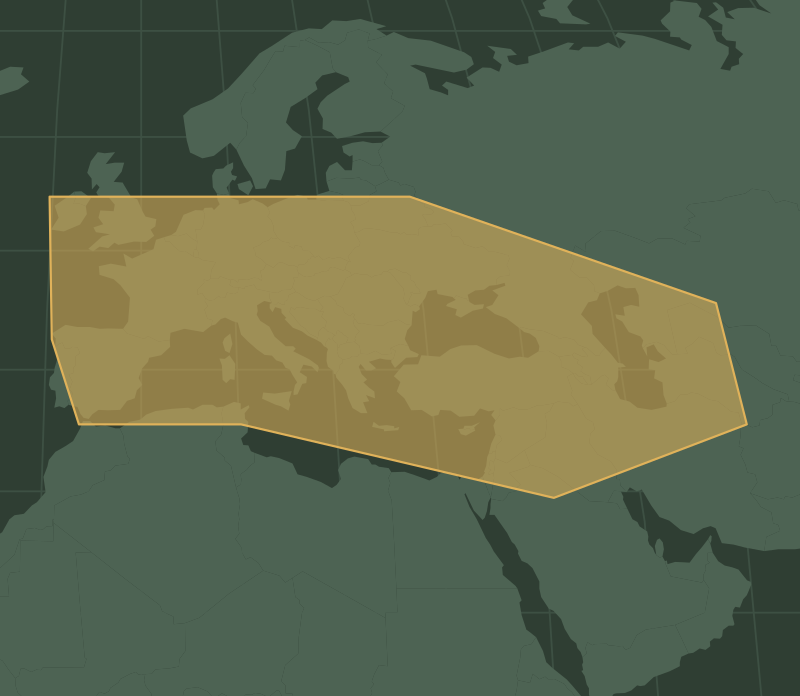
- From southern Europe to Asia; naturalised elsewhere
- Part used
- Leaf, root and fruit, highly toxic
- Active principles
- Atropine, scopolamine and hyoscyamine
- Onset and duration
- Unpredictable; no reliable data
- Who keeps its memory
- Folk traditions of Europe
Botany
A purple bell and a black berry
Atropa belladonna is a perennial, toxic herbaceous plant of the nightshade family, the same family that includes the tomato, the potato and the aubergine.3
It is a medium-sized shrub with dark green leaves and purple bell-shaped flowers.4 The berries are green at first and turn black as they ripen, when the alkaloids develop.6
Its original range ran from southern Europe to Asia, and today it is naturalised in many parts of the world.4
All its parts contain tropane alkaloids and are highly toxic. It is not a plant to handle, taste or identify on your own.
- Family
- Solanaceae
- Habit
- Medium-sized perennial herbaceous shrub
- Flower
- Purple, bell-shaped
- Fruit
- Black berry when ripe
Memory and tradition
The witches' plant
In Europe, the ‘witches' herbs’ (the genera Atropa, Datura, Hyoscyamus, Mandragora and Scopolia) have played a very important role in history and in shaping traditions of plant use.1 Their alkaloids made it possible to use them as medicines, poisons and intoxicants, and they gave rise to a great myth and a wide cultural appreciation.1
Belladonna has a long history of use as a medicine, a cosmetic and a poison.3 Its scientific name was given by Linnaeus.3 Its name means ‘beautiful woman’ in Italian; the story goes that a young Venetian woman used atropine drops to dilate her pupils and beautify her eyes.4
The 2020 study of these plants shows their importance, often misunderstood and vilified.1
Over time
Tropane alkaloids have been known since prehistory.2
Linnaeus gives it the name Atropa belladonna.3
Atropine is prepared in pure crystalline form.5
Its names
- belladonna
- ‘beautiful woman’, from the use of atropine in the eyes
- deadly nightshade
- ‘deadly nightshade’, the English name
- devil's cherries
- popular English name
The popular names stress its toxicity; it is a plant with an image as dark as it is real.7
Territory and care
A plant of woodlands and rubble
What helps
- Look at it and respect it where it grows, without touching the fruit.
- Keep it away from children and animals if it is cultivated.
- Know its history and do not repeat myths about witchcraft as if they were facts.
What it contains
Tropane alkaloids
The foliage and berries contain tropane alkaloids: atropine, scopolamine and hyoscyamine, which produce delirium and hallucinations and are also used as pharmaceutical anticholinergics.3
The alkaloids are concentrated throughout the plant, from the leaf to the root, and are most abundant in the roots.6 They are anticholinergics: they block the transmission of acetylcholine.28
Racemic form of hyoscyamine; dilates the pupil.[4][7]
Potent anticholinergic, with psychoactive effects.[3][4]
One of the plant's main alkaloids.[3][7]
The experience
Delirium, not vision
Belladonna's alkaloids cause delirium and hallucinations.3 The effects of the plant are unpredictable.5
The texts that describe it treat it as a poisoning with delirium, rather than as an experience people seek.13
Research
What has been studied
Atropine and scopolamine are very well studied as anticholinergic drugs.28
Scopolamine is among the essential medicines according to the WHO.8
Scope of these dataThere is a great deal of research on the isolated alkaloids and very little on the whole plant, which is not a therapeutic product.
With care
What it helps to know beforehand
To follow
Books and related medicines
Sources
Where each piece of information comes from
- Fatur K. «Hexing herbs» in ethnobotanical perspective: a historical review of the uses of anticholinergic Solanaceae plants in Europe. Economic Botany. 2020. ui.adsabs.harvard.edu/abs/2020EcBot..74..140F.
- Review of tropane alkaloids and anticholinergic burden. PMC9478010. pmc.ncbi.nlm.nih.gov/articles/PMC9478010.
- Wikipedia. «Atropa belladonna». en.wikipedia.org (accessed 24 November 2026).
- USDA Forest Service. Deadly nightshade, belladonna. fs.usda.gov/wildflowers/ethnobotany.
- Encyclopedia.pub. Atropa belladonna: history. encyclopedia.pub/entry/history/show/82513.
- Evergreen State College. Atropa belladonna. sites.evergreen.edu/plantchemeco/?p=576.
- Fatur K. Belladonna: the witches' plant. Society for Ethnobotany. ethnobotany.org.
- Springer. Tropane alkaloids review. Nat Prod Bioprospect. 2022. link.springer.com/10.1007/s13659-022-00357-w.
- Map APDER, with data from Natural Earth · public domain
- Molecule drawings APDER
Last reviewed: 24 November 2026. If you spot a mistake, write to us at info@apder.org.