

Plant · Leguminosae · Orinoco, Amazonia and Caribbean
Yopo
Anadenanthera peregrina (L.) Speg.
A thorny tree of the savannas and riverbanks of the Orinoco, whose seeds, toasted and ground, become a powder that is blown into the nose. It is one of the best-known visionary snuffs of the Americas, and its ritual use is still alive in communities of the Orinoco and the Amazon.12
Also calledyopo · jopo · cohoba · cojoba · parica · niopo · mopo · nopo · "calcium tree"
- What it is
- Tree whose seeds yield a visionary snuff
- Territory
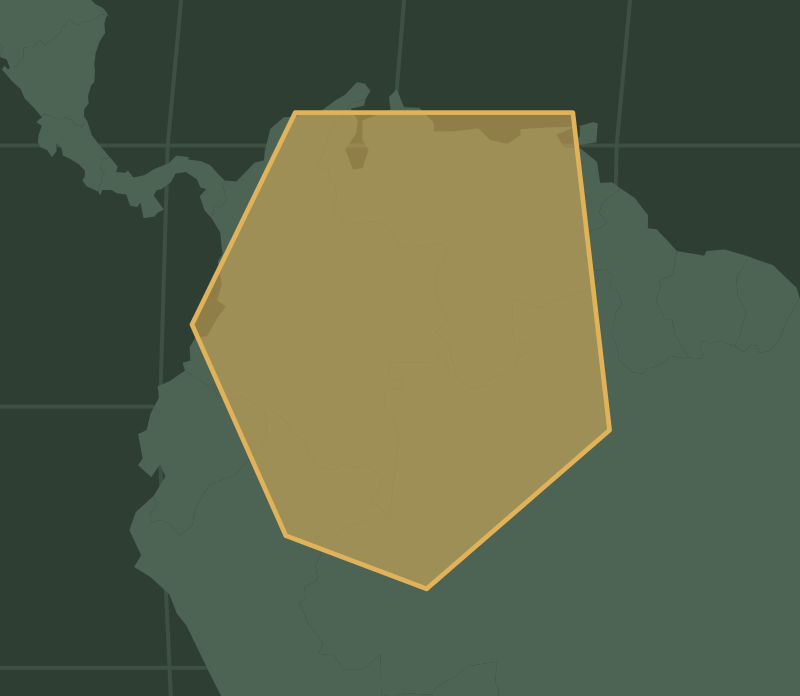
- Orinoco, Amazonia and Caribbean
- Part used
- Seeds
- Active principles
- Bufotenine, with traces of DMT and 5-MeO-DMT
- Onset and duration
- No reliable data in the sources consulted
- Who keeps its memory
- Piaroa, Guahibo, Maipures and other peoples of the Orinoco
Botany
The yopo tree
Anadenanthera peregrina is an evergreen tree native to the Caribbean and South America; it grows up to 20 m tall and has thorny bark.34 Its flowers are pale yellow to white and spherical.5
It is known as yopo, jopo, cohoba, cojoba, parica or "calcium tree".4
It used to be called Piptadenia peregrina, the name under which it appears in much of the classic literature.6
It is closely related to Anadenanthera colubrina, which yields cebil in northern Argentina and whose seeds have a similar chemical composition.25
- Family
- Leguminosae (Fabaceae)
- Height
- Up to 20 m
- Bark
- Thorny
- Part used
- Seeds
Memory and tradition
A snuff from far away
According to ICEERS, its ritual use is still alive in several Indigenous communities, above all in the Orinoco and the Amazon, within complex spiritual systems; its use does not seek recreation, but to restore spiritual, emotional and collective balance.12
The use of yopo is archaeologically documented for more than 4,000 years: radiocarbon dating gave 2130 BC.4 On the central coast of Peru, trays and inhalation tubes similar to those used for yopo were found, dating from 1200 BC.4
In 1801 Alexander von Humboldt described its use among the Maipures of the Orinoco, although he attributed its strength to lime mixed with fermented seeds.1 Half a century later Richard Spruce documented its use among the Guahibo in detail.2
Among the Piaroa, men take yopo with a round tray and Y-shaped tubes made from bird bone.7 The Piaroa include it in their origin myths, and their stories also warn of the dangers of abusing it.8
For centuries the cohoba of the Taíno was thought to be a form of tobacco, until Safford identified it with the snuff of Piptadenia peregrina.1
Over time
Radiocarbon date of Anadenanthera seeds associated with hallucinogenic use
Spanish record of cohoba in Hispaniola
Humboldt describes yopo among the Maipures
Richard Spruce notes its preparation and use (Orinoco)
Its names
- yopo, jopo
- Orinoco (Colombia, Venezuela)
- cohoba, cojoba
- Taíno Caribbean
- niopo, nopo, mopo
- other peoples of the Orinoco
- parica
- Amazonia
Territory and care
Orinoco, Amazonia and Caribbean
What helps
- Know it as the knowledge of peoples of the Orinoco.
- Do not buy powders of uncertain origin.
- Respect the ritual context of those who keep it.
What it contains
Tryptamines in the seed
According to ICEERS, the most abundant compound when administered through the nose is bufotenine (5-HO-DMT), with traces of DMT and 5-MeO-DMT.2
The seeds of A. colubrina have a similar chemical composition, with bufotenine as the main component.5
Harmine, a compound that does not come from Anadenanthera, was detected in a Piaroa snuff.7
The experience
A ritual use, not a recreational one
The sources consulted describe its use as part of healing, social and shamanic contexts.8
They give no reliable data on onset or duration.
Research
What has been studied
The classic ethnobotanical studies by Schultes, Holmstedt and von Reis Altschul identified the plant and its tryptamines.910
There is a study on the combination of yopo with Banisteriopsis caapi among the Piaroa of southern Venezuela.11
Scope of these dataEthnobotanical and chemical study; little clinical research.
With care
What it helps to know beforehand
To follow
Books and related medicines
Sources
Where each piece of information comes from
- ICEERS. Yopo: Basic Info. iceers.org/yopo-basic-info/.
- ICEERS. Yopo: Basic Info (origin and history, chemistry). iceers.org/rape/.
- Wikipedia. Anadenanthera peregrina. en.wikipedia.org/wiki/Anadenanthera_peregrina.
- Wikipedia. Anadenanthera peregrina (archaeology). en.wikipedia.org/wiki/Anadenanthera_peregrina.
- Wikidoc. Anadenanthera peregrina. wikidoc.org/index.php/Anadenanthera_peregrina.
- Schultes, R. E., Lindgren, J.-E., Holmstedt, B. and Rivier, L. Botanical and chemical collections of Anadenanthera peregrina. archive.org/download/biostor-160945/biostor-160945.pdf.
- MAPS. Bibliography: Orinoco snuffs. bibliography.maps.org/resources/download/12242.
- Tripsitter. Psychedelic Snuffs of South America: Yopo, Willka & Epena. tripsitter.substack.com/p/psychedelic-snuffs.
- MAPS. Bibliography: yopo snuff. bibliography.maps.org/resources/download/15073.
- Schultes, R. E. and Hofmann, A., cited in the MAPS bibliography. bibliography.maps.org/resources/download/15073.
- Wikipedia. Cohoba (cites "Snuff Synergy", Journal of Psychoactive Drugs 34 (3): 273–279). wikipedia.com/wiki/Cohoba.
- Map APDER, with data from Natural Earth · public domain
- Molecule drawings APDER
Last reviewed: 24 November 2026. If you spot a mistake, write to us at info@apder.org.