

Plant · Apocynaceae · Tropical Africa
Voacanga
Voacanga africana Stapf
A small tree of tropical Africa, from the same family as iboga, widely used in traditional African medicine and in healing rituals in south-eastern Nigeria. Its seeds contain alkaloids related to ibogaine.123
Also calledvoacanga · Voacanga africana · "seed tree"
- What it is
- Small tree of the Apocynaceae family
- Territory
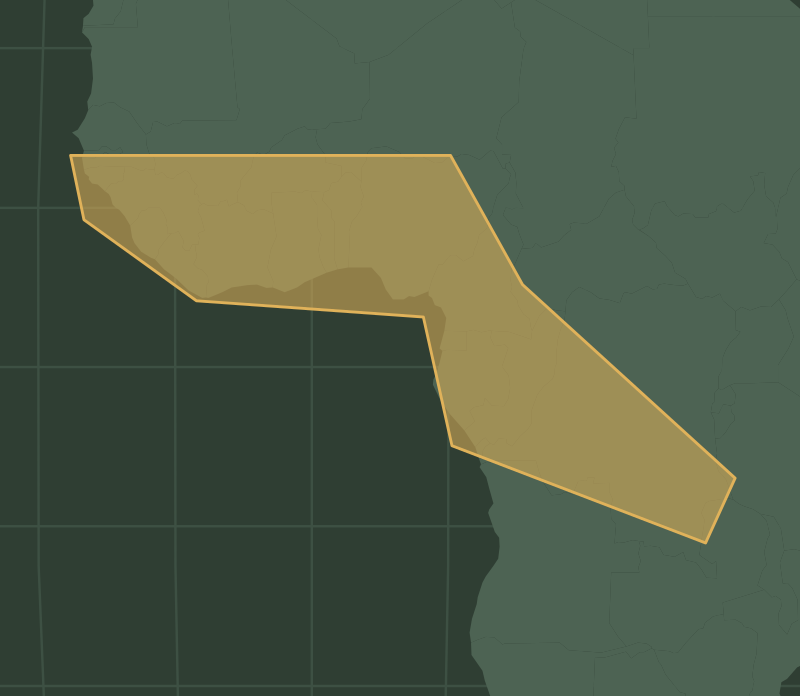
- Tropical Africa, found throughout West Africa
- Part used
- Seeds, bark, leaves and root, depending on the use
- Active principles
- Iboga-type alkaloids: voacangine, tabersonine and others
- Onset and duration
- No reliable data in the sources consulted
- Who keeps its memory
- Peoples of West Africa and south-eastern Nigeria
Botany
A small tree of the African forest
- Family
- Apocynaceae
- Height
- Up to about 6 m
- Leaf
- Up to 30 cm
- Most valued part
- The seed
Memory and tradition
African medicine and ritual
Several parts of the plant are used, but the seeds are especially prized for their economic value, because of the presence of ibogaine, tabersonine and voacangine.12
It is a medicinal plant widely used in many African countries.1
In West Africa it is used to treat leprosy, diarrhoea, generalised oedema, convulsions in children and madness, among other things.4
In south-eastern Nigeria it forms part of numerous healing rituals.5
For a long time it was thought to have little economic use, except as an adulterant of rubber; that changed in 1955, when the French chemists Maurice-Marie Janot and Robert Goutarel extracted from it three alkaloids with possible pharmaceutical uses.3
The various Voacanga species have limited local uses.6
Over time
Janot and Goutarel isolate three alkaloids from V. africana.3
Its names
- voacanga
- scientific name used as a common name
Territory and care
West Africa
What helps
- Know it as an African medicinal plant.
- Do not treat it as a substitute for iboga.
- Respect the knowledge of the peoples who use it.
What it contains
Iboga-type alkaloids
It contains alkaloids such as ibogaine, tabersonine and voacangine, as well as saponins, tannins, terpenes, steroids, flavonoids, phenols, glycosides and oils.12
It contains many alkaloids related to ibogaine, among them some of the only known natural antagonists of the CB1 receptor.3
Voacangine and voacristine are major constituents; dimeric alkaloids predominate in the leaves, and the main monomeric alkaloid is voaphylline.6
Voacamine, voacorine, coronaridine and tabernanthine have also been isolated, among others.7
Main alkaloid of the seed.[1][6]
Present in the seed.[1]
Cited in the seeds by one review; the plant contains related alkaloids.[1][3]
The experience
No reliable data
The sources consulted speak of activity on the central nervous system, with sedative effects.1 They give no reliable data on onset or duration.
Research
What has been studied
A 2024 review gathers its ethnomedical uses, biological activities and toxicity.1 An earlier review records 111 natural products from the genus in 44 references.4
According to a laboratory study, some isolated alkaloids validate the traditional use against onchocerciasis.7
There are no clinical studies of psychoactive use.
Scope of these dataLaboratory studies and reviews; no clinical trials.
With care
What it helps to know beforehand
Some of its alkaloids, such as voacangine and voacamine, show toxicity in animal models: cardiac depressant effect, convulsions, hypertension and depression of the central nervous system.18
It has alkaloids related to those of iboga, but it is a different species and a different tradition.3
Its ritual use is tied to the healing practices of specific peoples.5
Clinical studies are lacking.
To follow
Books and related medicines
Sources
Where each piece of information comes from
- Bekoe EO, Opare JAA, Lartey M, Amoateng P. Ethnomedicinal uses, biological activities, and toxicity of Voacanga africana Stapf ex Scott-Elliot. Advances in Traditional Medicine. 2024. pure.ug.edu.gh/en/publications/ethnomedicinal-uses-biological-activities-and-toxicity-of-voacang-3/.
- Bekoe EO et al. (repository abstract). ugspace.ug.edu.gh/bitstreams/618c6fb6-efda-405d-908f-6f2e33cc60cc/download.
- Wikipedia. Voacanga africana. en.wikipedia.org/wiki/Voacanga_africana.
- Review of the natural products of the genus Voacanga. informahealthcare.com/doi/abs/10.3109/13880209.2012.658478.
- Wikipedia. Apocynaceae alkaloids. en.wikipedia.org/wiki/Apocynaceae_alkaloids.
- PROSEA. Voacanga. prosea.prota4u.org/view.aspx?id=1370.
- Babiaka SB et al. Alkaloids with anti-onchocercal activity from Voacanga africana Stapf (Apocynaceae). doaj.org/article/d98fcf0fe3e74b26922cbd1a7906ebc2.
- Bekoe EO et al. (full record, toxicity). ugspace.ug.edu.gh/items/07502af0-904a-49d3-938f-1e9472d9972e/full.
- Map APDER, with data from Natural Earth · public domain
- Molecule drawings APDER
Last reviewed: 24 November 2026. If you spot a mistake, write to us at info@apder.org.