

Plant · Fabaceae · South-central Andes and neighbouring lowlands
Cebil
Anadenanthera colubrina (Vell.) Brenan
A tree of seasonal dry forests, known as vilca in Peru, Bolivia and Chile and as cebil in Argentina. Its seeds were used for a ritual snuff, of which there are archaeological traces some 4,000 years old.123
Also known ascebil · vilca · willka · wilca · huilca · huilco · wilco · curupay · curupau · angico · Anadenanthera colubrina var. cebil
- What it is
- Dry-forest tree of the legume family
- Territory
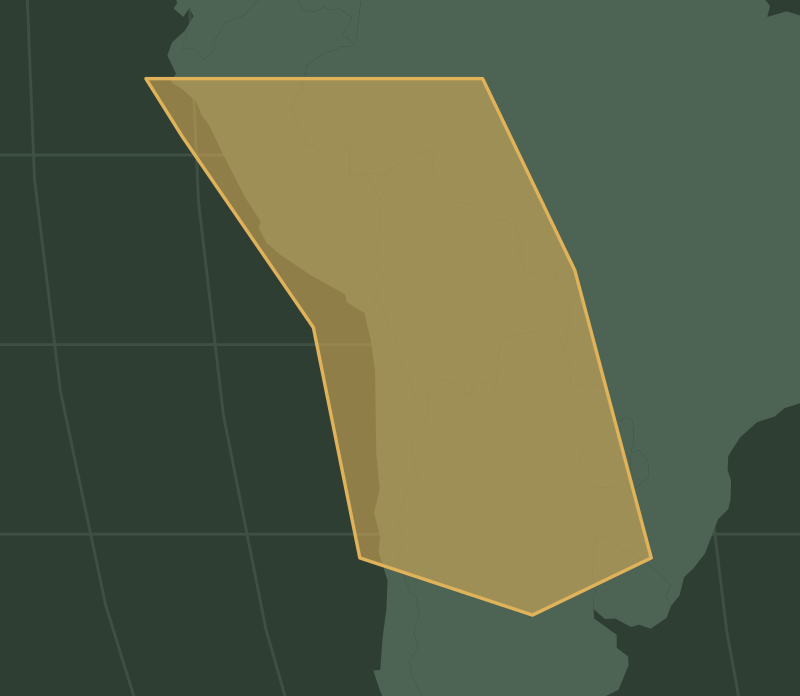
- Seasonal dry forests between 0 and 30 degrees south latitude
- Part used
- The seeds, ground, for a ritual snuff
- Active principles
- Bufotenine, main
- Onset and duration
- No reliable data in the sources consulted
- Who keeps its memory
- Peoples of the south-central Andes, including the Wichí
Botany
A tree of dry forests
Anadenanthera colubrina is a tree of the Fabaceae family, known in many South American countries by numerous names: vilca, huilco, huilca, wilco, willka, curupay, curupau, cebil or angico.2
It lives mainly in seasonal dry forests between 0 and 30 degrees south latitude.1 The cebil variety is known as vilca or willka in Peru, Bolivia and Chile and as cebil in Argentina.1
Its tannin is used in industry to tan hides.2
- Family
- Fabaceae
- Habit
- Dry-forest tree
- Latitude
- Between 0° and 30° south
- Variety
- Var. cebil (Griseb.) Altschul
Memory and tradition
Vilca snuff
The oldest evidence is some 4,000 years old, from archaeological finds of Anadenanthera colubrina var. cebil.1
At pre-Hispanic sites in north-western Argentina, cebil seeds and wood have been recovered, either unworked or used as raw material.1
There is iconographic evidence, in a sculpture from Chavín de Huántar, of the religious importance of vilca, and cebil, which grows east of the Peruvian Andes, is considered the most likely source of the psychoactive snuff of the rituals at Chavín and at centres such as Kuntur Wasi.3 These practices are said to be more than 2,000 years old.3
An archaeobotanical study identified remains of vilca and of Nicotiana at Chavín, the northernmost direct evidence of its pre-Hispanic use in the Andes.5
In north-western Argentina, two mummified bodies found in 1991 at Alero I La Matanza carried a tube containing powdered material, whose analysis sought to confirm its relationship with cebil.4
The Tiwanaku are also believed to have used the ground seeds as snuff, and there are reports of active use by Wichí shamans under the name hatáj.2
Over time
First archaeological finds of Anadenanthera colubrina var. cebil.1
Snuff rituals at Chavín de Huántar and other centres of the Early Horizon.3
Two mummified bodies are recovered at Alero I La Matanza, in north-western Argentina.4
Its names
- vilca / willka
- in Peru, Bolivia and Chile; from Quechua
- cebil
- in Argentina
- hatáj
- name of the snuff among the Wichí
- curupay / angico
- names from the Chaco region and Brazil
In Quechua, "willka" is translated sometimes as "sacred" and sometimes as "grandchild"; the sources do not agree.2
Territory and care
A tree of the Andean dry forest
What helps
- Get to know the tree and its Andean history before any use.
- Do not treat the snuff as a product: it is part of a tradition.
- Respect the peoples who safeguard it, such as the Wichí.
What it contains
Bufotenine
The main active component of vilca is bufotenine.2
Analyses of seeds of A. colubrina var. cebil and of Acacia visco found bufotenine in both, in very different concentrations.6
At a site in the Lípez highlands of Bolivia, chemical traces of bufotenine, DMT, harmine and cocaine were identified, which suggests that at least three plants with those compounds formed part of the shamanic toolkit.7
Main active component of vilca.[2][6]
Identified in traces from an Andean archaeological context.[7]
The experience
What is known from archaeology
The sources consulted mainly describe the ritual context and the chemistry; they give no reliable data on the experience or its duration.13
The experience was understood within collective rituals, with abundant tools for preparing the snuff at Chavín.3
Research
What has been studied
Most of the research is archaeological, ethnographic and chemical.146
Archaeometric studies have demonstrated the consumption of coca, vilca or cebil, and tobacco in the Andes.7
Scope of these dataThere is good archaeological evidence and little research on its effects in people.
With care
What it helps to know beforehand
To follow
Books and related medicines
Sources
Where each piece of information comes from
- Use of cebil (Anadenanthera colubrina var. cebil) in pre-Hispanic and colonial times and in present-day markets in north-western Argentina, Bolivia and southern Peru. proquest.com/docview/3103956020.
- Wikipedia. "Anadenanthera colubrina" (Wilco tree). en.wikipedia.org (accessed 24 November 2026).
- Iconographic evidence of vilca in a sculpture from Chavín de Huántar. academia.edu/3788774.
- Pochettino ML, Cortella AR, Ruiz M. Hallucinogenic snuff from northwestern Argentina: microscopical identification of Anadenanthera colubrina var. cebil in powdered archaeological material. Economic Botany. sedici.unlp.edu.ar.
- Archaeobotanical evidence of vilca and Nicotiana at Chavín de Huántar. repositorio.pucp.edu.pe.
- Gili F, Carrasco C, Niemeyer HM. Vilca, un encuentro de aproximaciones: antecedentes y herramientas para su búsqueda en contextos arqueológicos del centro-sur andino. redalyc.org/pdf/326/32649574007.pdf.
- Archaeometric analysis of shamanic paraphernalia in Lípez, Bolivia. pmc.ncbi.nlm.nih.gov/articles/PMC6561276.
- Map APDER, with data from Natural Earth · public domain
- Molecule drawings APDER
Last reviewed: 24 November 2026. If you spot a mistake, write to us at info@apder.org.