

Plant · Myristicaceae · Upper Orinoco and Rio Negro
Epená
Virola spp.
A snuff that peoples of the upper Orinoco and the Rio Negro, such as the Waika or Yanomami, prepare from the reddish resin of the bark of trees of the genus Virola. Its botanical and chemical identification is a field story spanning several decades.1235
Also calledepená · epena · nyakwana · yakee · yato · parica (in part) · Virola theiodora · Virola elongata · Virola calophylla
- What it is
- Snuff made from the resin of trees of the nutmeg family
- Territory
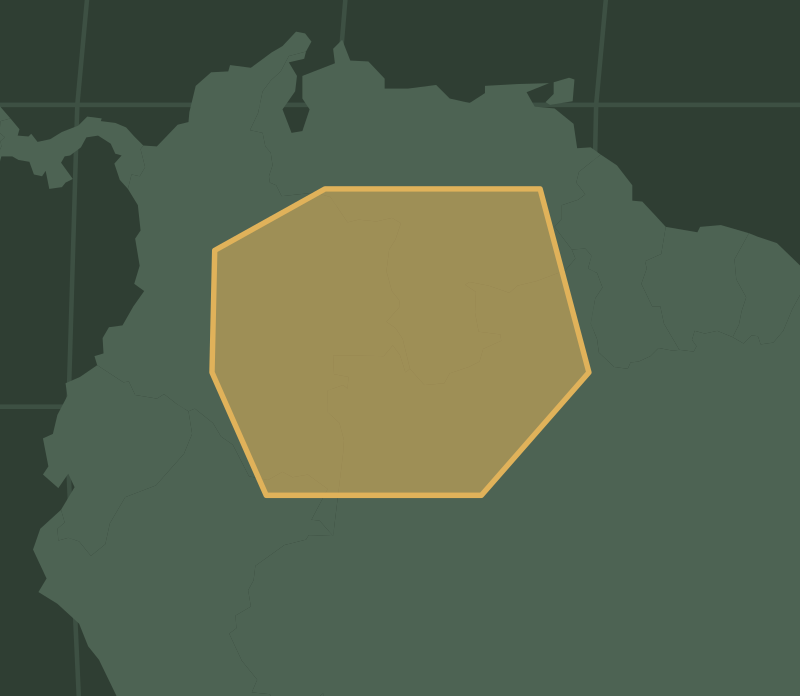
- Upper Orinoco, Rio Negro and neighbouring areas of Venezuela, Brazil and Colombia
- Part used
- The reddish resin of the inner bark
- Active principles
- Tryptamines, including DMT and 5-MeO-DMT
- Onset and duration
- No reliable data in the sources consulted
- Who keeps its memory
- Waika or Yanomami, Puinave and other Amazonian peoples
Botany
Trees of the nutmeg family
Epená is obtained from several species of the genus Virola, trees of the Myristicaceae family.3 These include V. theiodora, V. elongata, V. calophylla and V. calophylloidea.4
The most important species appears to be V. theiodora.2 A detailed ethnotoxicological study from 1968 showed that the Waika groups of the northern tributaries of the Rio Negro, in Brazil, use that species, apparently to the exclusion of others.5
Besides Virola, other plants such as Elizabetha princeps and Justicia pectoralis var. stenophylla are used in the region as snuff ingredients.4
- Family
- Myristicaceae
- Main species
- Virola theiodora
- Part used
- Resin of the inner bark
- Other snuff plants
- Elizabetha princeps, Justicia pectoralis
Memory and tradition
The snuff of the Waika
In Venezuela there are peoples who prepare a very potent hallucinogenic snuff from one of several species of Virola; it is called epena, nyakwana, yakee or yato.2
The Indigenous peoples of the upper Rio Negro use the dried leaves of V. theiodora and V. cuspidata to make a snuff powder they call parica.1
Ducke’s statements appear to be the first identification of this narcotic with Virola.1 When a snuff was mentioned in South America, anthropologists tended to assume automatically that it came from another plant.1
The missionary James Barker offered in 1953 a very detailed discussion of the snuffs of the Orinoco, working mainly with the Waika near the El Platanal mission.1
In the Colombian Amazon and neighbouring Peru, other peoples do not use Virola as snuff, but swallow pills prepared with the reddish resin of the inner bark.2
According to Seitz and Holmstedt and Lindgren, among the Waika Virola snuff is taken in the early afternoon, rarely at night and never in the morning.6
Brewer-Carías and Steyermark documented in 1976 the hallucinogenic snuffs of the Caburiwe-teri Yanomami of the Cauaburi River, in Brazil.4
Over time
James Barker describes the snuffs of the Orinoco among the Waika.1
Schultes and Holmstedt publish the detailed ethnotoxicological study.5
Brewer-Carías and Steyermark document the snuffs of the Yanomami of the Cauaburi River.4
Its names
- epená
- general name for the snuff
- nyakwana
- name of the Waika snuff
- yakee, yato
- other regional names
- parica
- term used for other snuffs of the Rio Negro
Waika, Yanomami or Yanomamö are names of neighbouring peoples that the sources use in different ways.4
Territory and care
The Orinoco and the Rio Negro
What helps
- Know it as part of a living tradition of Amazonian peoples.
- Do not present it as a product.
- Respect the territory and the rules of each people.
What it contains
Tryptamines of the resin
The resin of Virola theiodora is rich in tryptamines; the nyakwana snuff of the Waika contains 5-MeO-DMT and DMT, along with traces of other tryptamines.5
Virola snuff shares the psychoactive activity of snuffs from other sources, such as those made from Anadenanthera.57
Main tryptamine of Virola theiodora snuff.[5]
Present alongside the one above.[5]
The experience
A snuff for ritual use
The sources describe it as a very potent hallucinogenic snuff.2
They give no reliable data on onset or duration.
Research
What has been studied
There is field and laboratory work by Schultes and other researchers on the botany and chemistry of the snuff.25
A multidisciplinary review of South American snuffs covers the ethnobotany, phytochemistry and pharmacology of the snuffs of Virola, Anadenanthera and others.7
Scope of these dataThere is good ethnobotanical and chemical documentation and little clinical research.
With care
What it helps to know beforehand
To follow
Books and related medicines
Sources
Where each piece of information comes from
- Schultes RE. Narcotic use of the genus Virola (chapter). bibliography.maps.org/resources/download/15074.
- Schultes RE. Summary of the use of Virola and other American snuffs. bibliography.maps.org/resources/download/15073.
- Schultes RE, Holmstedt B. Study of the Myristicaceae snuffs of the Waika. Rhodora. 1968;70. archive.org/download/biostor-180813/biostor-180813.pdf.
- Brewer-Carías C, Steyermark JA. Hallucinogenic snuff drugs of the Yanomamo Caburiwe-Teri in the Cauaburi River, Brazil. Economic Botany. 1976. bibliography.maps.org/resources/download/12875.
- Schultes RE. Study of the Myristicaceae used as snuff (tryptamine-rich resin). archive.org/download/biostor-160705/biostor-160705.pdf.
- Erowid. Ayahuasca: alkaloids, plants y analogs, section 3, part 2 (Anadenanthera), citing Seitz and Holmstedt and Lindgren. erowid.org/books_online/ayahuasca_apa/aya_sec3_part2_anadenanthera.shtml.
- De Smet PAGM, Rivier L. Multidisciplinary overview of Piaroa and related snuffs. J Psychoactive Drugs. bibliography.maps.org/resources/download/12242.
- Map APDER, with data from Natural Earth · public domain
- Molecule drawings APDER
Last reviewed: 24 November 2026. If you spot a mistake, write to us at info@apder.org.