

Preparation · Snuff · Taíno Caribbean
Cohoba
Anadenanthera peregrina (seeds)
The powder that the Taíno of Hispaniola inhaled in ceremonies to communicate with their deities, the zemís. Fray Ramón Pané described it around 1498 in the first written account, and archaeology has confirmed, in Puerto Rico, traces of starch compatible with cojoba seeds.123
Also calledcohoba · cojoba · cojóbana · kohobba · Taíno snuff · Anadenanthera peregrina
- What it is
- Ceremonial snuff made from seeds, with tubes and trays
- Territory
- The Antilles: Hispaniola, Puerto Rico, eastern Cuba, Jamaica
- Part used
- Cojoba seeds
- Active principles
- Bufotenine and DMT, according to analyses of the tree
- Onset and duration
- No reliable data in the sources consulted
- Who keeps its memory
- Taíno and their descendants
Ingredients
Cojoba powder
The seeds of Anadenanthera peregrina were used as snuff, inhaled through a Y-shaped wooden tube.3
Fernández de Oviedo (1556) described a hallucinogenic tree of the Taíno; Safford (1916) identified it as Anadenanthera peregrina.2
Sauer (1966) noted that cojóbana, A. peregrina, was used as a narcotic snuff mixed with tobacco and was probably introduced from South America.2
A taxonomic confusion led to another legume with no narcotic potential being mistaken for A. peregrina in the literature.2
Historical entry; it includes no preparation instructions.
- Origin
- Cojoba seeds
- Use
- Inhaled as snuff
- Implements
- Wooden tubes, trays
- Context
- Taíno ceremony
Memory and tradition
The ceremony of the zemís
During Columbus's second voyage (1493–1496), the admiral remarked on a mysterious “powder” that the Taíno “kings” of Hispaniola inhaled and with which they lost consciousness.4
Columbus commissioned fray Ramón Pané to study Taíno customs; Pané wrote that the buhuitihu, or shaman, takes a powder called cohoba, which intoxicates him until he does not know what he is doing.4
In his Relación, Pané describes cohoba as a powder that makes them “purge” a great deal, according to a university compilation.2
In that ceremony, the Taíno sat in a circle to communicate with their deities.2
It has been suggested that ritual specialists also used it in healing, especially to diagnose illnesses through visions.3
A Taíno guaiacum-wood zemí used as a cohoba stand, probably from Hispaniola, has been dated to between 974 and 1020 AD.5
There are objects associated with these ceremonies, such as stands for the powder and sticks used to induce ritual vomiting.6
Over time
Taíno zemí serving as a cohoba stand (dating of the object)
Cojoba starch grains on a coral grinder in Puerto Rico
Columbus and Ramón Pané describe the powder
Its names
- cohoba, cojoba
- Taíno
- cojóbana, kohobba
- variants used by chroniclers
- yopo
- name in South America
For centuries cohoba was believed to be a form of tobacco, until Safford identified it with the snuff of A. peregrina.4
Territory and care
The Antilles
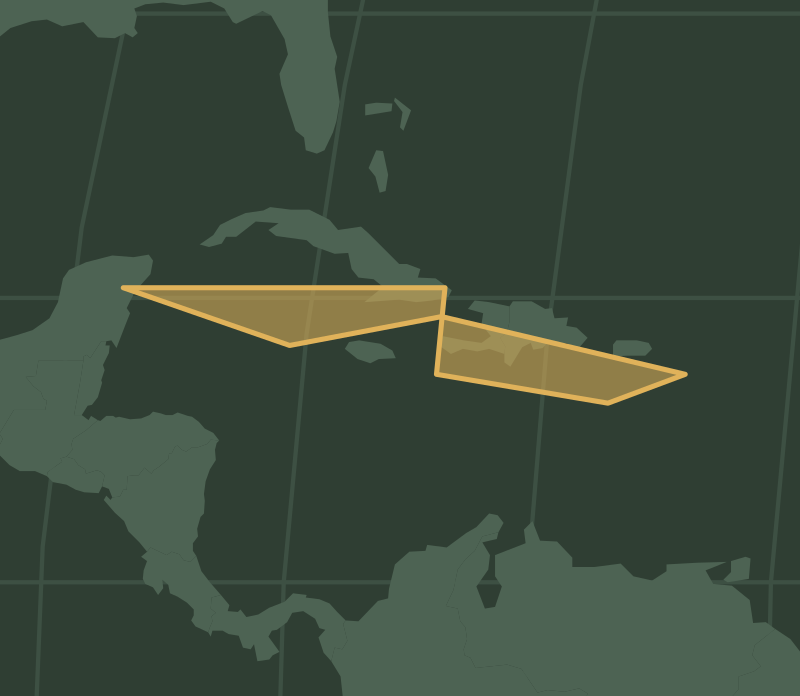
The Taíno occupied Hispaniola, Puerto Rico, Jamaica, the Bahamas and eastern Cuba.7
The native range of the tree includes Puerto Rico, Hispaniola and parts of the Lesser Antilles, according to Kew.5
Archaeological remains of the use of Anadenanthera appear in Argentina, Brazil, Chile, Colombia, Costa Rica, the Dominican Republic, Haiti and Peru.4
What helps
- To learn about Taíno history.
- To support the memory of the Taíno descendants.
- Not to treat the powder as a commodity.
What it contains
Bufotenine and DMT
Cojoba and its seeds contain DMT, according to the National Museum of Trinidad and Tobago.6
In the tree, the dominant alkaloid in the seed is usually bufotenine (5-HO-DMT); DMT is variable or lower in many analyses.5
Preclinical work has been done on molecules, not on the tree or the snuff; no controlled human study characterises the powder in its ritual context.5
The experience
No reliable data
The chronicles speak of loss of consciousness, purging and communication with the zemís.24
There are no reliable data on onset or duration.
Research
What has been studied
It has been studied through archaeology, ethnohistory and botany, including archaeobotanical finds in Puerto Rico.89
There are no clinical studies of the powder.5
Scope of these dataArchaeology and ethnohistory; no clinical research.
With care
What it helps to know beforehand
To follow
Books and related medicines
Sources
Where each piece of information comes from
- Kaye, Q. Intoxicant use in the prehistoric Caribbean with particular reference to spouted ceramic inhaling bowls. student-journals.ucl.ac.uk/pia/article/86/galley/126/view.
- University of Puerto Rico at Mayagüez. A study of the cohoba ceremony. scholar.uprm.edu (document in repository).
- Wikipedia. Cohoba. en.wikipedia.org/wiki/Cohoba.
- Erowid. The Entheogenic Legumes. erowid.org/dmt/dmt_culture1.shtml.
- LILA visionary.art. Anadenanthera peregrina. visionary.art/pharmakon/plants/anadenanthera-peregrina/.
- National Trust of Trinidad and Tobago. Communicating with spirits, getting high. nationaltrust.tt/wooden-artefacts-cohoba-ceremony/.
- Smarthistory. Taíno: natives of the Caribbean. smarthistory.org/?p=44648.
- Pagán-Jiménez, J. R. Archaeobotanical finds of cojoba in Puerto Rico. cambridge.org/core/journals/latin-american-antiquity.
- Meijer, J. From the Grave into the Spirit World (thesis, Leiden University). studenttheses.universiteitleiden.nl.
- Map APDER, with data from Natural Earth · public domain
- Molecule drawings APDER
Last reviewed: 24 November 2026. If you spot a mistake, write to us at info@apder.org.