

Plant · Dogbane family · Central African rainforests
Iboga
Tabernanthe iboga Baill.
A shrub of the Central African rainforest whose root bark is, for the Bwiti of Gabon, a sacrament of initiation. Ever since a naval doctor took it to France in 1864, it has remained one of the most delicate medicines.348
Also known asiboga · iboga root · iboga tree
- What it is
- Evergreen shrub of the rainforest, with white latex
- Territory
- Gabon and neighbouring countries of Central Africa
- Part used
- The root bark
- Active principles
- Ibogaine and other indole alkaloids
- Onset and duration
- 1–3 h · 24–36 h, with residual effects
- Who keeps its memory
- The Fang and Tsogho peoples, in the Bwiti tradition
Botany
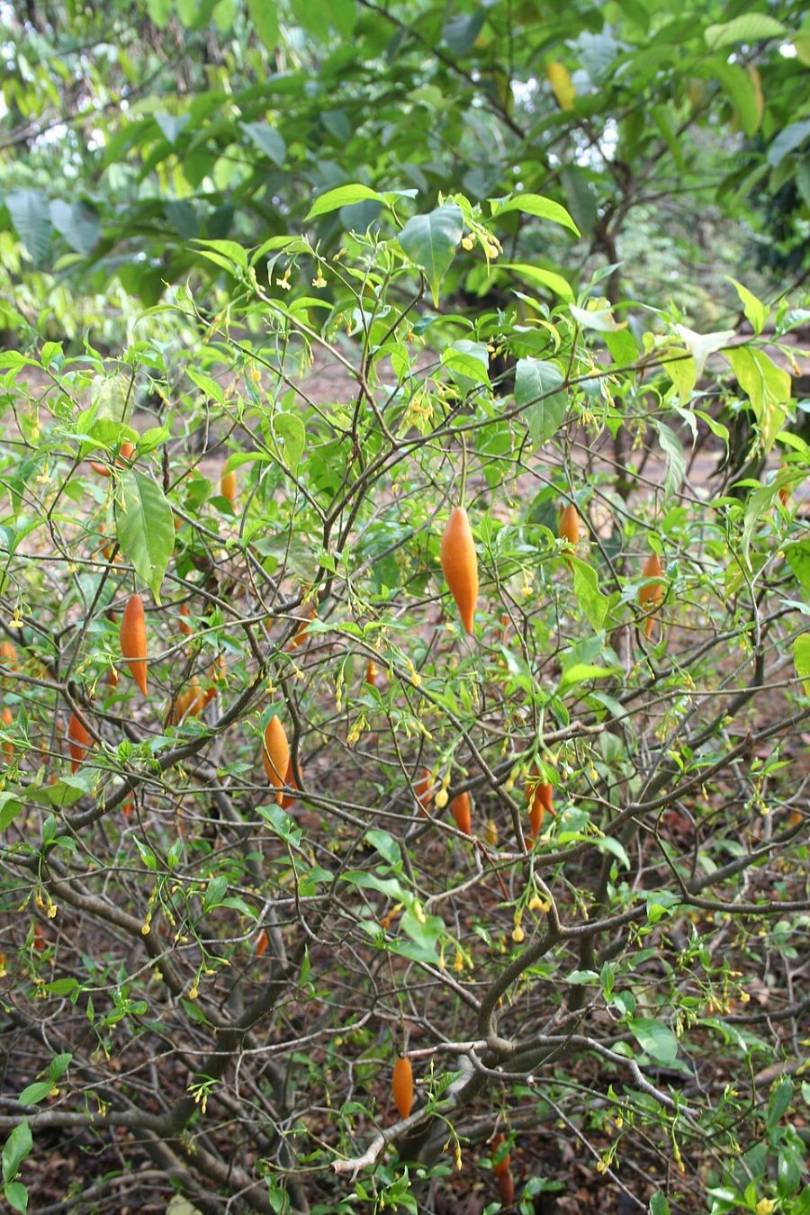
A shrub with orange fruit beneath the canopy
It is a rainforest shrub with narrow green leaves, usually around two metres tall. Given time and good conditions, it can grow into a small tree of up to ten metres.1
Its flowers are tubular, yellowish-white or pink, and give way to elongated fruits that ripen to orange and resemble a chilli.1
The part that is used is the root: its bark concentrates the main alkaloid, tastes very bitter and numbs the mouth and skin. The plant grows in damp soil and partial shade.1
- Family
- Apocynaceae
- Habit
- Shrub of 2 m, sometimes a small tree
- Flower
- Tubular, yellowish-white or pink
- Fruit
- Elongated, ripening to orange
Memory and tradition
The root that joins the living with the ancestors
Bwiti is the initiation tradition of Gabon and neighbouring countries in which iboga is taken. It is said that knowledge of the root passed from the Pygmy peoples of the forest to the Fang and to other peoples of Gabon.45
The ceremonies usually last all night and combine music, costumes and complex rites. For those who practise them, iboga is understood as bound up with the world of the ancestors.67 National Geographic estimates that around five per cent of Gabon's population practise Bwiti.6
Europeans learned of it in the 19th century: in 1864 a French naval doctor, Griffon du Bellay, took samples to France.4 In 1962, Howard Lotsof, a young man dependent on heroin, discovered its effect on withdrawal, and ever since then ibogaine has interested those who research addiction.47
Over time
Griffon du Bellay, a French naval doctor, records the first European report of the use of the root in Gabon and the Congo and takes samples to France.4
Henri Baillon describes the genus Tabernanthe.2
The Fang of Gabon found a syncretic Christian church, Bwiti, which uses iboga in its initiation rites.4
Dybowski and Landrin isolate ibogaine.4
Ibogaine hydrochloride goes on sale in France under the name Lambarène.7
Howard Lotsof reports that ibogaine took away his craving for heroin and his withdrawal.47
The complete synthesis of ibogaine is achieved.4
Its names
- iboga
- from Myene, a language of Gabon
- bwiti
- name of the initiation tradition; iboga is its sacrament
- Fang
- one of the peoples of Gabon who safeguard it
- Tsogho
- another people of Gabon; National Geographic links the name to a Tsogho word meaning "to heal".[6]
The name iboga comes from Myene and passed, with small variations, into other languages of the region.1
Territory and care
A root that travels far from the forest
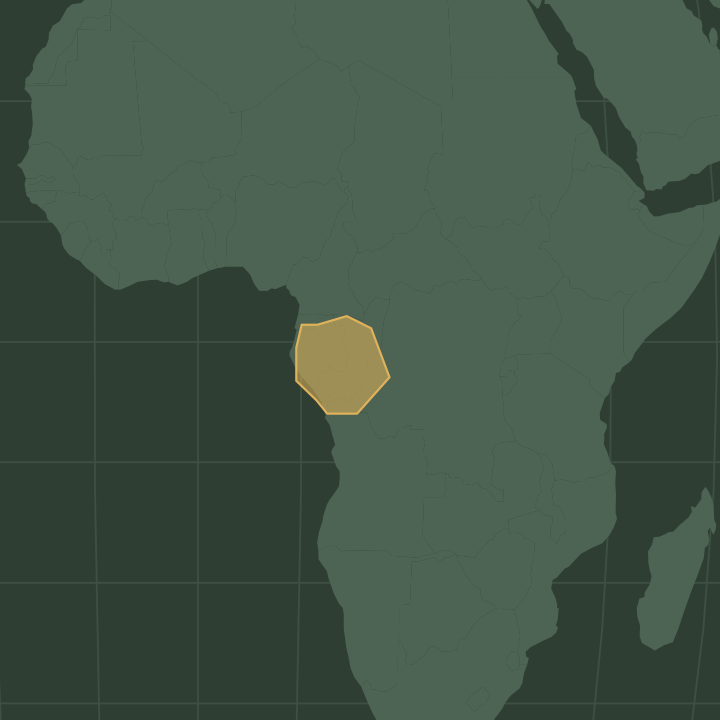
It is native to the forests of Gabon, the Democratic Republic of the Congo and the Republic of the Congo, and is cultivated elsewhere in central Africa.1
According to National Geographic, a good part of the world's ibogaine comes from plants taken from Gabon, and the authorities are seeking a fair and sustainable trade regulation.6
What helps
- Respect iboga as the sacrament of Bwiti, not as a consumer product.
- Ask about the origin of any extract or root before taking its provenance for granted.
- Support the communities that care for it and their participation in any trade.
What it contains
Ibogaine, a molecule that touches many systems at once
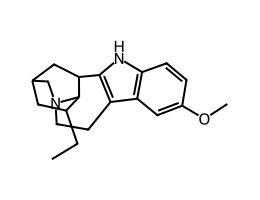
The root bark contains ibogaine and several other alkaloids; indole alkaloids make up around six per cent of the root.13
Ibogaine does not act like the classic psychedelics: it blocks the NMDA receptor and acts on opioid receptors and on the serotonin transporter. The liver converts it into noribogaine, which stays in the body for several days.8
 IbogaineIndole alkaloid · main
It blocks potassium channels in the heart (hERG), which lengthens the QT interval and explains its cardiac risk.[8]
The experience
More than a day
It begins to be felt between one and three hours later and lasts up to a day or more, with residual effects for one to three days: tiredness, insomnia and sensitivity to light and noise.78 The intense phase, lasting around four to eight hours, is usually described as a waking dream, with memories of one's own life passing by like a film.
It is a long and demanding experience, not at all recreational, and so the person needs to be lying down and accompanied from start to finish.
Indicative outline: it changes with the preparation, the amount and the person.
Research
What has been studied
An observational study with twelve months of follow-up in people dependent on opioids saw less withdrawal after a single treatment and less use in the following months.10 Another review of detoxification outcomes reports similar effects, together with frequent relapses.11
In 2024, a study without a comparison group of veterans with traumatic brain injury, treated with magnesium and ibogaine, described improvements in their symptoms.12
Scope of these dataThese are observational studies or studies without a comparison group, carried out under medical supervision. There are no placebo-controlled trials confirming these results, and there is no medicine made from ibogaine or iboga.
With care
What it helps to know beforehand
The heart: ibogaine lengthens the QT interval and can cause serious arrhythmias, including in the days afterwards.89
Electrocardiogram, potassium and magnesium tests and a review of all medication. APDER's guide details who should not take it.8
Medicines that lengthen the QT add their effect on the heart.8 The guide includes an interaction table, with opioids among the most delicate.
For Bwiti it is a sacrament. It is worth knowing that context and treating it with respect.6
To follow
Books and related medicines
 BwitiJames W. Fernandez · 1982In the APDER library →APDER LibraryIboga: The Visionary Root of African ShamanismIboga: The Visionary Root of African ShamanismVincent Ravalec, Mallendi and Agnès PaichelerIn the APDER library →
 IbogaineKenneth R. Alper and Stanley D. Glick (eds.) · 2001In the APDER library →
The main active principle of the root.
PlantVoacanga africanaVoacanga africanaAnother African apocynaceous plant that contains ibogaine.
PlantTabernaemontana undulataTabernaemontana undulataAnother plant of the same family with ibogaine.
PlantTabernanthe ellipticaTabernanthe ellipticaThe other recognised species of the genus, also African.
Sources
Where each piece of information comes from
- Wikipedia. «Tabernanthe iboga». en.wikipedia.org (accessed 24-11-2026).
- Taxonomic revision of the genus Tabernanthe (Apocynaceae). Wageningen Agricultural University Papers 89-4; 1989. edepot.wur.nl.
- ICEERS. Iboga: Basic Info. iceers.org.
- Erowid. Ibogaine timeline. erowid.org.
- Wikipedia. «Ibogaine». en.wikipedia.org (accessed 24-11-2026).
- National Geographic. This psychoactive plant could save lives—and everyone wants to cash in. nationalgeographic.com.
- Berkeley Center for the Science of Psychedelics. Ibogaine. psychedelics.berkeley.edu.
- Koenig X, Hilber K. The anti-addiction drug ibogaine and the heart: a delicate relation. Molecules. 2015;20(2):2208-2228.
- Alper KR, Stajić M, Gill JR. Fatalities temporally associated with the ingestion of ibogaine. J Forensic Sci. 2012;57(2):398-412.
- Noller GE, Frampton CM, Yazar-Klosinski B. Ibogaine treatment outcomes for opioid dependence from a twelve-month follow-up observational study. Am J Drug Alcohol Abuse. 2018;44(1):37-46.
- Brown TK, Alper K. Treatment of opioid use disorder with ibogaine: detoxification and drug use outcomes. Am J Drug Alcohol Abuse. 2018;44(1):24-36.
- Cherian KN, Keynan JN, Anker L, et al. Magnesium–ibogaine therapy in veterans with traumatic brain injuries. Nat Med. 2024;30(2):373-381.
- Iboga (Tabernanthe iboga) with its orange fruit. Marco Schmidt · CC BY-SA 2.5
- Map APDER, with data from Natural Earth · public domain
- Molecule drawings APDER
Last reviewed: 24 November 2026. If you spot a mistake, write to us at info@apder.org.