

Plant · Columelliaceae · Andes and southern South America
Taique
Desfontainia spinosa Ruiz & Pav.
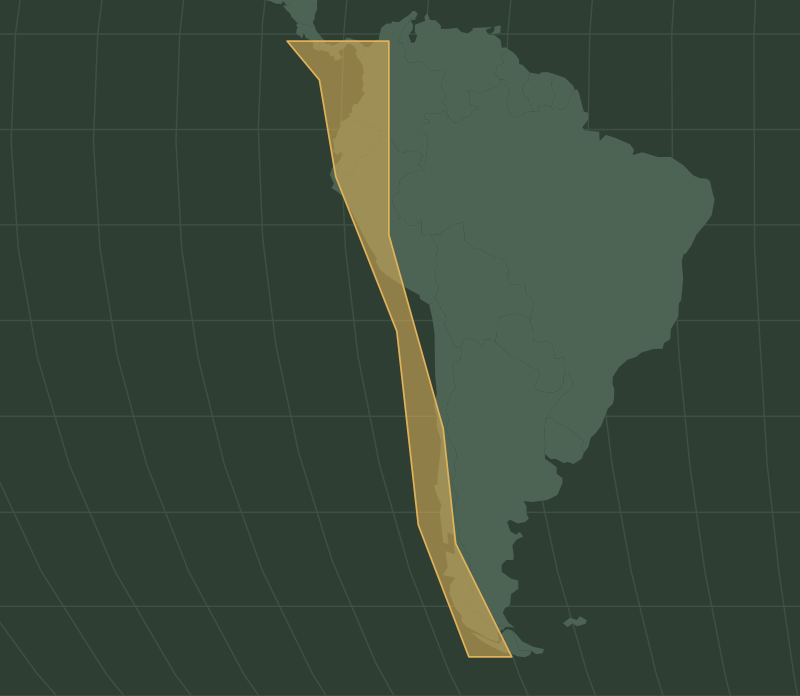
A shrub with glossy, holly-like leaves and red tubular flowers, which grows from Costa Rica to Tierra del Fuego. The shamans of the Sibundoy valley in Colombia make a tea from its leaves in order to dream and see visions, and in Chile it has long been known as a narcotic.123
Also known astaique · chapico · michay blanco · trautrau · borrachera de páramo · Chilean holly · Desfontainia spinosa
- What it is
- Evergreen shrub with holly-like leaves and red flowers
- Territory
- From Costa Rica to Tierra del Fuego, along the Andes
- Part used
- Leaves and fruit
- Active principles
- Unknown
- Onset and duration
- No reliable data in the sources consulted
- Who keeps its memory
- Shamans of the Sibundoy valley and peoples of Chile
Botany
The Chilean holly
Desfontainia spinosa is the best-known species of its genus and is called "Chilean holly" in English; it is native to the forests and mountain slopes of southern Central America and South America, from Costa Rica to some islands of Tierra del Fuego.1
It has glossy dark green leaves like those of holly and waxy red tubular flowers, often with yellow tips, up to 4 cm long; the fruit is a yellowish-green berry of about 1.5 cm.4 In cultivation it grows slowly to about 2.5 m, and in the wild it can be a small tree of about 4 m.4
In the Valdivian forests of Chile and Argentina it grows in the understorey of Nothofagus forests.1
It has been classified in several families: Solanaceae, Gentianaceae, Aquifoliaceae, Loganiaceae and its own Desfontainiaceae; today it is placed in the Columelliaceae.23
- Family
- Columelliaceae
- Height
- Up to about 4 m
- Flowers
- Red, tubular, with yellow tips
- Fruit
- Yellowish-green berry
Memory and tradition
A tea of visions
Carlos Mariani Ramírez reported that it was used as a "narcotic" and a stomach remedy in Chile.2
Later, in Colombia, Schultes found that its tea is or was used to bring on visions and to diagnose illness.2
The shamans of the Sibundoy valley make a tea from the leaves "when they want to dream" or "to see visions and diagnose illness".1
The sources note that the Sibundoy healers were very reluctant to talk about its use and that it is said never to be cultivated.2
In the páramo of Tambillo it is known as "borrachera de páramo"; in Chile also as chapico, michay blanco, taique and trautrau.2
A yellow dye for textiles is obtained from its leaves.2
Over time
Its names
- taique
- Chile
- chapico, michay blanco, trautrau
- other Chilean names
- borrachera de páramo
- páramo of Tambillo
- Chilean holly
- English
Territory and care
From Costa Rica to Tierra del Fuego
What helps
- To know it as a plant of Andean peoples.
- Not to cut it in the wild without need.
- To respect the healers' reserve.
What it contains
Unknown chemistry
Its safety, dosage, toxicity, adverse reactions and active components are unknown.2
Erowid classes it as a plant of unknown effects, with little specific information on its psychoactive use.6
The experience
No reliable data
The sources speak of dreams and visions, without systematic descriptions.12
There are no reliable data on onset or duration.
Research
What has been studied
Relatively little is known about its use.2
There are no clinical studies or published chemistry in the sources consulted.
Scope of these dataAlmost no research.
With care
What it helps to know beforehand
To follow
Books and related medicines
Sources
Where each piece of information comes from
- Wikipedia. Desfontainia. en.wikipedia.com/wiki/Desfontainia.
- Erowid. Ayahuasca: alkaloids, plants & analogs. Section 3, part 3: Desfontainia spinosa. erowid.org/books_online/ayahuasca_apa/aya_sec3_part3_desfontainia_spinosa.shtml.
- Wikiwand. Desfontainia. wikiwand.com/en/articles/Desfontainia.
- Wikiland. Desfontainia. wikiland.org/wiki/Desfontainia.
- Wikipedia. Desfontainia (distribution and dispersal). ipfs.aleph.im/ipfs/QmXoypizjW3WknFiJnKLwHCnL72vedxjQkDDP1mXWo6uco/wiki/Desfontainia.html.
- Erowid. Desfontainia spp. erowid.org/plants/desfontainia.
- Map APDER, with data from Natural Earth · public domain
- Molecule drawings APDER
Last reviewed: 24 November 2026. If you spot a mistake, write to us at info@apder.org.