

Plant · Solanaceae · Andes of South America
Tobacco
Nicotiana tabacum L.
A large-leaved herb, sacred for millennia to many peoples of the Americas, which Columbus took to Europe and which is now one of the most widespread crops. The nicotine it contains creates a very strong dependence.1310
Also known astobacco · leaf tobacco · nicotine · commercial tobacco
- What it is
- Annual herb, 1–2 m tall, with large leaves
- Territory
- Andean origin; now grown all over the world
- Part used
- The leaf, cured and dried
- Active principles
- Nicotine
- Onset and duration
- Seconds if smoked · a few minutes
- Who keeps its memory
- Close to 300 Indigenous peoples of South America
Botany
A hybrid never found in the wild
It is a herb grown each year that reaches between one and two metres. Its large leaves are gathered to be cured and dried.8
Commercial tobacco is not known in the wild. It is believed to have arisen from the hybridisation of Nicotiana sylvestris with N. tomentosiformis, two Andean species, and perhaps N. otophora.811
It has been a human crop for millennia; its origin, together with that of mapacho, is placed in the South American Andes.912
- Family
- Solanaceae
- Cycle
- Annual
- Habit
- 1–2 m
- Origin
- Hybrid of Andean species
Memory and tradition
The plant that almost every American people knew
For millennia, tobacco was one of the most sacred plants for many Indigenous peoples. Wilbert gathered data from close to 300 societies in South America and found six main ways of applying nicotine and several more.12
In ritual use, an acute nicotine intoxication is sought, and the pharmacology of the plant has informed the practices and beliefs of shamanism.2 According to Wilbert, it was not the drug that gave rise to shamanism, but religion that gave meaning to the effects of the drug.2
When Columbus reached Cuba, the Indigenous people offered him tobacco as a gift, and he took it to Spain.10 In 1561, the diplomat Jean Nicot took it to France, and nicotine takes its name from his.10
Over time
Many peoples of the Americas grow it and use it in rites and medicine.1
Columbus receives tobacco as a gift in Cuba and takes it to Spain.10
Jean Nicot takes it to France.10
John Rolfe plants a mixture of N. tabacum varieties in Jamestown.10
Its names
- tobacco
- a word of uncertain origin that Europeans took from the Americas
- nicotine
- from the name of Jean Nicot
- Nicotiana
- the genus, also in honour of Nicot
- commercial tobacco
- the kind in cigarettes, to distinguish it from mapacho
Cigarette tobacco and mapacho are two different species: N. tabacum and N. rustica.19
Territory and care
From the Andes to the world's plantations
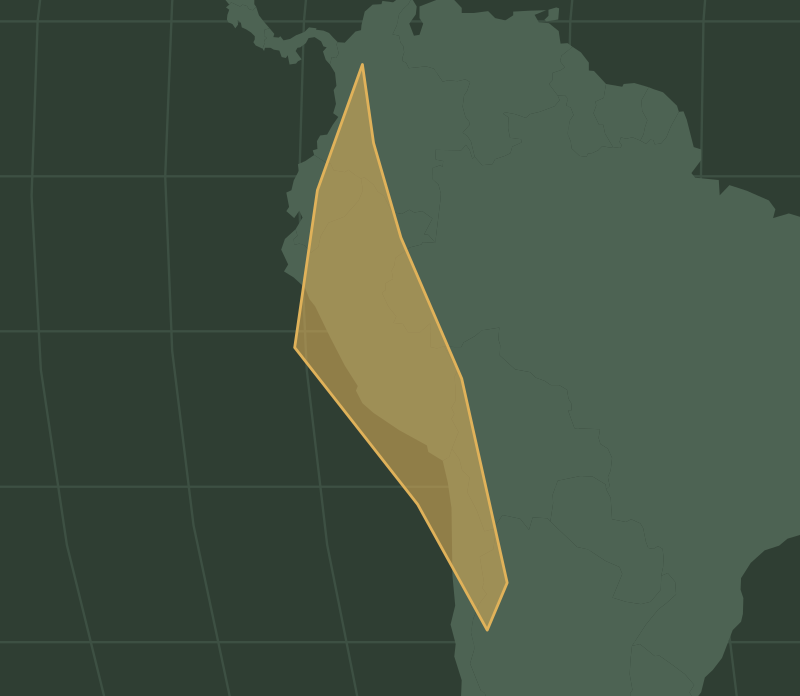
Its origin is placed in the South American Andes.912 From the sixteenth century it spread across the tropics and the world, and became one of the main export crops of the colonies.10
Today it is grown on large plantations. For the Indigenous peoples who keep it, sacred tobacco has nothing to do with the tobacco in cigarettes.
What helps
- To distinguish sacred tobacco from commercial tobacco: it is not the same thing, nor is it used in the same way.
- To support the communities that grow tobacco without additives for their ceremonies.
- To find out about it before using it: its effect on dependence is very strong.
What it contains
Nicotine, which activates acetylcholine receptors
Nicotine activates the nicotinic acetylcholine receptors in the brain and the rest of the body. It releases dopamine in the reward circuits, and that explains its capacity to create dependence.3
It also activates the sympathetic nervous system: pulse and blood pressure rise. Tobacco smoke, not nicotine, speeds up the elimination of some medicines in the liver, and when someone stops smoking their levels can rise.35
Smoked, it reaches the brain in seconds and its effect is short-lived: the body quickly learns to ask for the next one.[3]
The experience
Focus, relief and, sometimes, dizziness
In ceremonial use, tobacco seeks not visions but focus, "cleansing" and grounding. In everyday use, the sensation is one of relief, because it calms the withdrawal from the previous cigarette.13
With little experience, dizziness, pallor, cold sweats and nausea can appear: this is a mild nicotine intoxication.23
Indicative outline: it changes with the preparation, the amount and the person.
Research
What has been studied
A small pilot study, without a comparison group, tested psilocybin alongside therapy for quitting smoking and observed that many participants succeeded.6
A long-term follow-up of those people indicated that a good share remained smoke-free.7
Scope of these dataThese are small studies without a placebo; they do not show that psilocybin helps people to stop smoking. Tobacco, for its part, has no demonstrated therapeutic use.
With care
What it helps to know beforehand
A very strong dependence; with regular smoking, cancer and diseases of the heart and lungs.34
Drunk, or sniffed in liquid form, nicotine is absorbed in large amounts and can cause serious poisoning.1
Smoking changes the levels of some medicines, such as clozapine, olanzapine or theophylline; tell your doctor if you stop smoking.5
Ceremonial tobacco and cigarette tobacco are not the same, either in the plant or in what they imply.1
To follow
Books and related medicines
Sources
Where each piece of information comes from
- Wilbert J. Tobacco and Shamanism in South America. New Haven: Yale University Press; 1987.
- Wilbert J. Does pharmacology corroborate the nicotine therapy and practices of South American shamanism? J Ethnopharmacol. 1991. agris.fao.org.
- Benowitz NL. Pharmacology of nicotine: addiction, smoking-induced disease, and therapeutics. Annu Rev Pharmacol Toxicol. 2009;49:57-71.
- World Health Organization. Tobacco: fact sheet. who.int/news-room/fact-sheets/detail/tobacco.
- Kroon LA. Drug interactions with smoking. Am J Health Syst Pharm. 2007;64(18):1917-1921.
- Johnson MW, Garcia-Romeu A, Cosimano MP, Griffiths RR. Pilot study of the 5-HT2AR agonist psilocybin in the treatment of tobacco addiction. J Psychopharmacol. 2014;28(11):983-992.
- Johnson MW, Garcia-Romeu A, Griffiths RR. Long-term follow-up of psilocybin-facilitated smoking cessation. Am J Drug Alcohol Abuse. 2017;43(1):55-60.
- Wikipedia. "Nicotiana tabacum". en.wikipedia.org (accessed 24 November 2026).
- Encyclopedia.com. Origin and diffusion (tobacco). encyclopedia.com.
- Mark JJ. A brief history of tobacco in the Americas. World History Encyclopedia. worldhistory.org.
- Gray JC, Kung SD, Wildman SG, Sheen SJ. Origin of Nicotiana tabacum L. detected by polypeptide composition of Fraction I protein. Nature. 1974;252:226.
- Haustein K-O. History of tobacco. Springer. rd.springer.com/chapter/10.1007/978-3-662-05256-3_1.
- Map APDER, with data from Natural Earth · public domain
- Molecule drawings APDER
Last reviewed: 24 November 2026. If you spot a mistake, write to us at info@apder.org.