

Plant · Solanaceae · Southern Chile
Latué
Latua pubiflora (Griseb.) Phil.
A shrub from southern Chile, the only one of its genus, which the Mapuche and Huilliche peoples have used since pre-Hispanic times in rituals of medicine and religion. It is a nightshade with tropane alkaloids and is highly toxic.123
Also known aslatué · palo brujo · tree of the witches · latue-hue · Latua pubiflora · Lycioplesium pubiflorum
- What it is
- Shrub of the nightshade family, the only one of its genus
- Territory
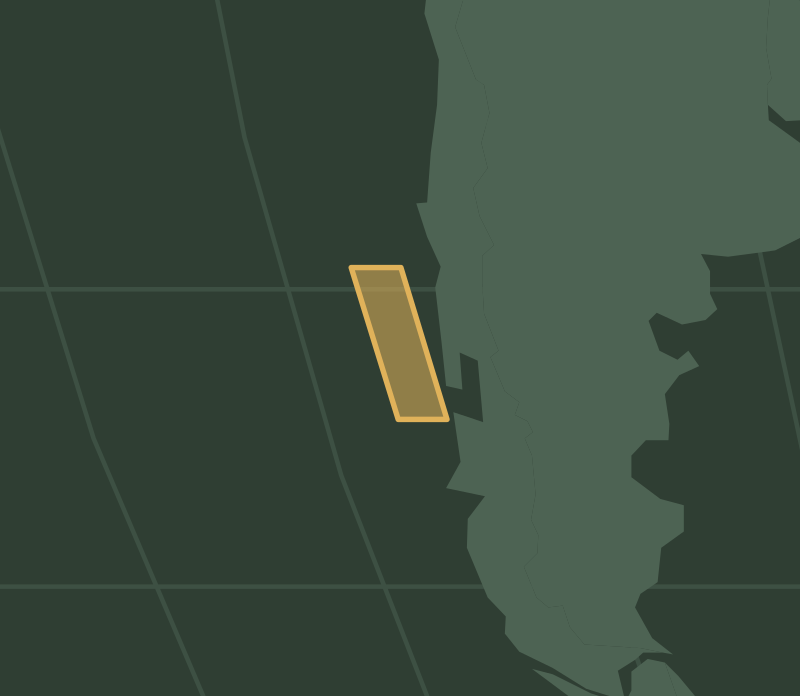
- Coastal Range of southern Chile, from Valdivia to Llanquihue
- Part used
- No reliable data in the sources consulted
- Active principles
- Tropane alkaloids, including scopolamine
- Onset and duration
- No reliable data in the sources consulted
- Who keeps its memory
- Mapuche and Huilliche machi
Botany
The only one of its genus
Latua pubiflora is the only species of the genus Latua, endemic to the coastal mountains of southern Chile.3
It is a shrub or small tree of up to 10 m, with magenta to red flowers pollinated by hummingbirds and a yellow fruit resembling a tomato.3
It grows wild in the Coastal Range, from the Valdivia to the Llanquihue regions, between 500 and 900 m above sea level.2
Grisebach published it in 1854 under the name Lycioplesium pubiflorum.3
- Family
- Solanaceae
- Height
- Up to about 10 m
- Flowers
- Magenta to red
- Fruit
- Yellow, like a small tomato
Memory and tradition
The tree of the witches
The Mapuche have used it since pre-Hispanic times to induce sedative effects and hallucinations in religious or medicinal rituals.2
It plays an important mystical role in Mapuche culture because of its supposed spiritual, sedative and medicinal benefits.1
The machi, Mapuche-Huilliche shamans, use it in traditional medicine, as a poison and to enter trance.3
Its popular name, "latué" in Mapudungun or "palo brujo" in Spanish, literally means "magic stick".2
Anthropological research in Chile shows that nightshades were smoked in ancient rituals, latué among them.1
The genus name comes from the plant's indigenous Mapudungun name, whose oldest variant, now fallen out of use, is latue-hue.3
Over time
Grisebach describes it as Lycioplesium pubiflorum.3
First study of its sedative and anxiolytic effects in animals, with metabolomic analysis.12
Its names
- latué
- Mapudungun
- palo brujo
- Spanish: "magic stick"
- tree of the witches
- Spanish
Territory and care
The Coastal Range
What helps
- Get to know it as a plant of power of the Mapuche people.
- Do not cut or handle it without knowledge.
- Respect the machi.
What it contains
Tropane alkaloids
In plant extracts, 18 tropane alkaloids, 8 phenolic acids and related compounds, and 7 flavonoids were identified.4
The plant's toxicity is due to its content of tropane alkaloids, and in small doses it is a hallucinogenic deliriant.3
It is chemotaxonomically related to other nightshades such as belladonna, thorn apple and henbane.2
Prominent alkaloid in the literature on the plant.[1]
Found alongside the tropane alkaloids.[4]
The experience
Sedation and trance
The sources describe its ritual use to induce sedative effects, hallucinations and trance.23
There are no reliable data on onset or duration.
Research
What has been studied
In 2017, the plant's sedative and anxiolytic effect was assessed for the first time in rats and mice, together with a high-resolution metabolomic analysis.4
The extracts increased sleeping time and altered motor activity in mice; the alkaloid extract reduced flunitrazepam binding in rat cortices.12
There are no studies in people.
Scope of these dataA laboratory study from 2017; no clinical studies.
With care
What it helps to know beforehand
To follow
Books and related medicines
Sources
Where each piece of information comes from
- Sánchez-Montoya EL et al. High resolution UHPLC-MS metabolomics and sedative-anxiolytic effects of Latua pubiflora: a mystic plant used by Mapuche Amerindians. Front Pharmacol. 2017;8:494. pmc.ncbi.nlm.nih.gov/articles/PMC5527703.
- Sánchez-Montoya EL et al. (full text). frontiersin.org/journals/pharmacology/articles/10.3389/fphar.2017.00494/full.
- EPFL Graph Search. Latua (summary of the Wikipedia article). graphsearch.epfl.ch/en/concept/13388189.
- Sánchez-Montoya EL et al. (abstract). frontiersin.org/journals/pharmacology/articles/10.3389/fphar.2017.00494/text.
- Map APDER, with data from Natural Earth · public domain
- Molecule drawings APDER
Last reviewed: 24 November 2026. If you spot a mistake, write to us at info@apder.org.