

Plant · Nitrariaceae · Mediterranean, Middle East and Central Asia
Syrian rue
Peganum harmala L.
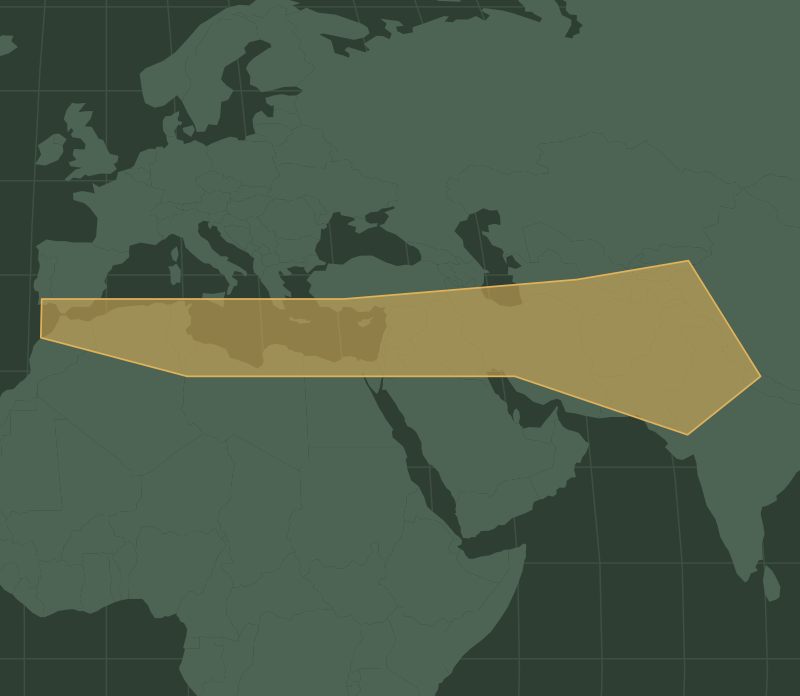
A perennial herb of saline and desert soils, from the eastern Mediterranean to India, used for centuries in the Middle East, North Africa and Central Asia as a ritual, protective and medicinal plant. Its seeds contain β-carbolines that inhibit monoamine oxidase.1234
Also known asSyrian rue · harmal · esfand · espand · harmel · wild rue · African rue · Peganum harmala
- What it is
- Perennial herb of arid zones, with a woody root
- Territory
- From the eastern Mediterranean and North Africa to Iran, Central Asia and India
- Part used
- The seeds, also bark and root
- Active principles
- β-carbolines: harmine, harmaline, harmalol and harmane
- Onset and duration
- No reliable data in the sources consulted
- Who keeps its memory
- Peoples of Iran, Turkey, Central Asia and the Caucasus
Botany
A desert herb unrelated to rue
Peganum harmala is a perennial herbaceous plant with a woody rhizome, of the Nitrariaceae family, which grows in saline soils of temperate and Mediterranean desert regions.1
Its English name comes from its resemblance to rue (Ruta), to which it is not related.16 It is a fleshy plant with narrow, deeply divided leaves and solitary white flowers, which can reach 1 m but usually stays at around 30 cm.2
It is native from the eastern region of Iran westwards to India.3 In the United States it grows as an invasive exotic in several western states.6
- Family
- Nitrariaceae
- Height
- Up to 1 m, usually about 30 cm
- Flowers
- White, solitary
- Part used
- Seeds, bark, root
Memory and tradition
Esfand: protection and medicine
It has been used for centuries in the traditional medicine of Central Asia, the Middle East and the Caucasus, above all as a ritual and psychedelic plant.5
It is very well known in Iran, where its seeds, bark and root are used as folk medicine.4
Among Iranians, the dried capsules, mixed with other ingredients, are burned as an amulet against the ‘evil eye’.4 In Turkey, strings of dried capsules are hung in houses or vehicles against the evil eye.6
It is popular in the folk medicine of the Middle East and North Africa.1
The seeds have been part of the rites of many cultures for thousands of years.7
A red pigment is also obtained from the seeds, which has been used to dye wool and carpets, and it is used as a spice and a traditional aphrodisiac.5
Over time
Its names
- esfand, espand
- Iran
- harmal, harmel
- Arabic and others
- Syrian rue
- Spanish
- Syrian rue
- English
Territory and care
Arid zones of the Old World
What helps
- Know it as a protective and medicinal plant of particular peoples.
- Do not confuse it with common rue or with other plants.
- Respect its cultural context.
What it contains
β-carbolines
The seeds contain β-carbolines: harmine, harmalol and harmane, and harmine is considered the alkaloid with hallucinogenic action.5
The main alkaloids are harmaline, harmine, harmalol and peganine.3
Harmine and harmaline are psychoactive and are potent, reversible, short-acting inhibitors of MAO-A.2
These alkaloids, also present in Banisteriopsis caapi, are the same ones that give ayahuasca its inhibiting base.4
The most studied alkaloid; a reversible inhibitor of MAO-A.[2][4]
An MAO-A inhibitor, alongside harmine.[2]
Main alkaloid cited in reviews.[3]
The experience
An inhibitor, not a vision in itself
The sources describe its alkaloids as psychoactive and as MAO inhibitors.2
There are no reliable data on onset or duration.
Research
What has been studied
There are reviews of its traditional uses and of the pharmacological effects of the whole extract and of its alkaloids, above all harmine and harmaline.45
Harmine is the most studied natural alkaloid.4
Scope of this evidenceMany laboratory studies; few clinical trials.
With care
What it helps to know beforehand
To follow
Books and related medicines
Sources
Where each piece of information comes from
- Wikipedia. Peganum harmala (harmal). en.wikipedia.com/wiki/Harmal.
- Erowid. Syrian rue: basics. erowid.org/plants/syrian_rue/syrian_rue_basics.shtml.
- Wild rue (P. harmala): a review of its traditional medicinal uses and health benefits. link.springer.com/doi/10.1186/s40816-021-00255-7.
- Wild Syrian rue (Peganum harmala): traditional uses and pharmacological effects of the total extract and its alkaloids (review). pmc.ncbi.nlm.nih.gov/articles/PMC3841998.
- Mamedov NA, Pasdaran A, Mamadalieva NZ. Pharmacological studies of Syrian rue (Peganum harmala L., Zygophyllaceae). Int J Secondary Metabolite. 2018;5(1):1-6. dergipark.org.tr/en/download/article-file/336701.
- Wikidoc. Harmal. wikidoc.org/index.php/Harmal.
- BioDiversity4All. Peganum harmala. biodiversity4all.org/guide_taxa/1236612.
- Map APDER, with data from Natural Earth · public domain
- Molecule drawings APDER
Last reviewed: 24 November 2026. If you spot a mistake, write to us at info@apder.org.