

Cactus · Cactaceae · Chihuahuan Desert
Peyote
Lophophora williamsii (Lem. ex Salm-Dyck) J.M.Coult.
Growing flush with the ground, without a single spine, peyote goes unnoticed. For the Wixárika people it is the híkuri, a being that joins maize, the deer and the road to Wirikuta, and its history in the desert goes back more than five thousand years.24
Also calledhíkuri · híkuli · péyotl · tútu · jículi · mescal button
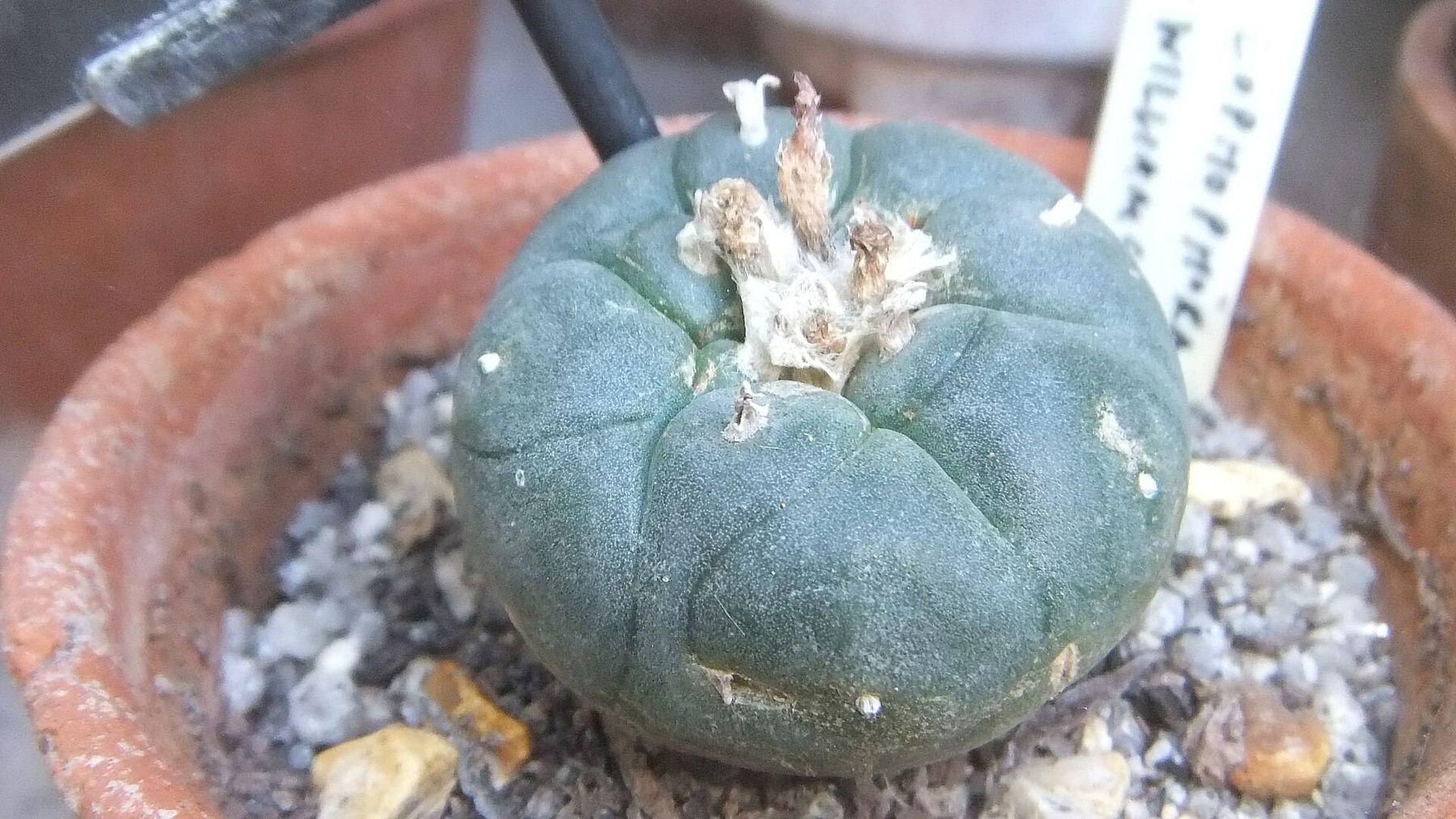
- What it is
- Small, spineless, very slow-growing cactus
- Territory
- Chihuahuan Desert: southern Texas and northern and central Mexico
- Part used
- The head that shows above the ground, the ‘button’
- Active principles
- Mescaline and other alkaloids
- Onset and duration
- 45–90 min · 8–12 h, sometimes more
- Who keeps its memory
- Wixárika, Rarámuri, Cora and the Native American Church
Botany
A blue-grey disc flush with the ground
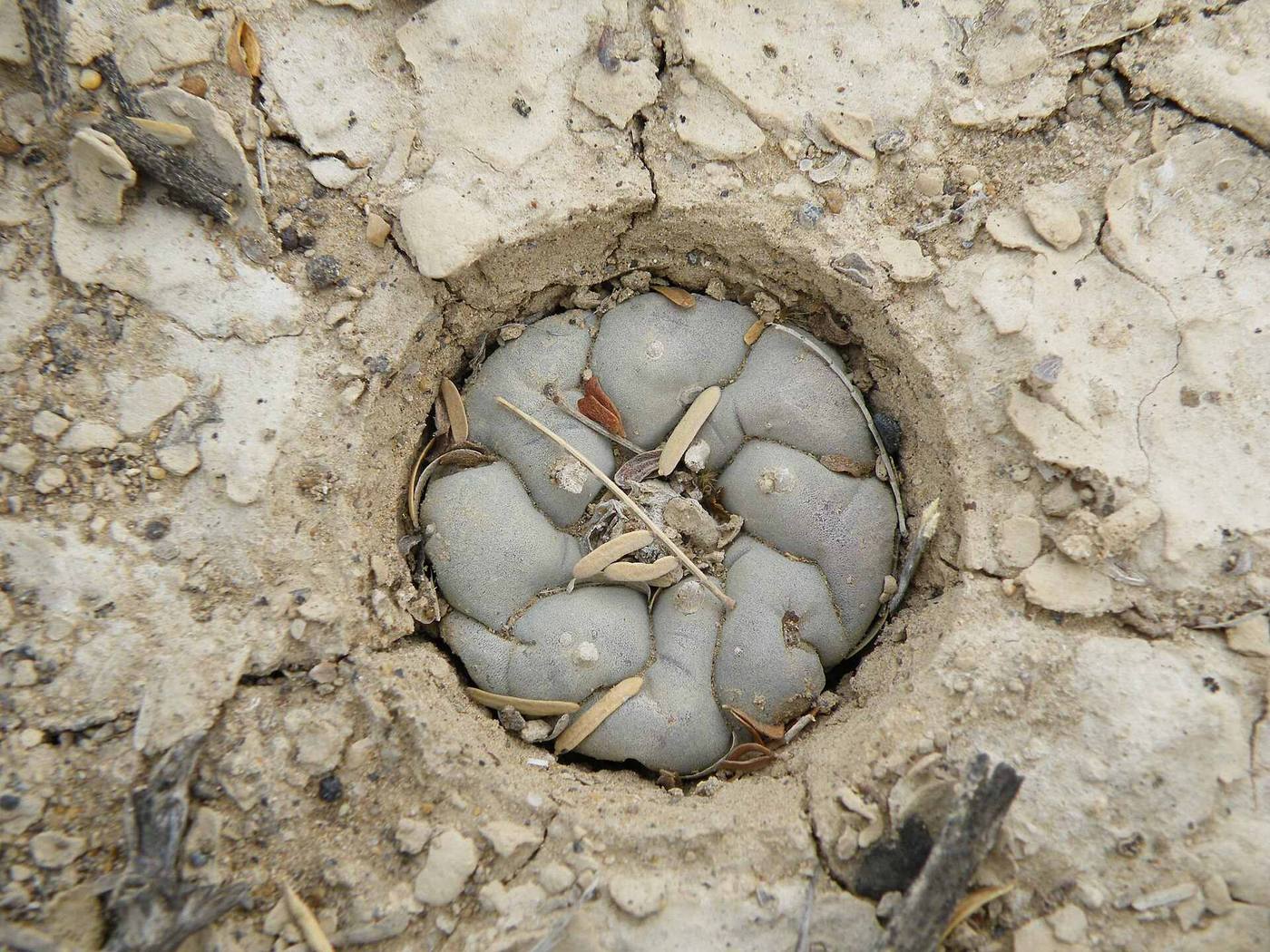
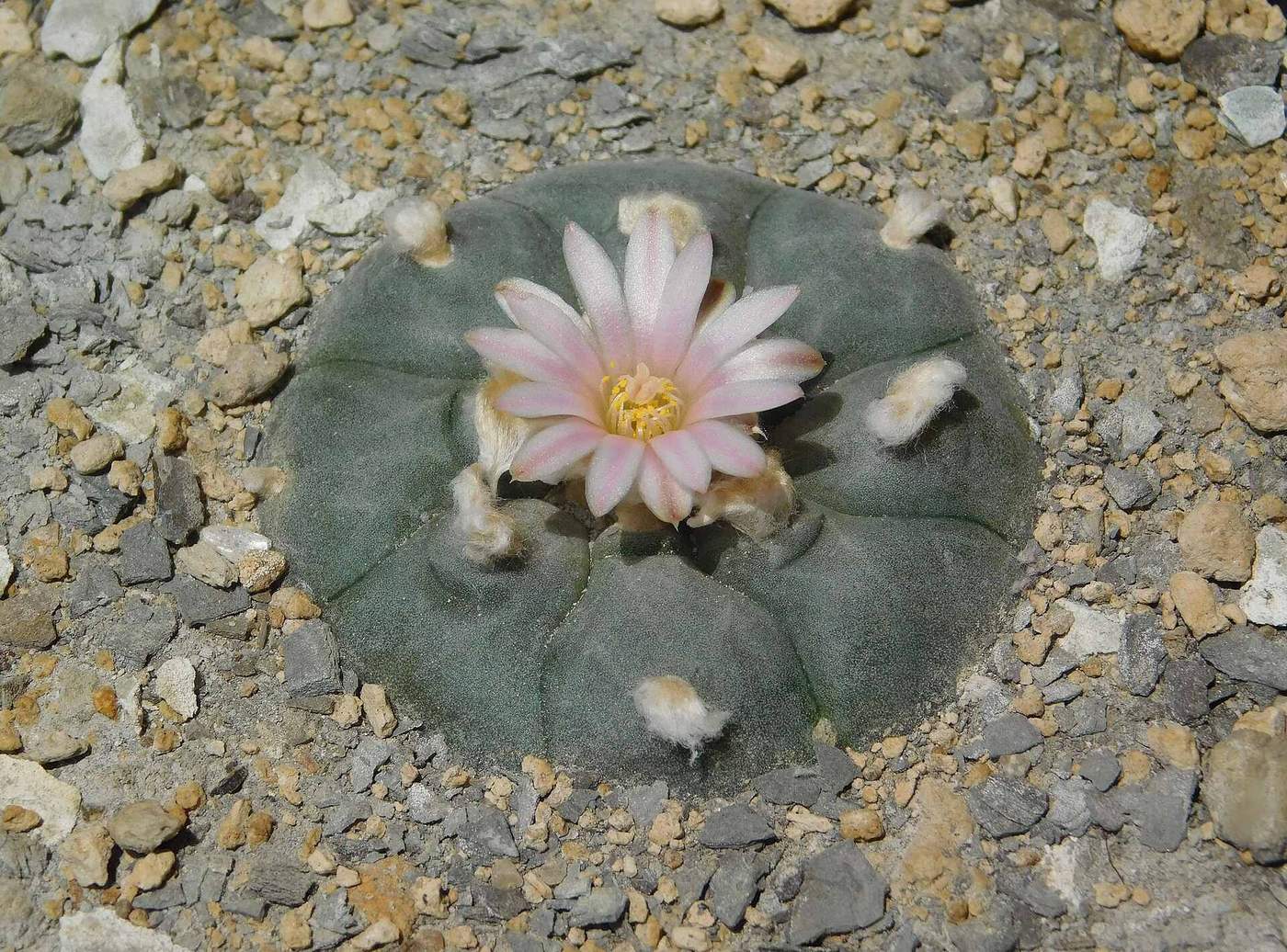
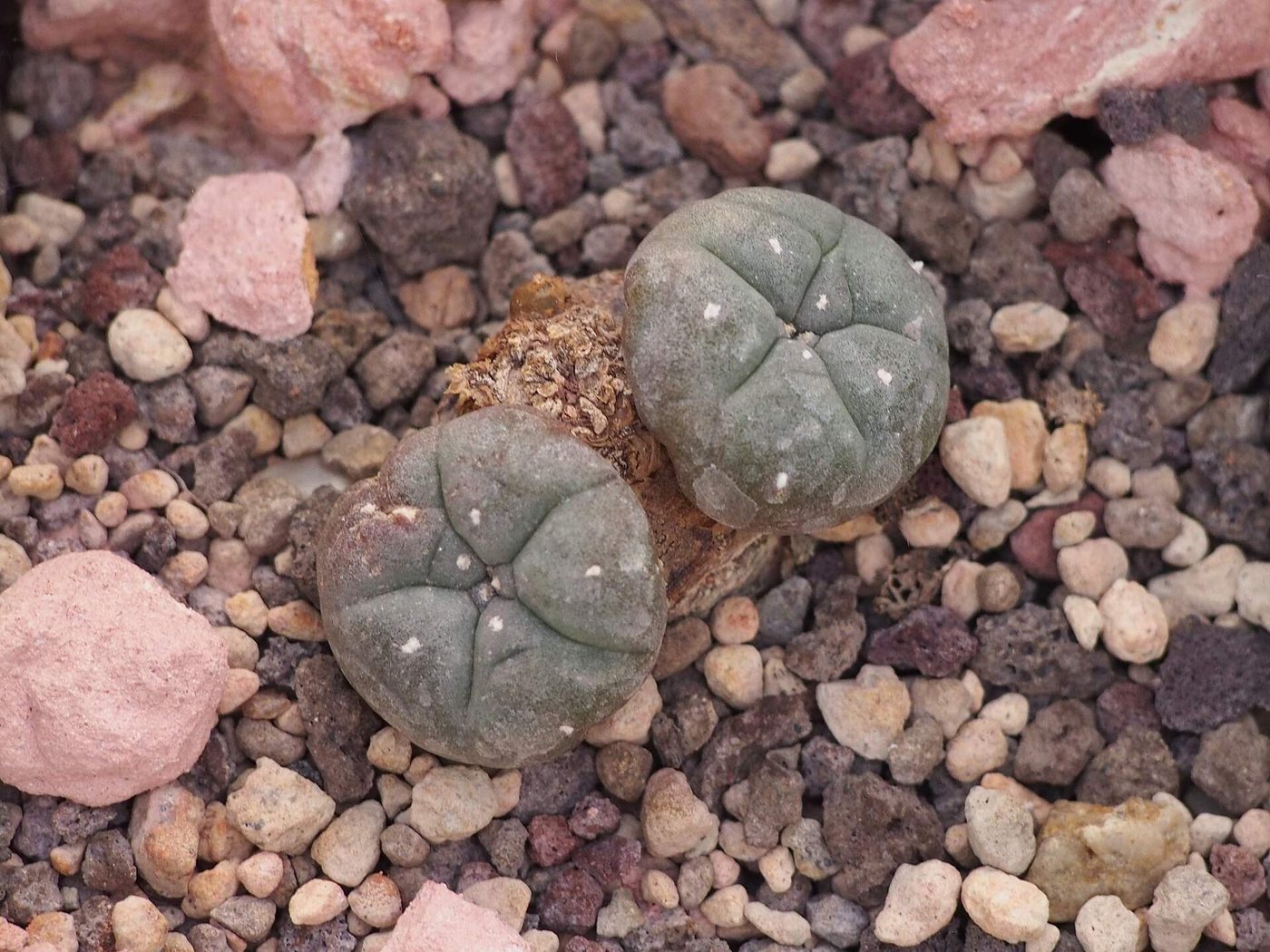
It is a spineless cactus that rarely exceeds twenty centimetres. Almost all that can be seen is a broad, flattened head, with soft ribs and tufts of fine hair at the top. Below, a thick, carrot-shaped root anchors it in the dry soil.3
From its centre grow pale pink flowers of a couple of centimetres that last only a few days, between March and September. Afterwards a club-shaped, pinkish fruit appears, with very small black seeds.3
It is one of the slowest-growing cacti. In cultivation, a plant grown from seed takes about five years to reach harvest size.3
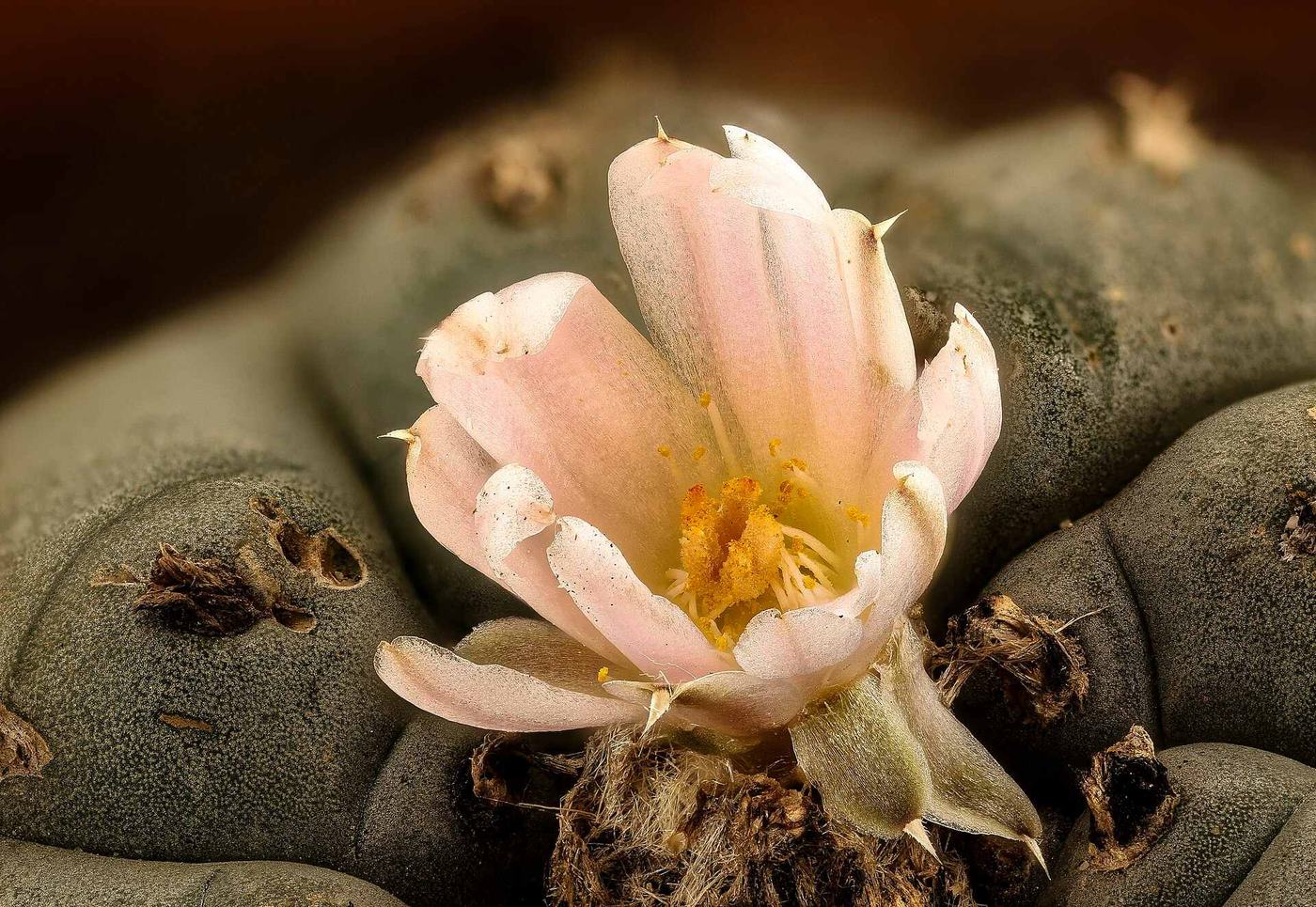
- Family
- Cactaceae
- Habit
- Globular, spineless cactus
- Flower
- Pale pink, in the centre
- Fruit
- Pinkish berry with black seeds
Memory and tradition
The cactus that walks with the deer
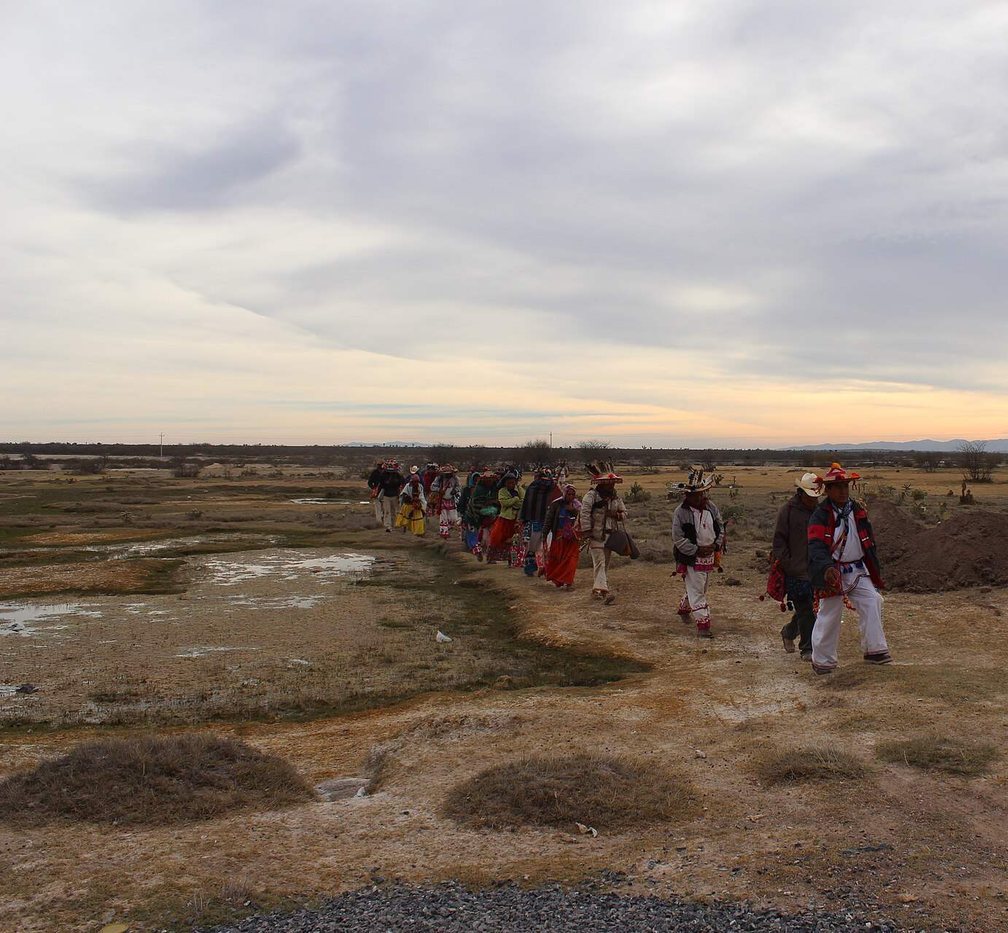
For the Wixárika people, the híkuri is part of a relationship that links maize, the deer and the sacred places of the pilgrimage to Wirikuta, in the San Luis Potosí desert. Those who take part in the ‘Hablemos de Híkuri’ project say that this meaning is learned by walking.4
In a cave in southern Texas, peyote buttons about 5,700 years old have been found, and in a tomb in Coahuila, fragments from between the 9th and 11th centuries that still held alkaloids.23 In colonial times its use among Indigenous peoples was banned and the Inquisition persecuted it.3
The rite spread northwards. In 1918 the Native American Church was founded in the United States, which takes it as a sacrament.11
Over time
Peyote buttons buried in a cave in southern Texas, the oldest that have been dated.2
In a tomb in a cave in Coahuila, fragments of peyote appear with alkaloids still detectable.3
Its use is banned among Indigenous peoples and the Inquisition punishes it.3
Antoine Lemaire describes it as Echinocactus williamsii; in 1894 John Coulter moves it to the genus Lophophora.3
Arthur Heffter isolates mescaline.10
The Native American Church is founded in the United States.11
In Basel, the first modern trials of mescaline in healthy people.67
Its names
- híkuri
- Wixárika
- tútu
- Wixárika: the flower of the peyote
- híkuli
- Rarámuri
- péyotl
- Nahuatl, the language of the Mexica
- huatari
- Cora
- wokowi
- Comanche
- seni
- Kiowa
- ho
- Mescalero Apache
The Wixaritari distinguish several forms of the cactus, and some, such as the one that resembles maize, have a special value for those who guide the pilgrimage.3
Territory and care
A desert, a road and a slow plant
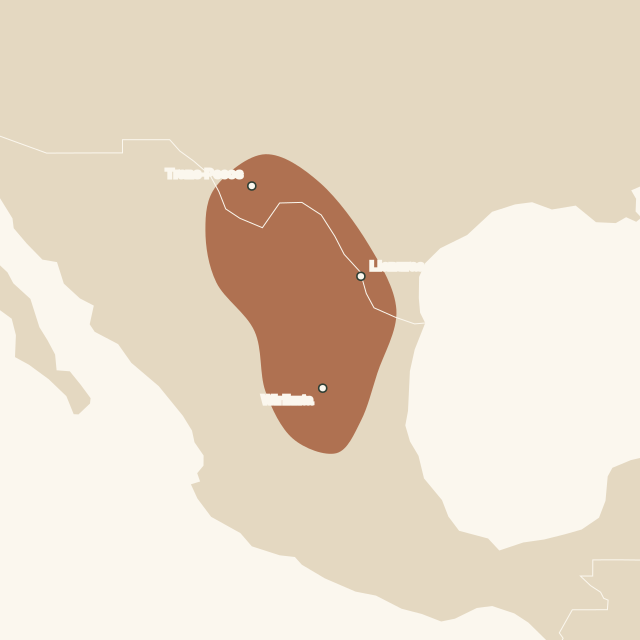
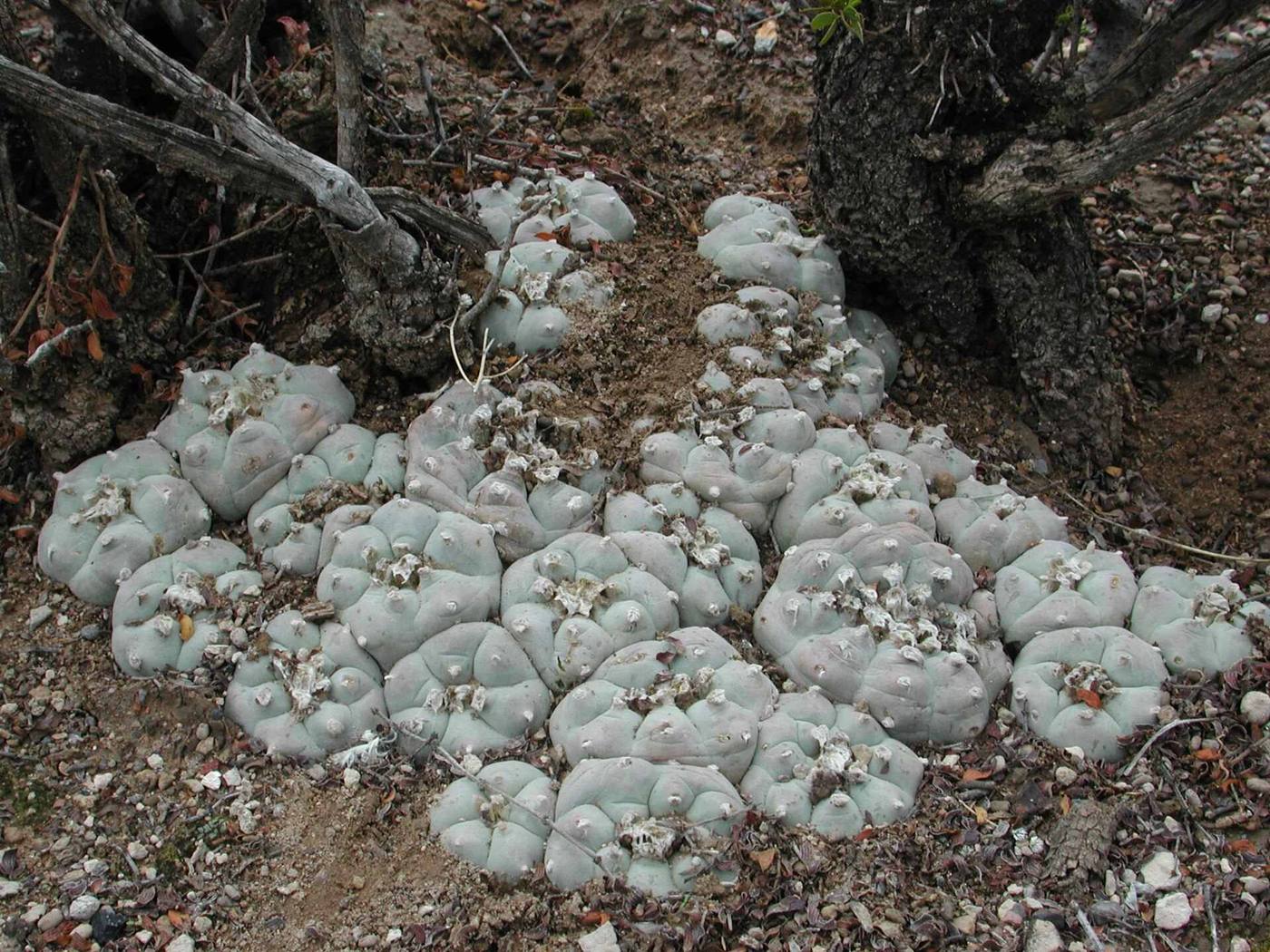
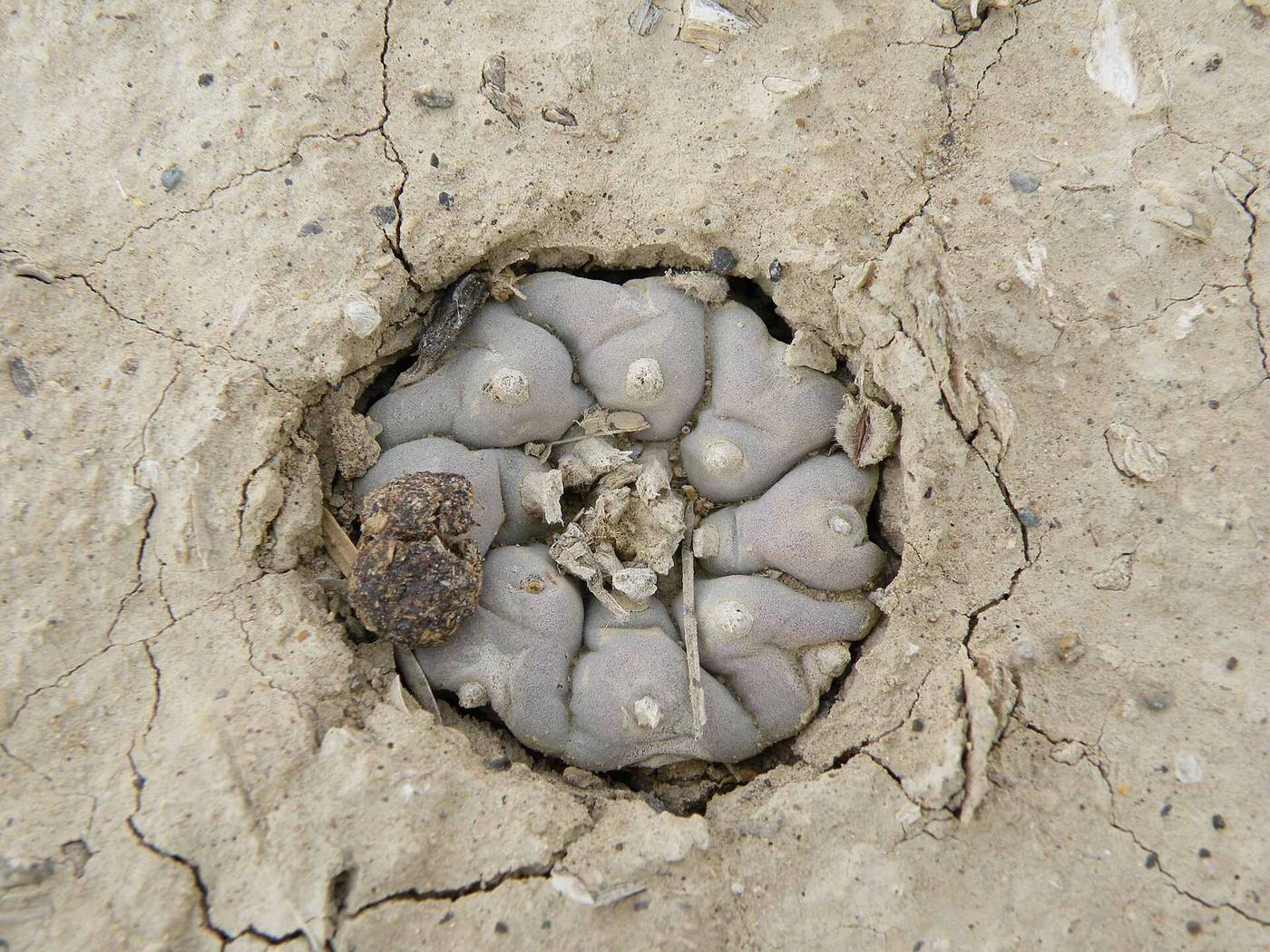
It grows in the Chihuahuan Desert, from southern Texas to central Mexico (Tamaulipas, Coahuila, Nuevo León, San Luis Potosí and Zacatecas), often in the shade of shrubs such as mesquite.13
With growth this slow, harvesting weighs heavily on populations. Within the Wixárika people, the ‘Hablemos de Híkuri’ project arose from a simple observation: each pilgrimage required walking further to find it.4
What helps
- Respect the sacred nature of the híkuri for the peoples who care for it.
- Prefer cultivated plants to wild-harvested ones.
- Support conservation projects led by the communities themselves.
What it contains
Mescaline, the molecule of light
The main active alkaloid is mescaline, a phenethylamine that activates the serotonin 5-HT2A receptor, the same one on which psilocybin and LSD act.67 The cactus contains more than fifty alkaloids in total, but only mescaline has clear psychoactive effects.3
The amount of mescaline varies greatly from one cactus to another, depending on age, cultivation and the part of the plant, which is why clinical trials use pure mescaline of a known dose.10
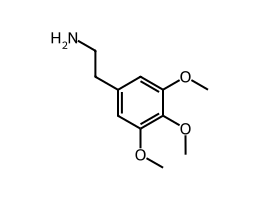 MescalinePhenethylamine · main alkaloid
It activates the serotonin 5-HT2A receptor. In a 2024 trial, a drug that blocks that receptor cancelled almost all of its effects.
The experience
A long day
It begins to be noticed between 45 and 90 minutes and lasts between eight and twelve hours, sometimes more. In trials it is described as an experience similar to that of LSD or psilocybin, with very intense colours, patterns and strong emotions. The main difference is the duration.6
With the cactus, nausea and vomiting are common, especially as the effects come on. In many traditions this purge is part of the path.10
Indicative outline: it changes with the preparation, the amount and the person.
Research
What has been studied
In 2023, a trial in Basel compared mescaline, LSD and psilocybin in healthy people: 500 mg of mescaline produced an experience very similar to that of 100 µg of LSD and that of 20 mg of psilocybin.6 In 2024, another showed that its effects increase with the dose and that they depend on the 5-HT2A receptor.7
A survey of people who had used it on their own gathered psychiatric improvements that they themselves reported.12 This is survey information, with no comparison group.
Scope of these dataThese trials were carried out with pure mescaline, in healthy people and under medical supervision. They did not evaluate a treatment, nor peyote, nor the pilgrimage, and there is no medicine containing mescaline.
With care
What it helps to know beforehand
A very long and sometimes difficult experience; in predisposed people, episodes of psychosis or mania.8
Lithium is the most dangerous combination: seizures and psychosis have been described.9
Gallery
A closer look
To follow
Books and related medicines
 People of the PeyoteStacy B. Schaefer and Peter T. Furst (eds) · 1996In the APDER library →
 En la tierra mágica del peyoteFernando Benítez · 1968In the APDER library →
The columnar cactus of the Andes, with the same mescaline.
MoleculeMescaline3,4,5-trimethoxyphenethylamineThe active principle of both cacti.
CactusFalse peyoteAriocarpus fissuratusA cactus from the same desert that is sometimes given that name.
CactusPeyotilloPelecyphora aselliformisAnother small cactus from northern Mexico.
Sources
Where each piece of information comes from
- Royal Botanic Gardens, Kew. Plants of the World Online: Lophophora williamsii (Lem. ex Salm-Dyck) J.M.Coult. powo.science.kew.org.
- Bruhn JG, De Smet PAGM, El-Seedi HR, Beck O. Mescaline use for 5700 years. Lancet. 2002;359(9320):1866.
- Rätsch C. The Encyclopedia of Psychoactive Plants. Rochester: Park Street Press; 2005. Entry ‘Lophophora williamsii’.
- Bonilla L, Nájera P. Hablemos de Híkuri (Let's Talk About Hikuri): conservation project for the peyote of the Wixárika people. wixarika.org.
- Terry M. Lophophora williamsii (versión corregida de la evaluación de 2013). The IUCN Red List of Threatened Species 2017: e.T151962A121515326.
- Ley L, Holze F, Arikci D, et al. Comparative acute effects of mescaline, lysergic acid diethylamide, and psilocybin in a randomized, double-blind, placebo-controlled cross-over study in healthy participants. Neuropsychopharmacology. 2023;48(11):1659-1667.
- Klaiber A, Schmid Y, Becker AM, et al. Acute dose-dependent effects of mescaline in a double-blind placebo-controlled study in healthy subjects. Transl Psychiatry. 2024;14:395.
- Johnson MW, Richards WA, Griffiths RR. Human hallucinogen research: guidelines for safety. J Psychopharmacol. 2008;22(6):603-620.
- Nayak SM, Gukasyan N, Barrett FS, Erowid E, Erowid F, Griffiths RR. Classic psychedelic coadministration with lithium, but not lamotrigine, is associated with seizures: an analysis of online psychedelic experience reports. Pharmacopsychiatry. 2021;54(5):240-245.
- Cassels BK, Sáez-Briones P. Dark classics in chemical neuroscience: mescaline. ACS Chem Neurosci. 2018;9(10):2448-2458.
- Stewart OC. Peyote Religion: A History. Norman: University of Oklahoma Press; 1987.
- Agin-Liebes G, Haas TF, Lancelotta R, et al. Naturalistic use of mescaline is associated with self-reported psychiatric improvements and enduring positive life changes. ACS Pharmacol Transl Sci. 2021;4(2):543-552.
- Peyotes (Lophophora williamsii) with their tufts of fine hair. Chelsea Physic Garden, London. YubKooka · CC BY-SA 4.0
- Peyote in flower, from the area of Texas and Mexico where it is native. USGS Bee Inventory and Monitoring Lab · public domain
- The Wixaritari pilgrimage to Wirikuta, in San Luis Potosí. Kauyumarie · CC BY-SA 4.0
- Map APDER, with data from Natural Earth · public domain
- Wild peyotes in Wirikuta, near Wadley, San Luis Potosí. Kauderwelsch · CC BY-SA 3.0
- Molecule drawings APDER
- Wild peyote in its hollow of dry earth. Amante Darmanin · CC BY 2.0
- A peyote in flower. Resenter1 · CC BY 2.0
- Two young plants on volcanic gravel. Agnieszka Kwiecień · CC BY-SA 4.0
- Head of a peyote seen from above, with its ribs and tufts. Amante Darmanin · CC BY 2.0
Last reviewed: 24 November 2026. If you spot a mistake, write to us at info@apder.org.