

Plant · Daisy family · Mexico and Central America
Pericón
Tagetes lucida Cav.
A perennial aromatic herb from Mexico and Central America. The Aztecs used it in a ritual incense called yauhtli, the Maya added it to tobacco mixtures, and today it is drunk as a tea and used as a traditional tranquilliser.12
Also calledpericón · yerbaniz · hierbanís · tzitziqui · yauhtli · sweet marigold · Mexican tarragon · Tagetes lucida
- What it is
- Aromatic herb of the daisy family
- Territory
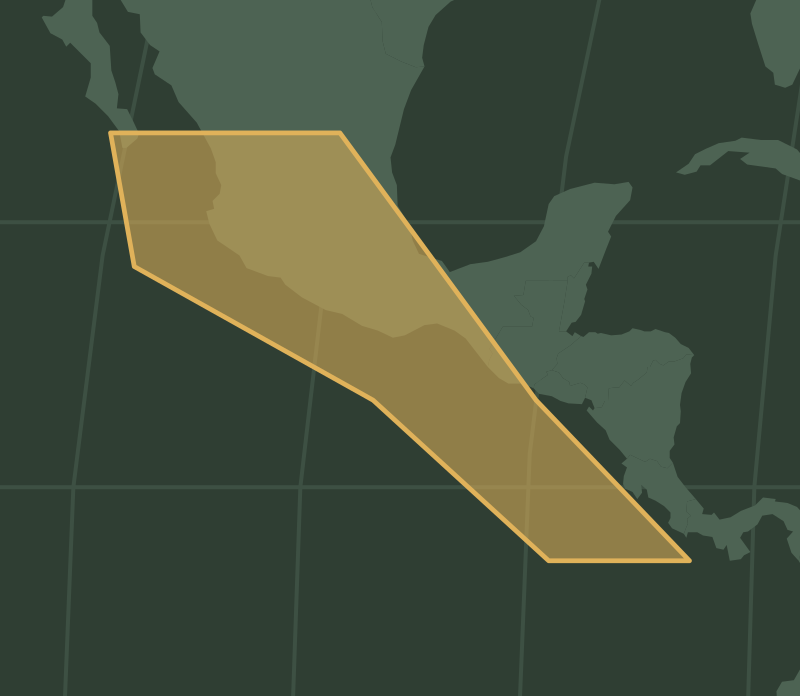
- Mexico and Central America
- Part used
- The aerial parts, with flowers
- Active principles
- Essential oils, methyleugenol and flavonoids
- Onset and duration
- No reliable data in the sources consulted
- Who keeps its memory
- Mexica, Maya, Huichol and Mexican folk medicine
Botany
An aromatic marigold
Tagetes lucida is a perennial plant of the Asteraceae family, native to Mexico and Central America.1
It grows to 45 to 75 cm, needs full sun or light shade, and can be upright or bushy, depending on the variety.1 Its flower heads measure about 15 mm and have 3 to 5 golden-yellow ray flowers.1
The genus Tagetes has roughly 50 to 55 species.2 Pericón (T. lucida), cinco llagas (T. lunulata) and anisillo (T. micrantha) are used as therapeutic remedies in Nicolás Romero, State of Mexico.2
- Family
- Asteraceae
- Height
- 45 to 75 cm
- Flower
- Flower heads of about 15 mm, golden yellow
- Aroma
- Aniseed-like
Memory and tradition
Yauhtli, incense and tobacco
The Aztecs used it in a ritual incense called yauhtli and dedicated it to the rain god, Tláloc.1
Archaeologists found that the Maya used it as an additive in tobacco mixtures.1
The Huichol of Mexico have been reported to smoke it with Nicotiana rustica as an entheogen, and it is sometimes said to be smoked on its own as a hallucinogen.1
Today it is still used mainly as a tea for colds, intestinal gas and diarrhoea.1
Common names include pericón, yerbaniz and hierbanís, as well as ‘sweet marigold’ and ‘Mexican tarragon’.1
In Morelos, traditional healers and market vendors use it for its tranquillising properties.3
Over time
Its names
- pericón
- Mexico
- yerbaniz, hierbanís
- other Spanish names
- tzitziqui
- Nahuatl
- yauhtli
- Aztec incense
The sources on yauhtli disagree about its exact identification; here we include only what is attributed to Tagetes lucida.1
Territory and care
Mexico and Central America
What helps
- Getting to know it as a plant of Mexican traditions.
- Asking those who use and sell it.
- To respect the peoples who safeguard it.
What it contains
Essential oils and flavonoids
Its compounds include methyleugenol and quercetin.1
The secondary metabolites of the genus Tagetes give the plants their medicinal properties, and produce pigments used in agribusiness.4
Aromatic compound identified in the plant.[1]
Flavonoid found in the plant.[1]
The experience
A mild tranquilliser
In Morelos it is used in traditional medicine to influence the activity of the central nervous system, as a tranquilliser.3
There are no reliable data on onset or duration.
Research
What has been studied
A 2016 study brought together interviews with healers and vendors in Morelos and tests in mice, which showed anxiolytic and sedative responses.3
There are no clinical studies in people.
Scope of these dataEthnobotany and animal models; no trials in people.
With care
What it helps to know beforehand
To follow
Books and related medicines
Sources
Where each piece of information comes from
- Wikipedia. Tagetes lucida. wikipedia.com/wiki/Tagetes_lucida.
- Etnobotánica y morfo-anatomía comparada de tres especies de Tagetes que se utilizan en Nicolás Romero, Estado de México. Botanical Sciences. 2012;90(3):221-232. scielo.org.mx/pdf/bs/v90n3/v90n3a1.pdf.
- Tagetes lucida Cav.: ethnobotany, phytochemistry and pharmacology of its tranquilizing properties. J Ethnopharmacol. 2016;181:221-228. pesquisa.bvsalud.org/bvsms/resource/pt/mdl-26873624.
- Tagetes (género): usos y metabolitos. core.ac.uk/download/322440759.pdf.
- Map APDER, with data from Natural Earth · public domain
- Molecule drawings APDER
Last reviewed: 24 November 2026. If you spot a mistake, write to us at info@apder.org.