

Plant · Myristicaceae · Moluccas, Indonesia
Nutmeg
Myristica fragrans Houtt.
The tree that gives two spices, nutmeg and mace, native to the Banda Islands in Indonesia. It has been used for centuries as a medicine and a spice, and in quantities above culinary ones it is said to have psychoactive effects.1234
Also callednuez moscada · macis · nutmeg · nux moschata · Myristica fragrans
- What it is
- Seed of a tropical tree, used as a spice
- Territory
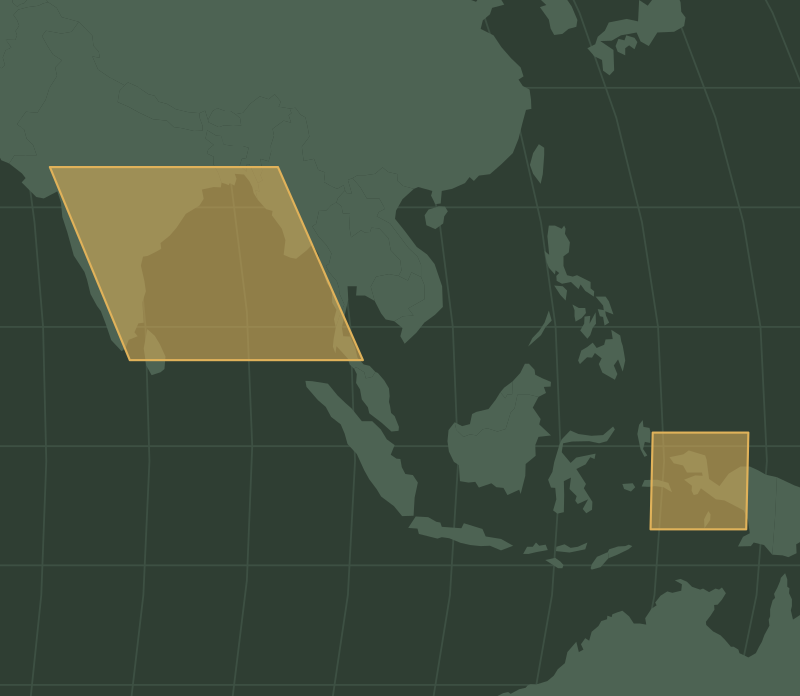
- Banda and Molucca Islands, Indonesia; cultivated in India, Malaysia and Grenada
- Part used
- The seed (nutmeg) and its aril (mace)
- Active principles
- Myristicin, elemicin and other phenylpropanoids
- Onset and duration
- No reliable data in the sources consulted
- Who keeps its memory
- Traditional medicines of India, South-East Asia and Europe
Botany
A tree of two spices
Nutmeg and mace are products of the same tree, Myristica fragrans, of the nutmeg family (Myristicaceae).1 It is a slow-growing evergreen tree that exceeds 20 m.3
Mace is the dried aril that surrounds the seed; nutmeg is the seed, which is extracted and dried.3
The English name comes from the Latin nux muscat, "musky nut".4 The tree is native to the Banda Islands, the Spice Islands, in Indonesia.4
- Family
- Myristicaceae
- Height
- Over 20 m
- Spices
- Nutmeg (seed) and mace (aril)
- Origin
- Banda Islands, Indonesia
Memory and tradition
A spice that changed history
The seed has been used in the traditional medicine of most civilisations since prehistory.5 In traditional Indian medicine the kernel is widely used.6
Nutmeg was of enormous commercial and historical importance; it is presented as one of the seeds that changed the world.7
As a medicine it has been used for many disorders; its use as an abortifacient is also mentioned.4
Today it is a common spice, and people who use it at doses above culinary ones report psychoactive effects.23
In the 20th century it was studied as an alternative narcotic and hallucinogen.13
Over time
Gronovius describes the genus Myristica.8
Weil publishes in the UN Bulletin on Narcotics a review of its history, pharmacology and narcotic use.1
Its names
- nutmeg
- name in Spanish
- mace
- aril that surrounds the seed
- nux moschata
- Latin
- nutmeg
- English
Territory and care
The Spice Islands
What helps
- Get to know it as part of the history of spices.
- Distinguish its culinary use from its psychoactive use.
- Recognise the origin of its trade.
What it contains
Myristicin, elemicin and others
The volatile fraction contains dozens of terpenes and phenylpropanoids, among them pinene, limonene, borneol, terpineol, geraniol, safrole and myristicin.2
Myristicin is chemically similar to other aromatic ethers in the oil: eugenol, isoeugenol and safrole.1
The second psychoactive ingredient is elemicin.7 It has been suggested that myristicin would be converted in the liver into an amphetamine-like compound, but this has not been shown.7
Pure myristicin is a toxin.2
Main psychoactive component attributed to nutmeg.[7]
Second proposed psychoactive compound.[7]
The experience
Between spice and intoxication
In quantities above culinary use, the powder can cause allergic reactions, contact dermatitis or psychoactive effects.2
There are no reliable data on onset or duration.
Research
What has been studied
There are recent reviews of its traditional use, chemical components, pharmacological activity and quality control.96
Clinical evidence for its medicinal uses is limited.2
Scope of these dataLaboratory chemistry and pharmacology; limited clinical evidence.
With care
What it helps to know beforehand
To follow
Books and related medicines
Sources
Where each piece of information comes from
- Weil AT. Nutmeg as a narcotic. Bulletin on Narcotics. 1966;4:15-23. unodc.org/unodc/en/data-and-analysis/bulletin/bulletin_1966-01-01_4_page003.html.
- Wikipedia. Nutmeg. wikipedia.org/wiki/Nutmeg.
- Drugs.com. Nutmeg. drugs.com/npp/nutmeg.html.
- Nagano I. Myristica fragrans: an exploration of the narcotic spice. Entheogen Review. 2008;16(1):15-24. upload.erowid.org/plants/nutmeg/nutmeg_article1.shtml.
- Nutmeg and its potential in alternative or complementary therapy. pmc.ncbi.nlm.nih.gov/articles/PMC11059288/.
- Ashokkumar K et al. Nutmeg (Myristica fragrans Houtt.) essential oil: a review. pmc.ncbi.nlm.nih.gov/articles/PMC9541156.
- May P. Myristicin: the psychoactive molecule in nutmegs. University of Bristol, Molecule of the Month, 2014. chm.bris.ac.uk/motm/myristicin/myristicinh.htm.
- Saikia SP et al. Ethnomedicinal, phytochemical and pharmacological review of nutmegs. neist.res.in/home/SP_Saikia__PR__2021__3_.pdf.
- Nutmeg: a review on basic source, traditional use, chemical components, pharmacological activities, mechanism, and quality control. thieme-connect.de/products/ejournals/html/10.1055/a-2623-1165.
- Map APDER, with data from Natural Earth · public domain
- Molecule drawings APDER
Last reviewed: 24 November 2026. If you spot a mistake, write to us at info@apder.org.