

Plant · Arecaceae · Pacific, South Asia and South-East Asia
Betel nut
Areca catechu L.
The seed of a palm that has been chewed for millennia, mostly wrapped in a betel leaf with slaked lime. Its main alkaloid, arecoline, is both its psychoactive principle and its most toxic compound.134
Also callednuez de betel · nuez de areca · areca · betel nut · areca nut · supari · Areca catechu
- What it is
- Seed of a palm, wrongly called a "nut"
- Territory
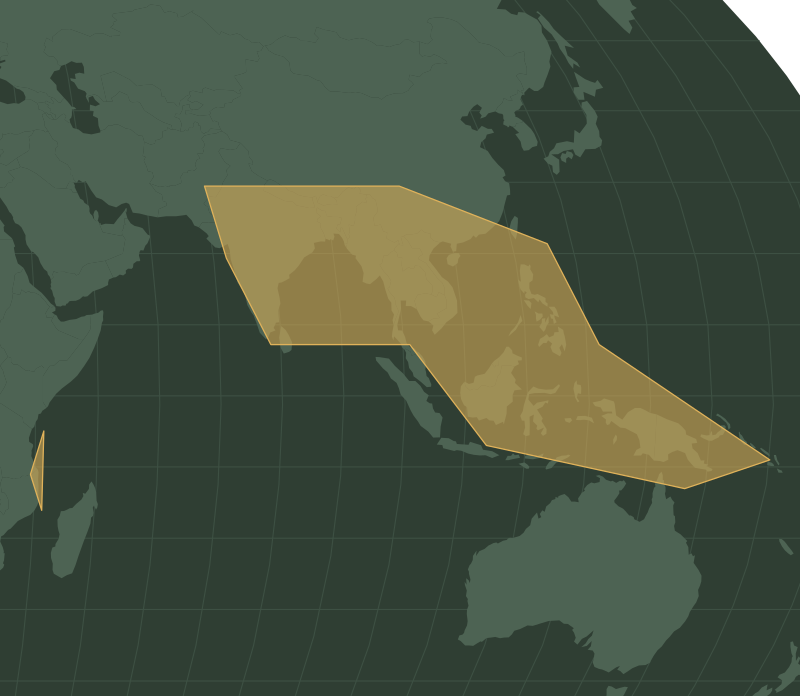
- Tropical Pacific, South Asia and South-East Asia, and parts of East Africa
- Part used
- The seed, inside the fruit
- Active principles
- Arecoline and other areca alkaloids
- Onset and duration
- No reliable data in the sources consulted
- Who keeps its memory
- Many peoples of South Asia, South-East Asia and Oceania
Botany
A palm seed, not a nut
The betel or areca nut is not a nut but the seed of the fruit of the palm Areca catechu, which grows across much of the tropical Pacific (Melanesia and Micronesia), South Asia, South-East Asia and parts of East Africa.410
It is a palm with an unbranched trunk reaching about 15 metres, crowned by 6 to 9 fronds.8 The seed lies inside a fruit the size of an egg, is mottled brown with greyish-white markings, and is gathered shortly before ripening, usually between August and November, then boiled and dried until it turns brown.8
- Family
- Arecaceae
- Height
- Up to about 15 m
- Fruit
- Egg-sized
- Seed
- Mottled brown
Memory and tradition
Chewed for millennia
The "betel quid", traditionally prepared with areca nut, betel leaf and slaked lime, has been consumed for thousands of years, mostly by chewing.1
For chewing, slices of the nut are usually wrapped in a betel leaf with calcium hydroxide (slaked lime), and it may include clove, cardamom, catechu resin or other spices.4
Chewing the betel nut and leaf preparation is an important and popular cultural activity in many countries of South Asia, South-East Asia, East Asia and Oceania.4
In the tradition of Singapore and the region, it is used as a symbol of the bond of love and marriage, and betel leaves are offered at engagements and weddings.8
According to traditional Ayurvedic medicine, chewing areca nut and betel leaf is a good remedy for bad breath.4
Over time
The betel quid is already being chewed.1
Its names
- betel nut
- common name, although the plant is not the betel (Piper betle)
- areca nut
- more accurate botanical name
- supari
- name in South Asian languages
Betel proper is the leaf of another plant, Piper betle; the nut is the seed of the areca palm.8
Territory and care
A palm of the humid tropics
What helps
- Learn about its cultural context, which varies greatly from one people to another.
- Find out about the health risks before any use.
- Do not take the quid as if it were an ordinary food.
What it contains
Arecoline and its relatives
The main alkaloid is arecoline.4 The areca alkaloids are arecoline, arecaidine, guvacoline and guvacine, of similar structure; arecaidine is the hydrolysed product of arecoline.2
Arecoline is an alkaloid with muscarinic cholinergic agonist properties, and is the main psychoactive component of the nut.7 It is also the main toxic compound of the plant.3
Arecoline makes up around 0.25% of the nut.8
Main alkaloid of the nut, a muscarinic agonist.[3][7]
Hydrolysed product of arecoline.[2]
Other areca alkaloids.[2]
The experience
A mild stimulant with a rhythm of its own
It is chewed for its psychostimulant effects.9 That nervous excitation has contributed to its popularity.5
Arecoline produces cholinergic effects in the parasympathetic nervous system and acts as a psychoactive agent.9
Research
What has been studied
There are reviews of its history and use, its chemistry, its pharmacology and its toxicology.23
A 2015 review reports that the seed has been widely used in clinical practice in China, India and other countries of South and South-East Asia.3
Scope of these dataThere is a great deal of research on its health risks; research on its ritual and cultural value is far smaller.
With care
What it helps to know beforehand
Arecoline is both the plant's main active compound and its main toxin.3
Chewing betel nut is associated with oral submucous fibrosis and oral cancer, among other risks.5
Prolonged use can lead to dependence on the betel quid.5
It is chewed with or without tobacco, and the risks add up.7
To follow
Books and related medicines
Sources
Where each piece of information comes from
- Systematic review on areca nut and betel quid (literature from 1919 to 2019). pmc.ncbi.nlm.nih.gov/articles/PMC7558723.
- Review of the areca nut: history, components, pharmacological activity and toxicity. pmc.ncbi.nlm.nih.gov/articles/PMC10219234.
- Areca catechu L. (Arecaceae): a review of its traditional uses, botany, phytochemistry, pharmacology and toxicology. J Ethnopharmacol. 2015;164:340-356. doi:10.1016/j.jep.2015.02.010.
- Wikipedia. «Areca nut». wikipedia.org/wiki/Supari (accessed 24 November 2026).
- Review of the betel nut and arecoline as a risk factor for oral cancer. pmc.ncbi.nlm.nih.gov/articles/PMC8387188.
- Taylor & Francis. Areca. taylorandfrancis.com/knowledge.
- Dependence among daily areca nut chewers in Karnataka, India. pmc.ncbi.nlm.nih.gov/articles/PMC3143027.
- Betel chewing. Infopedia, National Library Board of Singapore. eresources.nlb.gov.sg/infopedia/articles/SIP_883_2004-12-17.html.
- Kozlakidis Z, Cheong IH, Wang H. Betel nut and arecoline: past, present, and future trends. typeset.io.
- LiverTox. Areca nut. Bookshelf NBK590486. ncbi.nlm.nih.gov/books/NBK590486.
- Map APDER, with data from Natural Earth · public domain
- Molecule drawings APDER
Last reviewed: 24 November 2026. If you spot a mistake, write to us at info@apder.org.