

Plant · Piperaceae · Pacific Islands
Kava
Piper methysticum G. Forst.
A perennial shrub of the Pacific islands, whose root is made into a drink regarded as sacred and served at welcome ceremonies, births, weddings and funerals. Its active principles are the kavalactones.134
Also known askava · kava kava · ʻawa (Hawaii) · ʻava · yaqona (Fiji) · sakau (Pohnpei) · Piper methysticum
- What it is
- A shrub of the pepper family, with a sedative root
- Territory
- Hawaii, Micronesia, Vanuatu, Fiji, Samoa and Tonga
- Part used
- The root or rhizome
- Active principles
- Kavalactones
- Onset and duration
- No reliable data in the sources consulted
- Who keeps its memory
- Peoples of Melanesia, Polynesia and Micronesia
Botany
The intoxicating pepper
Kava is a dioecious perennial shrub of the southern Pacific, of the pepper family, and its scientific name Piper methysticum comes from the Latin for "pepper" and the Latinised Greek for "intoxicating".15
The cultivars are sterile and are cloned from their wild ancestor, Piper wichmannii, so today there are hundreds of cultivars spread across the Pacific.2
The plants are traditionally harvested at around four years, because older ones have more kavalactones.2
- Family
- Piperaceae
- Wild ancestor
- Piper wichmannii
- Part used
- Root or rhizome
- Traditional harvest
- At around four years
Memory and tradition
The sacred drink of the Pacific
Its origin is thought to lie in New Guinea or Vanuatu, where seafarers are believed to have domesticated it from Piper wichmannii.1
Botanical evidence suggests it was first domesticated in northern Vanuatu.6
The name "kava" comes from Tongan and Marquesan, where it means "bitter".2
The product is considered sacred in Pacific cultures and is served on important occasions: welcoming guests, celebrating a birth, weddings and funerals.3
Today, in many places, the drink is also taken to socialise, to reaffirm relationships and rank, and as an alternative to alcohol.5
It is not known whether present-day practices are the same as those of the past, nor whether consumption was more or less ceremonial than it is now.6
In Vanuatu, "tudei" or two-day kava is reserved for special ceremonial occasions and may not be exported.2
In Tonga, Fiji and Pohnpei, kava ceremonies are still alive.5
Over time
Its names
- kava
- Tongan and Marquesan: "bitter"
- ʻawa
- Hawaii
- yaqona
- Fiji
- sakau
- Pohnpei
Territory and care
The Pacific islands
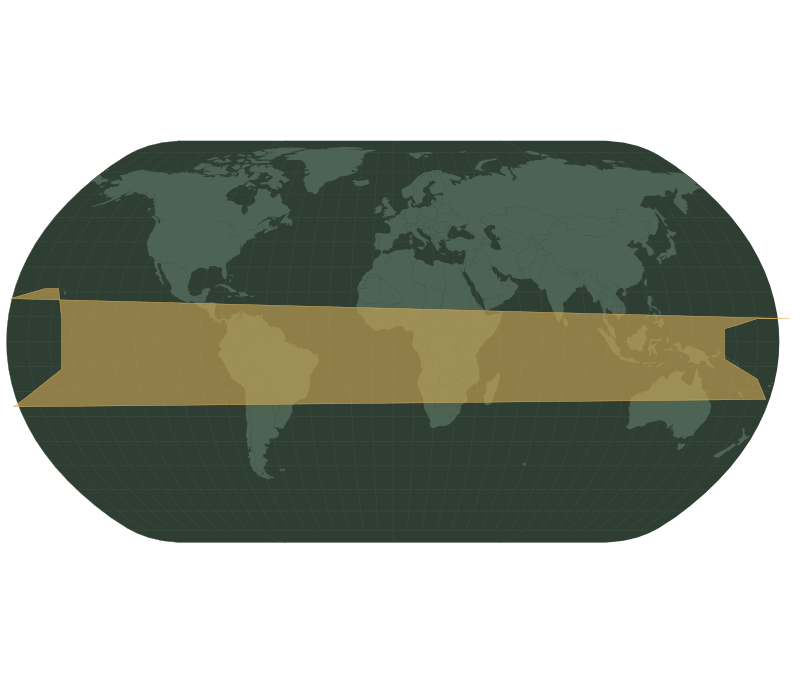
Historically it was grown only in Hawaii, the Federated States of Micronesia, Vanuatu, Fiji, Samoa and Tonga.1
There is no evidence that it was used in New Caledonia until about twenty years ago, and only marginal signs of use in the Solomon Islands.6
Since the 1990s it has become popular outside the Pacific, in the United States, Europe and Australia, as a relaxant.7
What helps
- Know it as a sacred drink of Pacific peoples.
- Prefer products that respect the communities that grow it.
- Respect the varieties reserved for ceremonies.
What it contains
Kavalactones
Its active principles are called kavalactones.1
Analyses of Fijian crops also describe flavokavains and distinct chemotypes.8
Some varieties have a more favourable kavalactone composition than others.1
Active principles of the root.[1]
Compounds described in Fijian crops.[8]
The experience
Calm and relaxation
It has psychoactive properties, above all calming and relaxing effects.5
This is considered one of the reasons for its spread across the Pacific: it gives a feeling of calm and relaxation.5
There are no reliable data on onset or duration.
Research
What has been studied
A Cochrane review concluded that it is probably more effective than a placebo for short-term anxiety.1
Kava extracts were used in Europe as a medicine for anxiety.3
A 2010 project in Hawaii brought together indigenous Pacific scientists, practitioners of Hawaiian culture and Western pharmacologists to study the drink.4
Its potential in cancer models is also being investigated.5
Scope of these dataThere are clinical trials in anxiety; for the rest, tradition weighs more than clinical evidence.
With care
What it helps to know beforehand
Products made with organic solvents or with excessive amounts of low-quality material have been linked to a higher risk of adverse effects, including possible liver injury.1
It is advised not to combine it with alcohol or other psychotropic drugs, and to avoid prolonged use.7
The safety of long-term use has not been established.7
To follow
Books and related medicines
Sources
Where each piece of information comes from
- Wikipedia. Kava. wikipedia.com/wiki/Kava.
- Wikipedia. Kava (draft). wikipedia.org/wiki/User:Millieghawkins/sandbox.
- Kava: a review of its drinks and extracts. pmc.ncbi.nlm.nih.gov/articles/PMC7600512.
- Contemporary Pacific and Western perspectives on ʻawa (Piper methysticum) toxicology. Fitoterapia. 2015;100:56-67. pubmed.ncbi.nlm.nih.gov/25464054/.
- Kava (review: toxicology and potential in cancer). pmc.ncbi.nlm.nih.gov/articles/PMC9315573.
- Lynch J. Kava in Oceania (extract). muse.jhu.edu/article/37694/.
- Encyclopedia of Life. Kava (Piper methysticum). eol.org/pages/39966189/articles.
- Pasinszki T, Devi DD, Krebsz M. Bioactive compound profile and nutrition values of kava cultivated in Fiji. Horticulturae. 2025;11:1456. openresearch-repository.anu.edu.au/bitstreams/a49c9036-d63f-436b-a080-3eb7b483a2f7/download.
- Map APDER, with data from Natural Earth · public domain
- Molecule drawings APDER
Last reviewed: 24 November 2026. If you spot a mistake, write to us at info@apder.org.