

Plant · Aizoaceae · Karoo and Namaqualand, South Africa
Kanna
Mesembryanthemum tortuosum L.
A small succulent of the dry lands of South Africa that the San and Khoikhoi peoples have chewed, fermented, for centuries. Its effect is gentle and relaxing, without hallucinations, and the little that is known about it has yet to be confirmed.1910
Also known askanna · kougoed · channa · Sceletium tortuosum · skeleton fig
- What it is
- Creeping succulent, with leaves containing water cells
- Territory
- Karoo and Namaqualand, in southern Africa
- Part used
- The whole plant, crushed and fermented (kougoed)
- Active principles
- Mesembrine and mesembrenone
- Onset and duration
- Shortly after chewing · 1–3 h
- Who keeps its memory
- The San and Khoikhoi peoples
Botany
A succulent that hollows out as it dries
It is a short-lived succulent herb of creeping habit, which grows in the dry zones of western South Africa.1011
Its leaves, curved at the tip, have visible water cells and three to five veins; the stems become somewhat woody with age. On drying, the leaf is left skeletal, hence the old name Sceletium.312
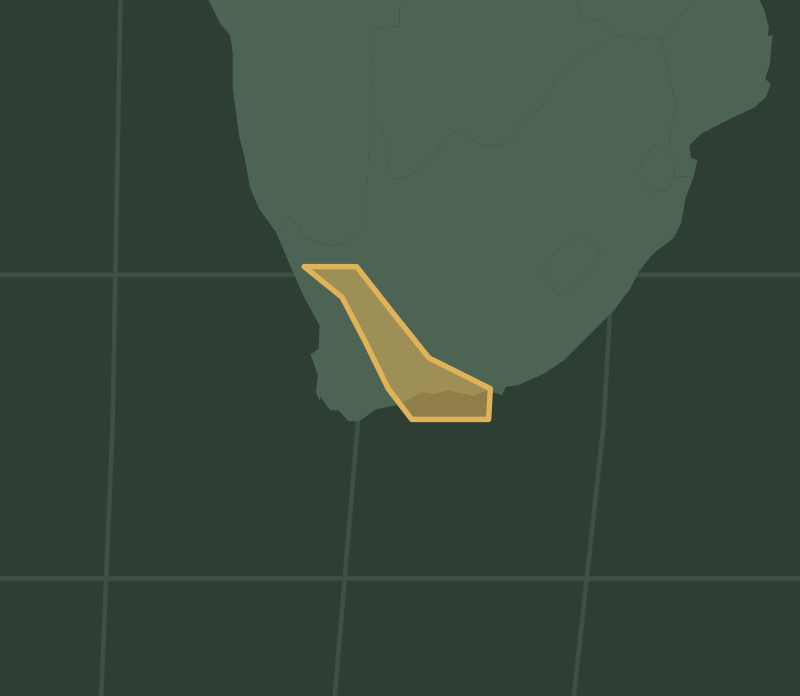
It grows in sandy soils, under shrubs and in partial shade, from Namaqualand to Montagu and, further east, to Aberdeen.12
- Family
- Aizoaceae
- Habit
- Creeping, short-lived succulent
- Leaf
- Curved, with water cells
- Habitat
- Sandy soil of the Karoo and Namaqualand
Memory and tradition
What is chewed to get through the day
The San people, hunter-gatherers, and the Khoikhoi, herders, have chewed kanna for centuries, often after fermenting it. It served them to quench thirst and hunger, fight tiredness, lift the mood and also in social and spiritual contexts.110
The name kougoed is Afrikaans and means "what is chewed". For the San, "kanna" is linked to the eland, the antelope they regard as the animal of trance par excellence.9
The first written records are colonial: Jan van Riebeeck mentions it around 1662, and Simon van der Stel left a drawing of the plant in 1685.1012
Over time
The San and Khoikhoi peoples chew kanna, often fermented.1
Jan van Riebeeck leaves the first written account of its use.12
Simon van der Stel draws it on his journey to Namaqualand.10
A historical review gathers 300 years of data and finds no evidence that it is hallucinogenic.9
The South African government announces a bioprospecting agreement to benefit the San.8
Its names
- kanna
- Khoi name; for the San it evokes the eland
- kougoed
- Afrikaans, "that which is chewed"
- channa
- old variant of kanna
- Sceletium
- former genus; the species is now included in Mesembryanthemum
In the literature you will find both Sceletium tortuosum and Mesembryanthemum tortuosum: it is the same plant under two classifications.12
Territory and care
A Karoo plant under pressure
What helps
- Prefer cultivated kanna to wild-harvested kanna.
- Ask where it comes from and whether the San and Khoikhoi communities share in the benefit.
- Respect it as a medicine of the peoples who safeguard it, not as a fashionable product.
What it contains
Mesembrine, a molecule that touches serotonin
Its main alkaloids are mesembrine and mesembrenone. The content varies greatly between species and between wild plants of the same species.25
They inhibit serotonin reuptake, like some antidepressants, and also the enzyme PDE4. Mesembrine is the most potent alkaloid at the serotonin transporter, and mesembrenone acts on both targets.5
It is the most potent at the serotonin transporter.[5]
It acts on the serotonin transporter and on PDE4.[5]
The experience
A gentle calm, without hallucinations
People who take it usually describe relaxation, less anxiety and a slightly lifted mood. It does not produce hallucinations: it is not a psychedelic.39
The effects described last between one and three hours. The half-life of its alkaloids has not been measured in people.4
Indicative outline: it changes with the preparation, the amount and the person.
Research
What has been studied
There are few trials, and they are small and with healthy volunteers. In a brain-imaging study, a standardised extract (Zembrin) reduced the amygdala's response to images of fear.7
A review of the trials concludes that none lasted longer than three months.4
Scope of these dataIt has not been proven as a treatment for anxiety or depression. The studies use a specific extract, not the fermented plant that is chewed.
With care
What it helps to know beforehand
Mixing it with antidepressants, MAOIs (including ayahuasca), MDMA or tramadol: because of its action on serotonin, it could cause serotonin syndrome.56
There are few studies in people, none longer than three months, and the amount of alkaloids varies greatly between products.24
Tradition already noted that it strengthens the effect of smoked cannabis.9
To follow
Books and related medicines
Sources
Where each piece of information comes from
- Gericke N, Viljoen AM. Sceletium: a review update. J Ethnopharmacol. 2008;119(3):653-663.
- Reddy K, Stafford GI, Makunga NP. Skeletons in the closet? Using a bibliometric lens to visualise phytochemical and pharmacological activities linked to Sceletium, a mood enhancer. Front Plant Sci. 2024;15:1268101.
- Drugs.com. Sceletium tortuosum. Natural products monograph. drugs.com/npp.
- Alzheimer's Drug Discovery Foundation. Sceletium tortuosum (Zembrin): Cognitive Vitality report. alzdiscovery.org.
- Harvey AL, Young LC, Viljoen AM, Gericke NP. Pharmacological actions of the South African medicinal and functional food plant Sceletium tortuosum and its principal alkaloids. J Ethnopharmacol. 2011;137(3):1124-1129.
- Yip K, Tanen D. Serotonin syndrome. MSD Manual, consumer version. msdmanuals.com.
- Terburg D, Syal S, Rosenberger LA, et al. Acute effects of Sceletium tortuosum (Zembrin), a dual 5-HT reuptake and PDE4 inhibitor, in the human amygdala and its connection to the hypothalamus. Neuropsychopharmacology. 2013;38(13):2708-2716.
- SAnews (South African Government). 10 000 San to benefit from bio-prospecting license. 4 October 2010. sanews.gov.za.
- Smith MT, Crouch NR, Gericke N, Hirst M. Psychoactive constituents of the genus Sceletium N.E.Br. and other Mesembryanthemaceae: a review. J Ethnopharmacol. 1996;50(3):119-130.
- Manganyi MC, Bezuidenhout CC, Regnier T, Ateba CN. A chewable cure «Kanna»: biological and pharmaceutical properties of Sceletium tortuosum. Molecules. 2021;26(9):2557.
- South African National Biodiversity Institute (SANBI). Sceletium tortuosum. PlantZAfrica. pza.sanbi.org.
- Wikipedia. "Mesembryanthemum tortuosum". en.wikipedia.org (accessed 24-11-2026).
- Map APDER, with data from Natural Earth · public domain
- Molecule drawings APDER
Last reviewed: 24 November 2026. If you spot a mistake, write to us at info@apder.org.