

Plant · Malvaceae · Tropical understorey of the Americas
Cacao
Theobroma cacao L.
A small tree of the tropical understorey whose seeds were drunk in ceremonies long before there was chocolate. Its origin is now placed in the Upper Amazon, some 5,300 years ago, and it is not a psychedelic: it is a mild stimulant.345
Also calledceremonial cacao · cocoa · cacao tree · food of the gods
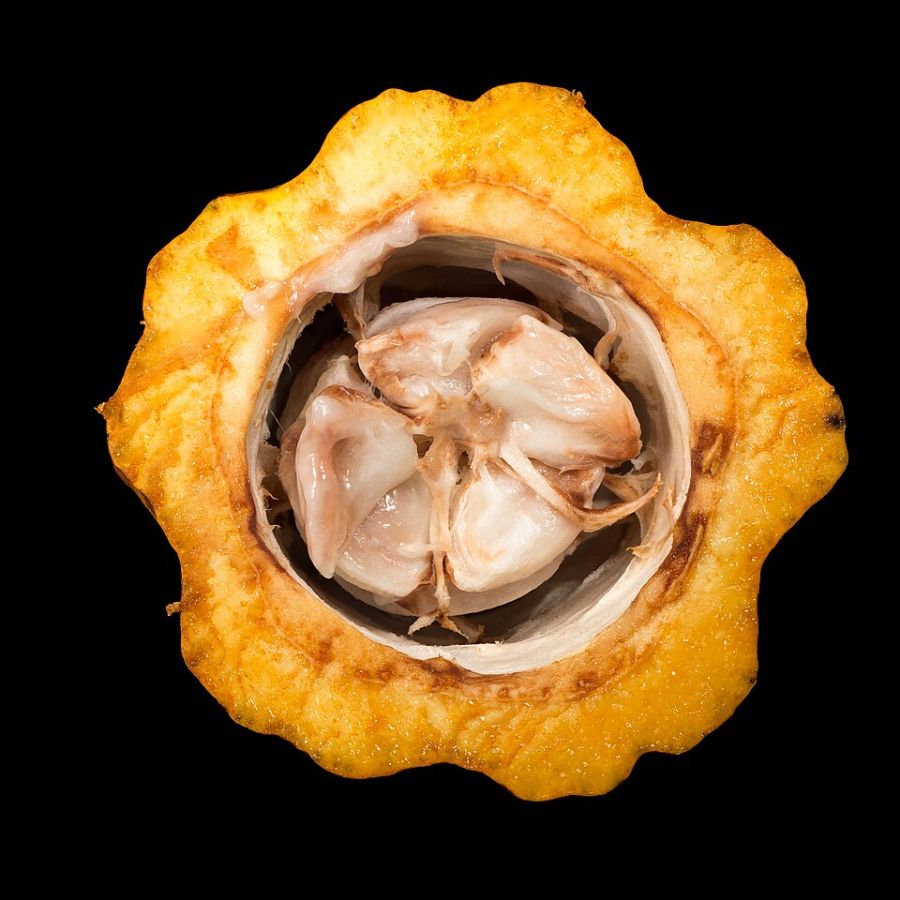
- What it is
- Evergreen tropical tree that grows beneath the canopy
- Territory
- Originally from the Upper Amazon; today cultivated throughout the tropics
- Part used
- The seed, fermented, roasted and ground into a paste
- Active principles
- Theobromine and, in smaller amounts, caffeine
- Onset and duration
- About 30–60 min · 2–4 h; theobromine takes a long time to clear
- Who keeps its memory
- Olmecs, Maya and Mexica; earlier, the Mayo-Chinchipe
Botany
A tree that bears fruit on its trunk
It is a small evergreen tree, between 6 and 12 metres tall in the forest, where it grows in the understorey, beneath the large trees.12
Its tiny flowers grow in clusters directly on the trunk and old branches, something called cauliflory. From them come the ribbed-skinned pods.12
Each pod holds between 20 and 60 seeds of about 2.5 cm, wrapped in a sweet white pulp. Those seeds, once fermented and roasted, are what we call cacao.1
- Family
- Malvaceae
- Habit
- Tree of 6–12 m, of the understorey
- Flower
- Small, in clusters on the trunk
- Fruit
- Pod with 20–60 seeds
Memory and tradition
A drink before it was sweet
In Mesoamerica, the Olmecs, Maya and Mexica cultivated cacao and drank it in ceremonies, weddings and offerings, and its seeds served as currency.4
Archaeology has moved its origin further south: at Santa Ana-La Florida, in south-eastern Ecuador, the Mayo-Chinchipe culture was already using cacao some 5,300 years ago, the oldest known trace. That places the origin of its domestication in the Upper Amazon.3
Around 1100 BC, at Puerto Escondido (Honduras), cacao drinks were already being consumed.4 The Spanish took it to Europe in the 16th century, where it was sweetened until it became chocolate. Today's cacao ceremonies, widespread in wellness circles, mix Mesoamerican elements with modern practices.
Over time
The Mayo-Chinchipe culture uses cacao at Santa Ana-La Florida, in the Upper Amazon of Ecuador.3
Cacao drinks are consumed at Puerto Escondido (Honduras).4
The Olmecs, Maya and Mexica take it in ceremonies and use it as currency.4
The Spanish take it to Europe, where it is sweetened and chocolate is born.
Its names
- cacao
- word that in Mesoamerica named the seed and the drink
- Theobroma
- ‘food of the gods’, the name given to it by Linnaeus
- ceremonial cacao
- pure cacao paste that dissolves in hot water
Cacao and cocoa name the same plant; in Spanish, cacao usually refers to the seed and the paste, and chocolate to the mixture with sugar.
Territory and care
From the Amazonian understorey to the world's plantations
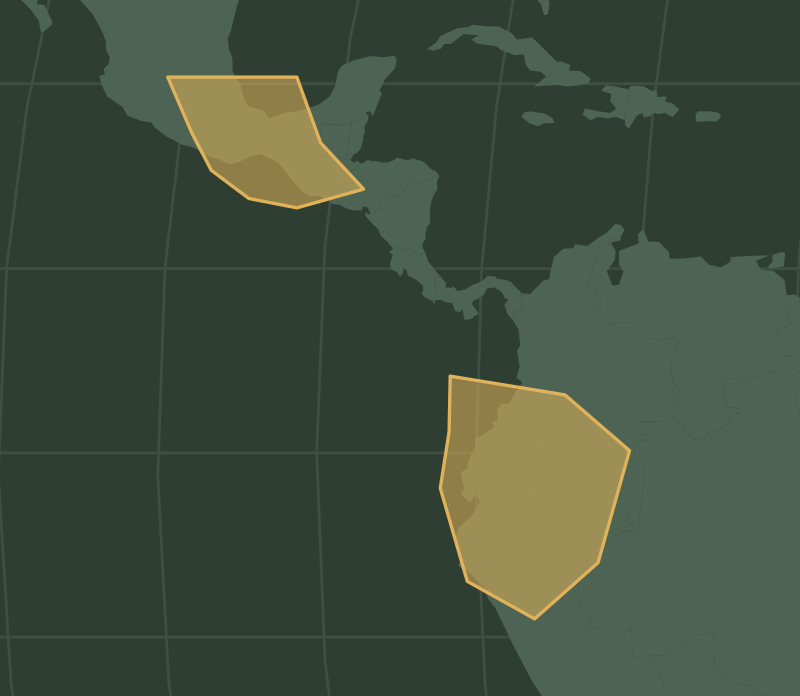
Its origin is placed in the tropical, humid zones of South America, with the greatest diversity near the borders of Colombia and Ecuador, in the Upper Amazon.3
Today it is cultivated throughout the tropics. A good part of the world's cacao comes from plantations where child labour is still present, which is why origin matters.8
What helps
- Choose cacao of traceable origin and with verified working conditions.
- Prefer those who work directly with producer communities.
- Respect cacao as the sacred food of the peoples who safeguard it, not as a fashion.
What it contains
Theobromine, the main substance
Cacao contains theobromine, caffeine and flavanols. There is between three and ten times more theobromine than caffeine.5
Theobromine and caffeine are methylxanthines: they block adenosine receptors, the brain chemical that gives the feeling of tiredness, and so they bring alertness and energy.5 One study concluded that methylxanthines are the psychopharmacologically active components of chocolate.6
A milder stimulant than caffeine; its half-life in healthy volunteers is about 10 hours, longer than that of caffeine.[5]
The experience
A gentle energy that stays for a few hours
It is taken slowly, with an intention, music or silence. People who drink it describe gentle, sustained energy, warmth in the body, a lifted mood and a sense of openness, lasting around two to four hours.5
Much of what is experienced comes from the ritual and the group, more than from the substance. Because theobromine takes a long time to be eliminated, it may be hard to sleep that night.
Indicative outline: it changes with the preparation, the amount and the person.
Research
What has been studied
A Cochrane review, which brings together randomised trials, found that flavanol-rich cacao slightly lowers blood pressure in short studies.7
A review of theobromine covers its effects on the nervous system and the blood vessels, although much of the work has been done in the laboratory.5
Scope of these dataThe studies use ordinary cacao or chocolate, not the amount used in a ceremony. There is no evidence that ceremonial cacao treats any illness.
With care
What it helps to know beforehand
In large amounts: insomnia, nervousness, palpitations or headache. Take more care in pregnancy, in childhood and with heart problems.5
If you take MAOI antidepressants, check first with whoever prescribes them. APDER's guide covers the other interactions.
EFSA recommends not exceeding 200 mg of caffeine a day from all sources in pregnancy and breastfeeding.10
Theobromine is toxic to dogs, and pure cacao is the most concentrated source. If one has eaten it, call the vet.9
To follow
Books and related medicines
The main substance in cacao.
Another plant with methylxanthines, with caffeine as its main active.
Sources
Where each piece of information comes from
- Britannica. Cacao (Theobroma cacao). britannica.com.
- Wikipedia. «Theobroma cacao». en.wikipedia.org (accessed 24 November 2026).
- Zarrillo S, Gaikwad N, Lanaud C, et al. The use and domestication of Theobroma cacao during the mid-Holocene in the upper Amazon. Nat Ecol Evol. 2018;2:1879-1888.
- Henderson JS, Joyce RA, Hall GR, Hurst WJ, McGovern PE. Chemical and archaeological evidence for the earliest cacao beverages. Proc Natl Acad Sci U S A. 2007.
- Martínez-Pinilla E, Oñatibia-Astibia A, Franco R. The relevance of theobromine for the beneficial effects of cocoa consumption. Front Pharmacol. 2015;6:30.
- Smit HJ, Gaffan EA, Rogers PJ. Methylxanthines are the psycho-pharmacologically active constituents of chocolate. Psychopharmacology. 2004;176:412-419.
- Ried K, Fakler P, Stocks NP. Effect of cocoa on blood pressure. Cochrane Database Syst Rev. 2017;(4):CD008893.
- NORC at the University of Chicago. Child labor grows in certain areas of cocoa production. November 2020. norc.org.
- Hayes C. Chocolate toxicosis in animals. Merck Veterinary Manual, professional version. merckvetmanual.com.
- European Food Safety Authority (EFSA). EFSA explains risk assessment: caffeine. 2015. efsa.europa.eu.
- Open cacao pod (Theobroma cacao). Rodrigo.Argenton · CC BY-SA 4.0
- Map APDER, with data from Natural Earth · public domain
- Molecule drawings APDER
Last reviewed: 24 November 2026. If you spot a mistake, write to us at info@apder.org.