

Plant · Lamiaceae · Southern Africa
Cola de león
Leonotis leonurus (L.) R.Br.
An orange-flowered shrub of southern Africa, known as “wild dagga” because of a similarity of name with cannabis. Science has not confirmed that it contains leonurine, the alkaloid to which its effect is attributed, and the name may be misleading.12
Also calledcola de león · dagga silvestre · wild dagga · lion's tail · lion's ear · wildedagga · imvovo · Leonotis leonurus
- What it is
- Robust shrub of the mint family
- Territory
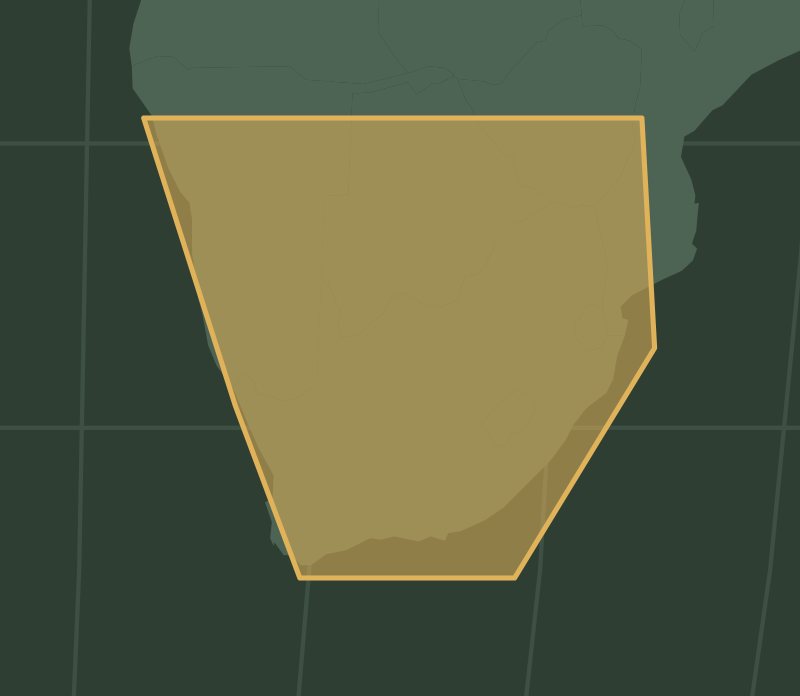
- Moist grasslands of southern Africa; naturalised elsewhere
- Part used
- Leaves and flowers; in medicinal use also the root
- Active principles
- Terpenoids, above all labdane diterpenes such as marrubiin
- Onset and duration
- No reliable data
- Who keeps its memory
- Khoikhoi, Xhosa, Zulu and other peoples of southern Africa
Botany
A shrub with orange flower spikes
Leonotis leonurus is a fast-growing, robust, soft-wooded shrub that reaches 2 or 3 metres in height and 1.5 in width.3 It belongs to the Lamiaceae, the mint family, which comprises about 3,200 species in 200 genera.4
Its red-orange flowers grow in spikes and are highly prized in gardening.5 They attract nectar-feeding birds, especially sunbirds.2
Its native habitat is the moist grasslands of southern Africa.2
- Family
- Lamiaceae
- Height
- 2–3 m
- Flower
- Red-orange, in spikes
- Habitat
- Moist grasslands
Memory and tradition
Wild dagga
The early inhabitants of South Africa, such as the Khoikhoi, smoked the dried leaves and flowers, which were said to have narcotic properties and to give a feeling of calm or euphoria; hence the name wildedagga, “wild dagga”.3
The word “dagga” comes from Afrikaans and this in turn from Khoikhoi dachab; in Afrikaans and South African English it came to be used for cannabis, and that is why “wild” is added to distinguish the plant.2
Some cultures have smoked it together with cannabis or as a substitute.5
In traditional medicine the plant has been used, as a decoction, for many ailments.1 An infusion of the leaves has been used for asthma and viral hepatitis.5
The peoples of southern Africa give it names such as imvovo in Xhosa or umfincafincane in Xhosa and Zulu.3
Over time
Its dried leaves and flowers are smoked.3
A review of the plant's traditional use and phytochemistry is published.1
Its names
- wildedagga
- Afrikaans, “wild dagga”
- duiwelstabak
- Afrikaans, “devil's tobacco”
- imvovo
- Xhosa
- umfincafincane
- Xhosa and Zulu
- cola de león
- for the shape of the flower, English name lion's tail
The name “wild dagga” may be a misleading name: according to one source, no part of the plant is used as a hallucinogen.2
Territory and care
A garden and grassland plant
What helps
- To grow it as a garden plant, which attracts bees and hummingbirds.
- To learn its history without presenting it as a substitute for anything.
- To listen to the peoples who name and use it in southern Africa.
What it contains
Terpenoids and a disputed leonurine
The plant contains mostly terpenoids, in particular labdane diterpenes, with marrubiin as the main one.1
The psychoactive effect has been attributed to leonurine, a mildly psychoactive alkaloid; but according to the 2015 review, leonurine appears only in the popular literature and has never been found in any scientific analysis of the extracts.1
Other sources claim the opposite, and the question is not settled.2
Main confirmed compound.[1]
Cited in the popular literature; not confirmed in the 2015 review.[1]
The experience
Between myth and analysis
It is said to have mildly hallucinogenic effects when the buds or dried leaves are smoked.5
That reputation rests on accounts and on the name, more than on studies.12
Research
What has been studied
A 2015 review gathers the literature between 1900 and 2015 on its botany, ethnopharmacology, phytochemistry, biological activity, toxicity and commercial aspects.1
Another review points out that more studies need to be established to guide safe use as a herbal product.4
Scope of these dataThere is a good review of the literature and little clinical evidence.
With care
What it helps to know beforehand
To follow
Books and related medicines
Sources
Where each piece of information comes from
- Nsuala BN, Enslin G, Viljoen A. “Wild cannabis”: a review of the traditional use and phytochemistry of Leonotis leonurus. J Ethnopharmacol. 2015;174:520-539. doi:10.1016/j.jep.2015.08.013.
- Wikipedia. “Leonotis leonurus”. en.wikipedia.org (accessed 24 November 2026).
- South African National Biodiversity Institute (SANBI). Leonotis leonurus. pza.sanbi.org/node/10505.
- Mazimba O. Leonotis leonurus: a herbal medicine review. J Pharmacogn Phytochem. 2015;3(6). phytojournal.com.
- Kruidwis. Wild dagga. sites.google.com/site/kruidwis.
- A study of the genus Leonotis as a herbal remedy in Africa. wiredspace.wits.ac.za.
- Map APDER, with data from Natural Earth · public domain
- Molecule drawings APDER
Last reviewed: 24 November 2026. If you spot a mistake, write to us at info@apder.org.