

Plant · Rubiaceae · Amazon and Atlantic forest
Chacruna
Psychotria viridis Ruiz & Pav.
A shrub of the coffee family whose leaf provides the DMT in ayahuasca. It is not taken alone: its DMT acts orally only alongside the vine that opens the way for it, and from that meeting comes a brew that Amazonian peoples call a teacher.125
Also known aschacruna · chacrona · chaqruy · rainha · ayahuasca leaf
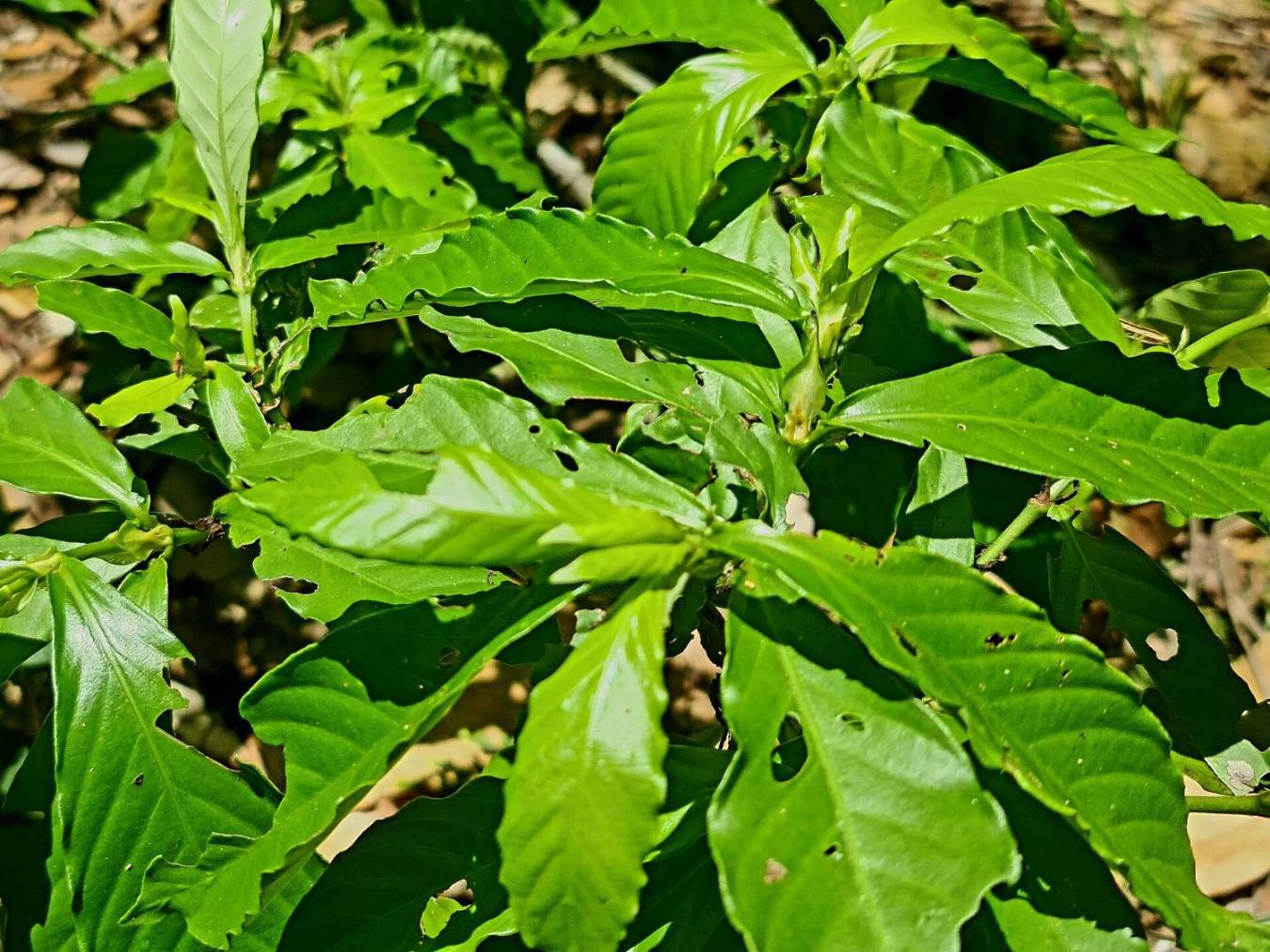
- What it is
- Shrub of about 5 m, of the coffee family
- Territory
- Amazon and Atlantic forest
- Part used
- The leaf
- Active principles
- DMT
- Onset and duration
- Taken within ayahuasca: a few hours
- Who keeps its memory
- Amazonian peoples; also the ayahuasca churches
Botany
A shrub of the coffee family
It is a perennial shrub of about five metres, with branches spreading about two metres. It belongs to the Rubiaceae, the coffee family.1
The leaves grow in pairs, about 5 to 15 cm long and 2 to 6 cm wide, elliptical in shape and papery in texture. The fruits are small and red.36
It is a shrub native to the Amazon and the Atlantic forest, growing in clay and sandy soils with plenty of water.2
- Family
- Rubiaceae, the coffee family
- Habit
- Shrub of about 5 m
- Leaf
- Elliptical, 5–15 × 2–6 cm
- Fruit
- Small and red
Memory and tradition
Light that accompanies the strength of the vine
It is used mainly as an ingredient of ayahuasca, a brew with a long history of use among Amazonian peoples, who regard it as a "teacher plant".1
In the Brazilian Santo Daime church it is said that the vine Banisteriopsis caapi gives the brew its "strength", and that chacruna gives it its "light".5
Its name comes from the Quechua chaqruy, "to mix", and speaks of its role in the mixture.4 In some parts of Ecuador, "chacruna" is the name of another plant, chaliponga.4
Over time
Amazonian peoples prepare ayahuasca with the vine and DMT-rich leaves.1
Ayahuasca enters religious rites in South America and, later, in other countries.2
Its names
- chacruna
- from the Quechua chaqruy, "to mix"
- chacrona
- the same word, in its Brazilian form
- rainha
- "queen", the name given to it by some churches in Brazil
- samiruka
- Ecuadorian name for the related species P. carthagenensis
In some parts of Ecuador, "chacruna" names chaliponga (Diplopterys cabrerana), not P. viridis.4
Territory and care
A forest shrub that is cultivated
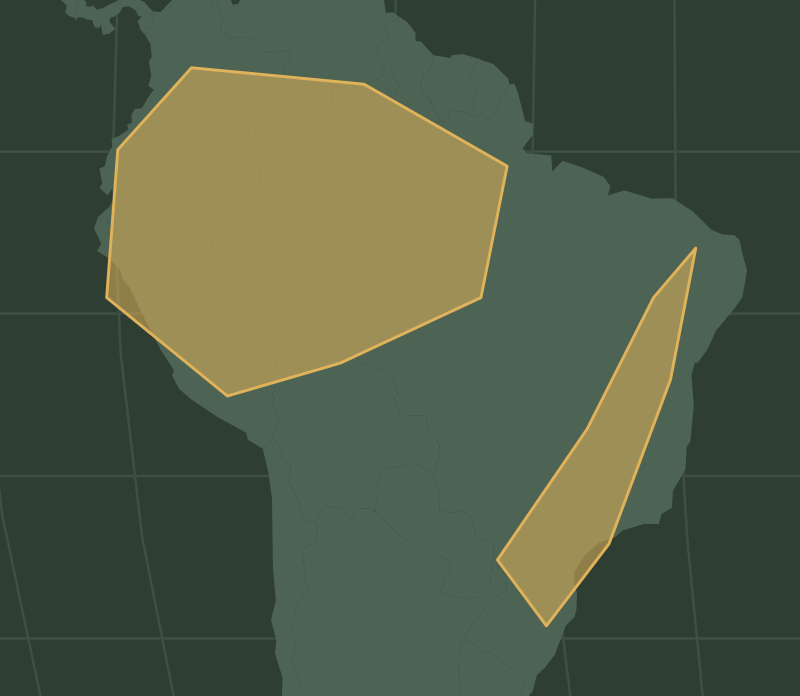
It is native to the Amazon and to the Atlantic forest of Brazil.2
Today it is also grown outside its native territory, in vegetable plots and gardens.
What helps
- Look after the cultivated shrub, which grows well in vegetable plots and gardens.
- Support the communities that grow and prepare ayahuasca with respect.
- Do not take leaves from the forest for trade without knowing where they come from.
What it contains
DMT, which needs the vine in order to act
The leaves contain DMT, an alkaloid found at 0.1 to 0.6 per cent of the dry leaf.3
Taken orally, DMT is not active on its own, because the liver and the gut break it down. It acts only with monoamine oxidase inhibitors, such as the harmine and harmaline of the vine.2
Present in the leaf in variable amounts; it is active orally only together with the MAO inhibitors of the vine.[2][3]
The experience
Not taken alone, but within ayahuasca
Chacruna is not taken alone. Within ayahuasca, there is first nausea, then an intoxication lasting from an hour to a few hours, and it all passes within a few hours.2
The experience is that of the whole brew: it depends on the vine, the leaf, the context and whoever supports you.
Indicative outline: it changes with the preparation, the amount and the person.
Research
What has been studied
Research is carried out on whole ayahuasca, not on the leaf alone. One study with volunteers measured its subjective and cardiovascular effects and how it is absorbed and eliminated.7
DMT is the main substance that the leaf contributes to the brew.
Scope of these dataThe studies do not separate the role of the leaf from that of the vine. There are no studies proving the use of chacruna alone as a medicine.
With care
What it helps to know beforehand
Ayahuasca contains MAO inhibitors: it can interact seriously with antidepressants and other medicines. The APDER guide details the interactions.2
Whoever does not know what is in their brew does not know what they are taking: the APDER guide explains how to find out.
The name is confused with other plants, such as chaliponga.4
For the peoples who use it, it is a teacher plant; it is worth knowing its context.1
To follow
Books and related medicines
Sources
Where each piece of information comes from
- Wikipedia. "Psychotria viridis". en.wikipedia.org (accessed 24 November 2026).
- Taylor & Francis. Psychotria viridis. taylorandfrancis.com/knowledge.
- Chemeurope. Psychotria viridis. chemeurope.com/en/encyclopedia (leaves, fruits and DMT content).
- Wikidoc. Psychotria viridis. wikidoc.org.
- Bionity. Psychotria viridis. bionity.com/en/encyclopedia.
- Erowid. Psychotria viridis. erowid.org/plants/psychotria.
- Riba J, Valle M, Urbano G, et al. Human pharmacology of ayahuasca: subjective and cardiovascular effects, monoamine metabolite excretion, and pharmacokinetics. J Pharmacol Exp Ther. 2003;306(1):73-83.
- Chacruna leaves (Psychotria viridis). Anthony Baratier · CC BY-SA 4.0
- Map APDER, with data from Natural Earth · public domain
- Molecule drawings APDER
Last reviewed: 24 November 2026. If you spot a mistake, write to us at info@apder.org.