

Preparation · Fabaceae · Yucatán and the Lacandon Jungle
Balché
Lonchocarpus longistylus and honey
A ceremonial Maya drink, lightly fermented, made from the bark of the balché tree and honey. It appears in codices, historical sources and ethnography; it was banned and persecuted in the colonial period, but Maya ritual specialists never stopped preparing it, and today it is used in both ancient and new ceremonies.121
Also known asbalché · balche · Maya ritual drink · xtabentún (a related drink)
- What it is
- Lightly fermented ritual drink of bark and honey
- Territory
- Yucatán Peninsula and the Lacandon Jungle
- Part used
- Tree bark and honey
- Active principles
- Compounds in the bark; effects of euphoria are cited
- Onset and duration
- No reliable data in the sources consulted
- Who keeps its memory
- Yucatec Maya and Lacandon Maya
Botany
The balché tree
Balché is made from the bark of a leguminous tree, Lonchocarpus violaceus according to the most widely cited source, soaked in honey and water and fermented.1
Another author notes that "true balché" is Lonchocarpus longistylus, which is abundant across most of Yucatán and more common in the rainy zones of the east and south.3 In north-central Yucatán, L. rugosus is a "green balché" that the Lacandon say can cause stomach ache.3
In the Maya area, different species of Lonchocarpus are used for the drink.3
A related drink, xtabentún, is made with honey from the flower of a climbing plant, Turbina corymbosa.1
A descriptive and historical entry; it includes no preparation instructions.
- Family
- Fabaceae
- Part used
- Bark
- Ingredients
- Bark, honey and water
- Varieties
- Several species of Lonchocarpus
Memory and tradition
The drink of the Maya gods
According to sixteenth-century Spanish sources, the ritual use of balché was a common feature of the religious life of the pre-Columbian Maya; because the rite involved ritual intoxication and offerings to "pagan" gods, the missionaries tried to put an end to it.4
One study detected its consumption for the first time in an archaeological context, dated to the Terminal Classic (AD 800–850), identifying it in an Ulúa vessel recovered in Belize.5
Pre-Columbian codices, historical sources and ethnography record it. The Madrid Codex suggests that honey or balché may have been kept in ceramic jars.2
Maya ritual specialists continued to prepare it despite colonial persecution, and it is used today in ceremonies.2
Balché was used above all in ceremonies such as the Nik Ché (flowering), to commune with the elements, the spirits of nature and the lords of the sky.6
Among the Lacandon Maya, balché holds a central place; the ethnography of R. Jon McGee documents it.4
Over time
First consumption detected in an archaeological context
Spanish sources record it and missionaries try to suppress it
Its names
- balché
- Yucatec Maya and Spanish
- xtabentún
- related drink made with flower honey
The commercial xtabentún liqueur, made from anise and fermented honey, may have its origin in balché.7
Territory and care
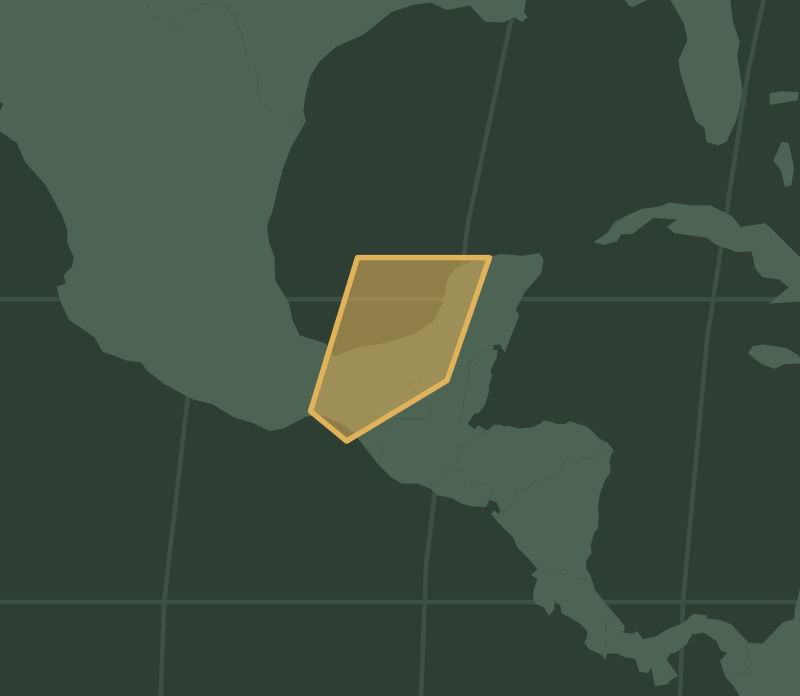
Yucatán and the Lacandon Jungle
What helps
- Learn about it as living Maya knowledge.
- Respect those who keep it.
- Do not treat it as a recreational drink.
What it contains
Bark and honey
One study indicates that the compounds in the bark produce a heightened sense of euphoria and emotional awareness.5
The honey used may come from bees that feed on a climbing plant, Turbina corymbosa, which is high in ergine, according to one source.8
Archaeometric experiments have been carried out with Yucatecan honeys and with balché prepared by contemporary Maya specialists.2
The experience
A gentle ritual intoxication
It is described as a mildly intoxicating drink.1 Some texts attribute entheogenic properties to it.6
A naturalist who tried it described it as sweetened and tasting of cinnamon and wood smoke, barely fermented.3
Research
What has been studied
There are recent archaeological, ethnographic and archaeometric studies on its ancient and present-day consumption.25
McGee's Lacandon ethnography is the classic reference.4
Scope of these dataArchaeological and ethnographic study; little chemistry.
With care
What it helps to know beforehand
To follow
Books and related medicines
Sources
Where each piece of information comes from
- Wikipedia. Balché. wikipedia.org/wiki/Balch%C3%A9.
- Maya Ritual Beverages: Unveiling the Ingredients for an Ancient Alcoholic Offering. core.tdar.org/document/498733/maya-ritual-beverages-unveiling-the-ingredients-for-an-ancient-alcoholic-offering.
- Conrad, J. Balché. backyardnature.net/yucatan/balche.htm.
- McGee, R. J. The balché ritual of the Lacandon Maya. Estudios de Cultura Maya 18. revistas-filologicas.unam.mx/estudios-cultura-maya/index.php/ecm/article/view/184.
- Balché Consumption among the Ancient Maya: Bees, Honey, and Ritual Practice. core.tdar.org/document/498737/balche-consumption-among-the-ancient-maya-bees-honey-and-ritual-practice.
- Yucatan Times. Balché: Sacred Maya drink. theyucatantimes.com/2018/04/balche-sacred-maya-drink.
- Wikipedia. Xtabentún (liqueur). wikipedia.org/wiki/Xtabentun_(liqueur).
- Wikipedia. Entheogenics and the Maya. en.wikipedia.com/wiki/Entheogenics_and_the_Maya.
- Map APDER, with data from Natural Earth · public domain
- Molecule drawings APDER
Last reviewed: 24 November 2026. If you spot a mistake, write to us at info@apder.org.