

Plant · Lythraceae · From Mexico to Argentina
Sinicuichi
Heimia salicifolia Link
A yellow-flowered shrub that grows from the southern United States and Mexico to Argentina. Peoples of Mexico and Central America have used it for shamanic purposes, and hallucinogenic and medicinal effects are attributed to it, with alkaloids typical of the Lythraceae family.123
Also calledsinicuichi · sini · sun opener · shrubby yellowcrest · willow-leaf heimia · Heimia salicifolia
- What it is
- Yellow-flowered shrub of the Lythraceae family
- Territory
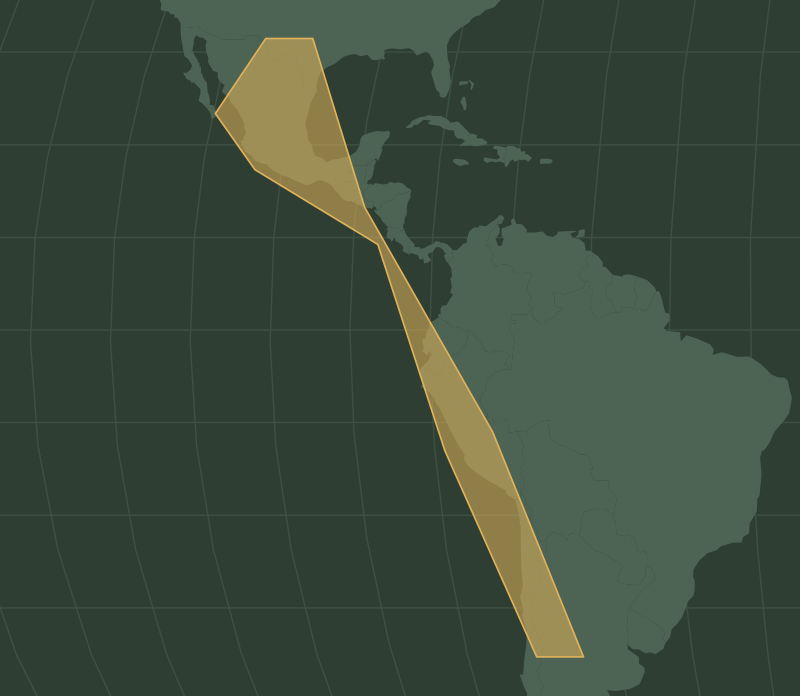
- From the south-western United States, through Mexico and Central America, to Argentina
- Part used
- The leaves
- Active principles
- Quinolizidine alkaloids: vertine (cryogenine), lythrine, nesodine and lyfoline
- Onset and duration
- No reliable data in the sources consulted
- Who keeps its memory
- Peoples of Mexico and Central America; the Aztecs are mentioned
Botany
The sun opener
Heimia salicifolia is a species of flowering plant of the Lythraceae family, native to the Americas, from the south-western United States (Texas and New Mexico) and Mexico to Argentina.1
It is a shrub of up to about 3 m, with yellow five-petalled flowers 2 to 3 cm in diameter.2 Its leaves resemble those of the willow, hence the name "willow-leaf heimia".6
The genus Heimia, described by Link and Otto in 1822, honours the German physician Ernst Ludwig Heim (1747-1834).6
- Family
- Lythraceae
- Height
- Up to about 3 m
- Flowers
- Yellow, five-petalled
- Part used
- Leaves
Memory and tradition
Shamanic use in Mexico and Central America
Shamanic use of the plant has been described among native peoples of Central America and Mexico.3 Hallucinogenic and also medicinal effects are attributed to it.3
Some Mexican shamans still use it as a tool for divination.4
The genus has a long history of medicinal use in several American cultures.2
Among the notes gathered is the name "elixir of the sun", but that association comes from popular sources.5
Over time
Link and Otto describe the genus Heimia.6
Malone and Rother publish a phytochemical and phytopharmacological review.7
Its names
- sinicuichi, sini
- Mexico
- sun opener
- English: "sun opener"
- shrubby yellowcrest
- English
Territory and care
From Mexico to Argentina
What helps
- Learn about it as a plant of Mesoamerican peoples.
- Do not treat it as a product.
- Respect the knowledge that safeguards it.
What it contains
Quinolizidine alkaloids
Five quinolizidine alkaloids have been found; the main psychoactive alkaloid appears to be vertine (cryogenine).4
The four most studied alkaloids are vertine, lyfoline, lythrine and nesodine.7
Lythrine and cryogenine (vertine) are diastereomers.6
The USDA phytochemical database records cryogenine in the stem and other alkaloids, such as dehydrodecodine.8
Related synthetic compounds, the 4-arylquinolizidines, are being studied for possible anti-inflammatory potential.7
Considered the main bioactive component.[1][4]
Diastereomer of cryogenine; studied in the laboratory.[6]
A much-studied alkaloid of the plant.[7]
The experience
Between the medicinal and the dreamlike
The sources consulted speak of hallucinogenic and medicinal effects, without systematic data.3
There are no reliable data on onset or duration.
Research
What has been studied
There is a phytochemical and phytopharmacological review from 1994.7
In 2020 a thesis evaluated whether lythrine has an anxiolytic effect in chicks.6
There are no clinical studies.
Scope of these dataChemistry and animal models; no studies in people.
With care
What it helps to know beforehand
To follow
Books and related medicines
Sources
Where each piece of information comes from
- Wikipedia. Heimia salicifolia (sinicuichi). wikipedia.org/wiki/Sinicuichi.
- Wikipedia. Heimia. en.wikipedia.com/wiki/Heimia.
- Wikipedia. Heimia salicifolia. en.wikipedia.org/wiki/Heimia_salicifolia.
- Rev. MeO, Auxin, Erowid. Heimia salicifolia FAQ. taz4.erowid.org/plants/sinicuichi/sinicuichi_faq.shtml.
- Earthpedia. Heimia salicifolia. earthpedia.earth.com/plant-encyclopedia/angiosperms/lythraceae/heimia-salicifolia.
- Carlton. Thesis on lythrine from Heimia salicifolia and its anxiolytic effect. Sam Houston State University. 2020. shsu-ir.tdl.org/bitstream/handle/20.500.11875/2764/CARLTON-THESIS-2020.pdf.
- Malone MH, Rother A. Heimia salicifolia: a phytochemical and phytopharmacologic review. J Ethnopharmacol. 1994;42(3):135-159. erowid.org/references/refs_view.php?ID=6470.
- USDA. Plant Heimia salicifolia (Lythraceae). phytochem.nal.usda.gov/node/5675.
- Map APDER, with data from Natural Earth · public domain
- Molecule drawings APDER
Last reviewed: 24 November 2026. If you spot a mistake, write to us at info@apder.org.