

Plant · Daisy family · Mexico and Central America
Dream herb
Calea ternifolia Kunth
A shrub from Mexico and Central America that the Chontal people of Oaxaca use to obtain divinatory messages in dreams. In traditional Mexican medicine it is also used for dysentery, fever and other ailments.123
Also known asdream herb · zacatechichi · "bitter herb" · thle-pela-kano · "God's leaf" · Calea zacatechichi · Mexican dream herb
- What it is
- Shrub of the daisy family
- Territory
- From Mexico to Costa Rica
- Part used
- The dried leaves
- Active principles
- Sesquiterpene lactones and flavonoids; the compound responsible for the dream effect is still unknown
- Onset and duration
- No reliable data in the sources consulted
- Who keeps its memory
- Chontal of Oaxaca, Popoluca Zoque and Mixe peoples
Botany
The bitter herb
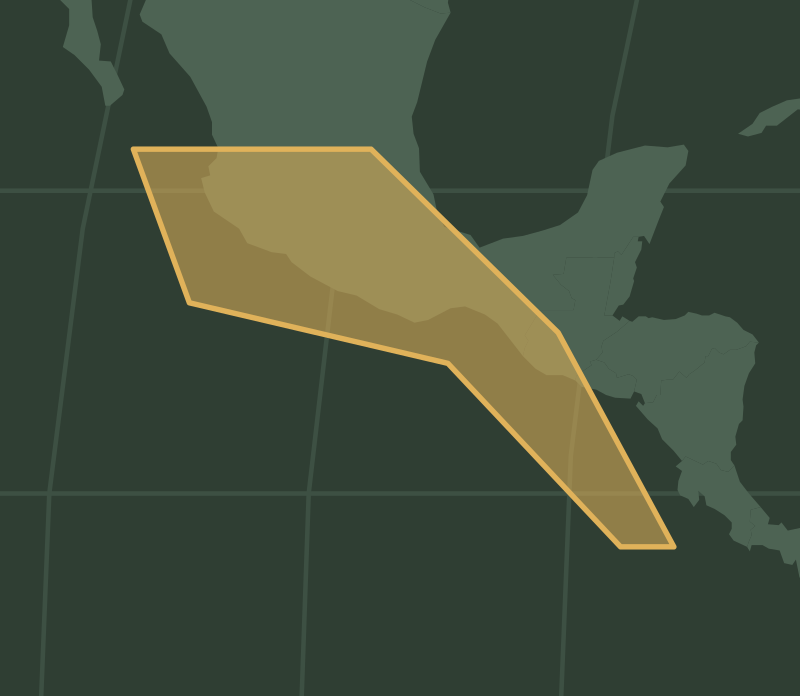
Calea ternifolia (synonym Calea zacatechichi) is a flowering plant of the daisy family, native to Mexico and Central America.3 It is distributed from Mexico to Costa Rica.2
It is a medium-sized shrub.5 Its English names include "bitter-grass", "Mexican calea" and "dream herb".3
The species was recorded as Calea ternifolia in 1820 and renamed Calea zacatechichi in 1835 using the Nahuatl word zacatechichi, "bitter herb".4
- Family
- Asteraceae
- Habit
- Medium-sized shrub
- Distribution
- From Mexico to Costa Rica
- Part used
- Dried leaves
Memory and tradition
Dreaming to divine
The Chontal people of Oaxaca use it to obtain divinatory messages during sleep.1 They call it thle-pela-kano, "God's leaf", and say that it "clears the senses".56
Isolated rituals are described in which a plant believed to be this species is smoked, drunk as a tea and placed under the pillow to induce divinatory or lucid dreams.3
In Mexico it is also used as a remedy for dysentery and fever.3 The Popoluca Zoque call it tam huñi, "bitter gum", and use it for diarrhoea and asthma; the Mixe call it poop taam ujts, "bitter white herb", and use it for stomach pain and fever.3
It is not known since when it has been used, and its use is widespread in Mexico, far beyond Chontal territory.4
In Mexico, healers continue to use it for everything from hangovers to diabetes, while outside Mexico it is used to provoke lucid dreams.4
Over time
It is recorded as Calea ternifolia.4
It is renamed Calea zacatechichi.4
First psychopharmacological analysis in humans and animals.1
Its names
- zacatechichi
- Nahuatl: "bitter herb"
- thle-pela-kano
- Chontal: "God's leaf"
- tam huñi
- Popoluca Zoque: "bitter gum"
- dream herb
- English
Territory and care
From Mexico to Costa Rica
What helps
- To know it as part of traditional Mexican medicine.
- Not to treat it as a product.
- To respect the peoples who safeguard it.
What it contains
Compounds of the leaf
A 2021 review covers its chemical constituents, quality-control assays and pharmacological and toxicological studies.2
In a recent study of the leaf, chlorogenic acid, rutin and nicotiflorin appear.7
Described in the leaf.[7]
Described in the leaf.[7]
The experience
Sleep more than wakefulness
In a 1986 study, organic extracts at human doses produced signs of drowsiness on the EEG and light sleep in cats.1
In healthy volunteers, low doses of the extract increased reaction time and time estimation, and increased the light phases of sleep and the number of spontaneous awakenings.1
The effect of the extract on brain activity was different from that of hallucinogenic-dissociative drugs such as ketamine.1
In traditional use, dried leaves are taken before sleep to increase dreams.5
Research
What has been studied
There is a double-blind study with volunteers from 1986 and a 2021 review of traditional use, botany, chemistry, pharmacology and toxicity.12
The review concludes that solid pharmacological research supports the plant's use for oneiromancy, and shows spasmolytic, antidiabetic, antidepressant, anti-inflammatory and antinociceptive effects.2
Scope of these dataSmall study in volunteers; no large clinical trials.
With care
What it helps to know beforehand
At large doses, salivation, lack of coordination, retching and sometimes vomiting are described.1
Its divinatory use belongs to the Chontal people, with their own knowledge.1
The effect observed in the laboratory is on light sleep and awakenings, not a vision.1
Large clinical trials are lacking and the responsible compound is unknown.
To follow
Books and related medicines
Sources
Where each piece of information comes from
- Mayagoitia L, Díaz JL, Contreras CM. Psychopharmacologic analysis of an alleged oneirogenic plant: Calea zacatechichi. J Ethnopharmacol. 1986;18(3):229-243. pubmed.ncbi.nlm.nih.gov/3821139/.
- Mata R et al. Calea ternifolia Kunth, the Mexican dream herb, a concise review. 2021. agris.fao.org/search/en/records/6748532e6b7cc10eeb5abd31.
- Wikiwand. Calea zacatechichi. wikiwand.com/en/Calea_zacatechichi.
- Double Blind. Calea zacatechichi (Mexican dream herb). doubleblindmag.com/calea-zacatechichi-mexican-dream-herb/.
- Erowid. Calea zacatechichi. cache.erowid.org/plants/calea_zacatechichi.
- Wikidoc. Calea zacatechichi. wikidoc.org/index.php/Calea_zacatechichi.
- Phytochemical study of "Mexican calea" (Calea zacatechichi Schltdl.). recipp.ipp.pt/bitstreams/0bed35c7-0785-4ca4-ac44-ff467be934cf/download.
- Map APDER, with data from Natural Earth · public domain
- Molecule drawings APDER
Last reviewed: 24 November 2026. If you spot a mistake, write to us at info@apder.org.