

Animal · Bufonidae · Sonoran Desert
Sonoran Desert toad
Incilius alvarius (Girard, 1859)
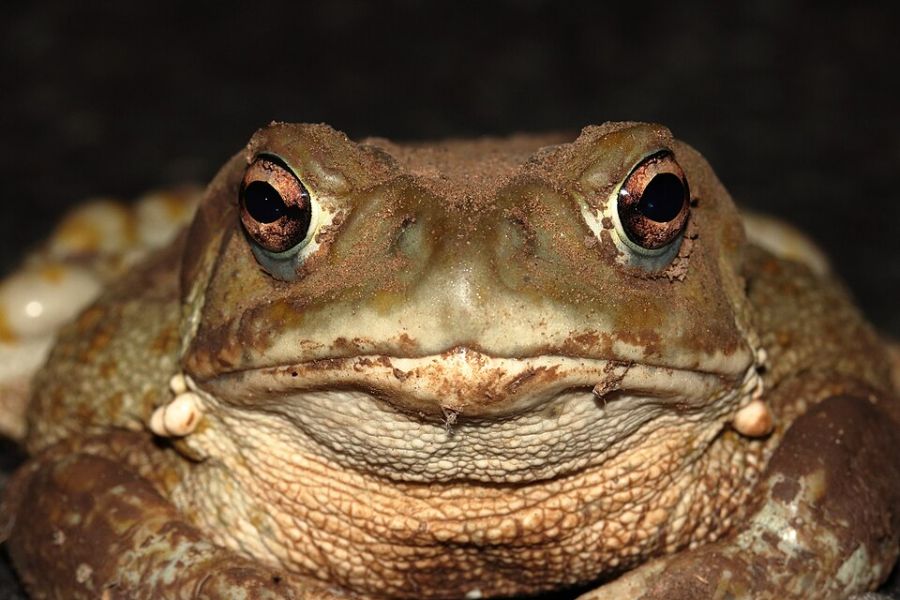
A large toad of the Sonoran Desert that comes out at night, after the rains. Its glands hold 5-MeO-DMT, one of the briefest and most intense tryptamines known, and its human use is recent and disputed.345
Also calledColorado River toad · Bufo alvarius · the toad · Sonoran Desert toad
- What it is
- Large, nocturnal amphibian of the desert
- Territory
- Sonoran Desert, between the south-western USA and north-western Mexico
- Part used
- The secretion of its parotoid glands
- Active principles
- 5-MeO-DMT and bufotenine
- Onset and duration
- Seconds · 15–45 min
- Who keeps its memory
- No people is known to be its accredited custodian
Biology
A smooth-skinned toad that waits for the rain
It is one of the largest toads in North America: it can exceed 17 centimetres. Its skin is smooth, olive or brown in colour, with large glands behind the eyes and others on the legs.12
It spends much of the year hidden in burrows and comes out at night, especially in the summer rainy season, when it breeds in temporary pools.12
When the animal feels threatened, the parotoid glands release a milky secretion that serves as a defence against predators.23
- Family
- Bufonidae
- Size
- Up to about 17 cm or more
- Habits
- Nocturnal, lives in burrows
- Reproduction
- In temporary pools after the summer rains
Memory and tradition
A medicine with a short history
Unlike other medicines in this encyclopedia, no documented Indigenous tradition of using it is known. That it may have been used in pre-Columbian Mexico is a hypothesis of researchers, not an established fact.4
Its modern history begins with science: in 1992 Davis and Weil described the toad as a candidate to be the first hallucinogenic agent of animal origin, and in 1994 they showed that its dried secretion can be smoked and is highly psychoactive, whereas it is toxic if swallowed.34
Since then it has become a practice of contemporary ceremonies and groups. It is a young tradition, and anyone approaching it should do so knowing this.
Over time
Girard describes the species under the name Bufo alvarius.2
Davis and Weil publish "Identity of a new world psychoactive toad".4
Weil and Davis document that the secretion is psychoactive when smoked and toxic when swallowed.3
A review gathers the clinical pharmacology of 5-MeO-DMT and its possible therapeutic development.5
Its names
- Sonoran Desert toad
- after the Sonoran Desert where it lives
- Colorado River toad
- English name, Colorado River toad
- Bufo alvarius
- earlier scientific name; now Incilius alvarius
- The toad
- how 5-MeO-DMT is referred to in many circles
The genus changed from Bufo to Incilius after a revision of the classification of the bufonids, and that is why both names coexist in the literature.12
Territory and care
A desert animal in a fragile territory
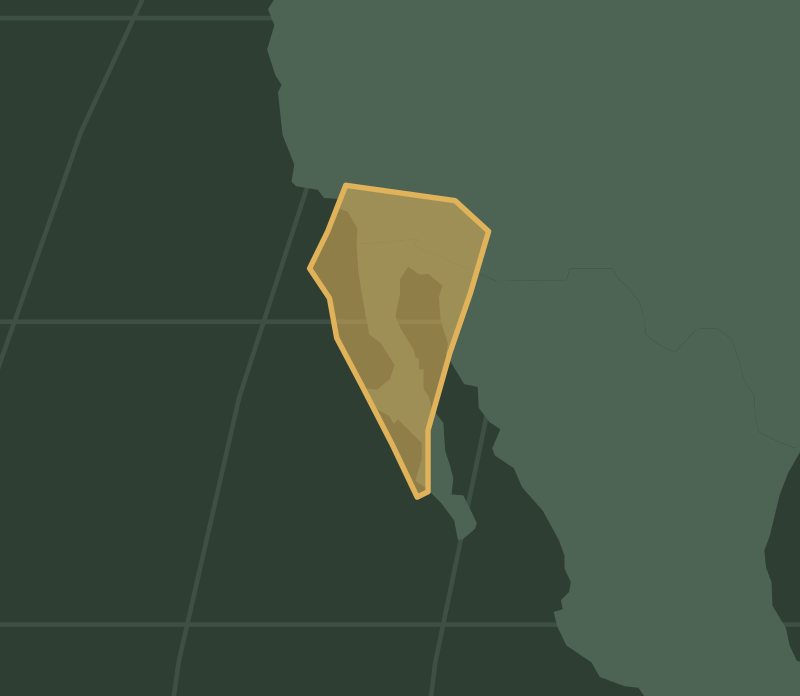
It lives in the Sonoran Desert and neighbouring areas: southern Arizona and south-western New Mexico in the USA, and the Mexican states of Sonora, Sinaloa and Chihuahua.12
It is a wild animal, and demand for it in ceremonies outside its homeland worries those who look after it; synthetic 5-MeO-DMT is the alternative that does not touch the animal.
What helps
- Prefer synthetic 5-MeO-DMT, which does not require capturing animals.
- Do not capture or "milk" toads: it is a wild animal of a fragile desert.
- Ask about the origin of any secretion before accepting its provenance.
What it contains
5-MeO-DMT, a fast and very potent tryptamine
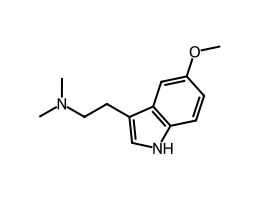
The secretion contains 5-MeO-DMT and bufotenine, among other substances. Davis and Weil identified 5-MeO-DMT as the main psychoactive component.35
5-MeO-DMT acts mainly on the serotonin 5-HT1A receptor, and also on 5-HT2A.5 The secretion also contains other substances, some of them toxic if swallowed, and for this reason it is never taken by mouth.3
 5-MeO-DMTTryptamine · main
It binds mainly to the 5-HT1A receptor, with lower affinity for 5-HT2A.[5]
The experience
A quarter of an hour that changes everything
It begins to be noticed within seconds and lasts between fifteen and forty-five minutes, with a gradual return afterwards. Because of its speed, it is one of the briefest and most intense psychedelic experiences.56
Those who experience it find it hard to describe in words: many people speak of a dissolution of the self. For this reason, although short, it is not a light experience and should not be undertaken without support.
Indicative outline: it changes with the preparation, the amount and the person.
Research
What has been studied
A 2022 review reports that 5-MeO-DMT has been studied in human beings with initial explorations and that further research is justified, with the same precautions as for other classic psychedelics.5
In 2023, a phase 1/2 study of a vaporised formulation of synthetic 5-MeO-DMT, in people with treatment-resistant depression, reported acceptable safety and an improvement in symptoms.6
Scope of these dataThese are initial studies, with few people and without a sufficient placebo group to draw conclusions. There is no approved medicine containing 5-MeO-DMT, and the studies use the synthetic form, not the toad's secretion.
With care
What it helps to know beforehand
The secretion is toxic if swallowed; only its use smoked and dried has been described.3
Interactions: some medicines, especially monoamine oxidase inhibitors, greatly change its effects. The APDER guide details who should not take it.
Capturing toads harms a wild animal and its habitat. Synthetic 5-MeO-DMT avoids that harm.
It does not come from a documented tradition; it is worth knowing where the person offering it comes from and how they provide support.4
To follow
Books and related medicines
Sources
Where each piece of information comes from
- AmphibiaWeb. Incilius alvarius — Sonoran Desert Toad. amphibiaweb.org.
- Wikipedia. "Colorado River toad". en.wikipedia.org (accessed 24 November 2026).
- Weil AT, Davis W. Bufo alvarius: a potent hallucinogen of animal origin. J Ethnopharmacol. 1994;41(1-2):1-8.
- Davis W, Weil AT. Identity of a New World psychoactive toad. Ancient Mesoamerica. 1992;3(1):51-59.
- Reckweg JT, Uthaug MV, Szabo A, et al. The clinical pharmacology and potential therapeutic applications of 5-methoxy-N,N-dimethyltryptamine (5-MeO-DMT). J Neurochem. 2022;162(1):128-146.
- Reckweg JT, van Leeuwen CJ, Henquet C, et al. A phase 1/2 trial to assess safety and efficacy of a vaporized 5-methoxy-N,N-dimethyltryptamine formulation (GH001) in patients with treatment-resistant depression. Front Psychiatry. 2023;14:1133414.
- Sonoran Desert toad (Incilius alvarius). Rstanton13 · CC BY-SA 4.0
- Map APDER, with data from Natural Earth · public domain
- Molecule drawings APDER
Last reviewed: 24 November 2026. If you spot a mistake, write to us at info@apder.org.