

Molecule · Psychoactive
Salvinorin A
neoclerodane diterpenoid
Salvinorin A is the active principle of Salvia divinorum, the ‘diviner’s sage’, used by the Mazatecs of Oaxaca. It is a nitrogen-free diterpene that acts as a potent and selective agonist of the kappa opioid receptor, not at the 5-HT2A receptor of the classic psychedelics. It was isolated in 1982.1256
Also known assalvinorin · divinorin (Valdés’s original name)
- What it is
- Non-alkaloid hallucinogenic diterpene
- Territory
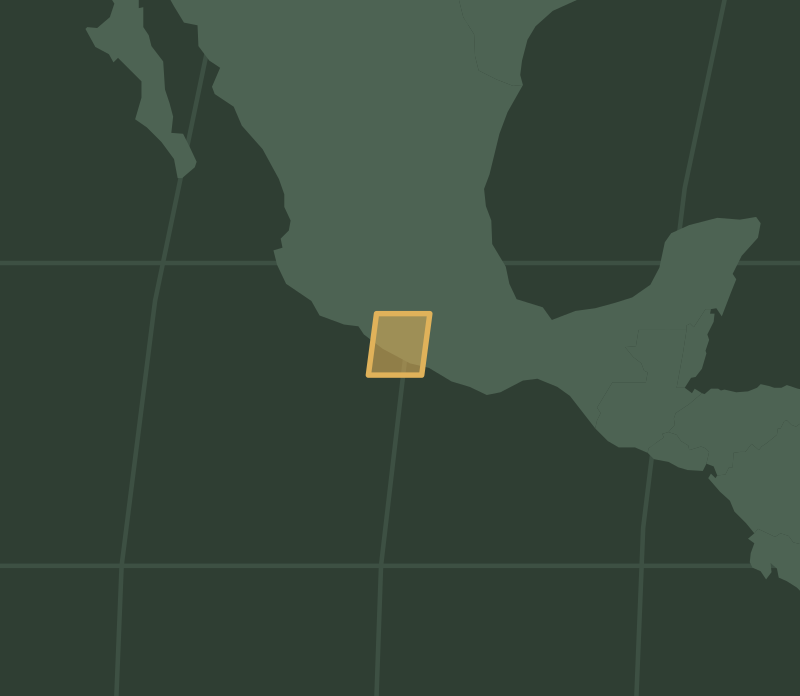
- Sierra Mazateca, Oaxaca, Mexico
- Source
- Leaves of Salvia divinorum
- Mechanism
- Selective agonist of the kappa opioid receptor
- Onset and duration
- Very short: about fifteen to thirty minutes
- Who keeps its memory
- Mazatec people
The substance
A nitrogen-free diterpene
It is a trans-neoclerodane diterpenoid, the first compound to act on the kappa opioid receptor without being an alkaloid.87
It is found together with salvinorins B to I, divinorins A to F and other related compounds.4
Salvia divinorum is a mint of the Lamiaceae family, with a Mazatec tradition of use.9
Descriptive profile: no doses and no preparation.
- Class
- Diterpenoid
- Source
- Salvia divinorum
- Receptor
- Kappa opioid
- Isolation
- 1982
Memory and history
The diviner’s sage
The Mazatec people of Oaxaca have used it for centuries in spiritual and divinatory practices.73
The Mazatecs call it ‘ska Maria Pastora’, from the belief that it is the incarnation of the Virgin Mary.2
Traditionally it is chewed as a quid or drunk as an extract of fresh leaves.9
Alfredo Ortega and colleagues isolated and described it in 1982 in Mexico, and Leander Valdés studied it in a thesis published in 1983 as ‘divinorin’; the name was corrected to salvinorin A and B in 1984.8
The plant was collected by Hofmann and Wasson, and Epling described it as a new species.39
Over time
Ortega isolates salvinorin A
The kappa opioid receptor is identified
Its names
Context and care
Origin and context
What helps
- Seeking information from reliable sources.
- Telling research, experience and regulated use apart.
- Respecting legal and clinical frameworks.
Chemistry and mechanism
Kappa opioid, not serotonergic
In 2002 salvinorin A was found to be a potent and selective agonist of the kappa opioid receptor; it was the first non-alkaloid subtype-selective opioid agonist.57
Its effects are not mediated by the 5-HT2A receptor, the classic target of LSD or psilocybin.2
It has also been found to act as a partial agonist of the D2 receptor.8
It is active at very low doses and its duration is very short.8
The experience
What is described
Produces a mild, short-lived hallucinogenic state of about fifteen to thirty minutes, according to tradition.1
Research
What has been studied
Kappa antagonists are being investigated as candidate psychiatric drugs for distorted perceptions such as those in schizophrenia or dementia.5
Its analogues are being studied as probes of opioid receptors and for drug design.1
There is a review of its psychopharmacology.3
Scope of these dataBasic pharmacology and medicinal chemistry; no clinical trials.
With care
What it helps to know beforehand
Its effect is intense and disorienting, although brief; in the tradition it is taken with support.
Its kappa opioid action differs from that of the classic psychedelics.2
Its recreational use has increased over the last decade.9
To follow
Books and related medicines
Sources
Where each piece of information comes from
- MAPS. Salvia divinorum: Chemistry and Pharmacology. bibliography.maps.org/resources/download/19202.
- Study on salvinorin A as an opioid agonist, PubMed Central. pmc.ncbi.nlm.nih.gov/articles/PMC3082450.
- MAPS. Psychopharmacology of Salvia divinorum. bibliography.maps.org/resources/download/19274.
- MAPS. Salvinorins and opioid receptors. bibliography.maps.org/resources/download/14710.
- Roth, B. L. et al. Salvinorin A: a potent naturally occurring nonnitrogenous kappa opioid selective agonist. PNAS, 2002. pubmed.ncbi.nlm.nih.gov/12192085/.
- Study on the pharmacophore of salvinorin A, PubMed Central. pmc.ncbi.nlm.nih.gov/articles/PMC2777653.
- Roth, B. L. et al. PNAS 2002 (full text). pmc.ncbi.nlm.nih.gov/articles/129372.
- Wikipedia. Salvinorin A. wikipedia.com/wiki/Salvinorin_A.
- MAPS. Salvia divinorum, Mazatec use. bibliography.maps.org/bibliography/resources/download/20612.
- Map APDER, with data from Natural Earth · public domain
- Molecule drawings APDER
Last reviewed: 24 November 2026. If you spot a mistake, write to us at info@apder.org.