

Plant · Caryophyllaceae · Eastern Cape, South Africa
African dream root
Silene capensis Otth
A sticky herb from the Eastern Cape of South Africa that the Xhosa people hold sacred. Its root, the ubulawu, is used in the initiation of traditional healers to bring on vivid dreams that, according to the Xhosa, are prophetic.123
Also known asAfrican dream root · ubulawu · undlela zimhlophe · ‘white paths’ · unozitholana · Silene undulata · Silene capensis
- What it is
- Sticky perennial herb of the pink family
- Territory
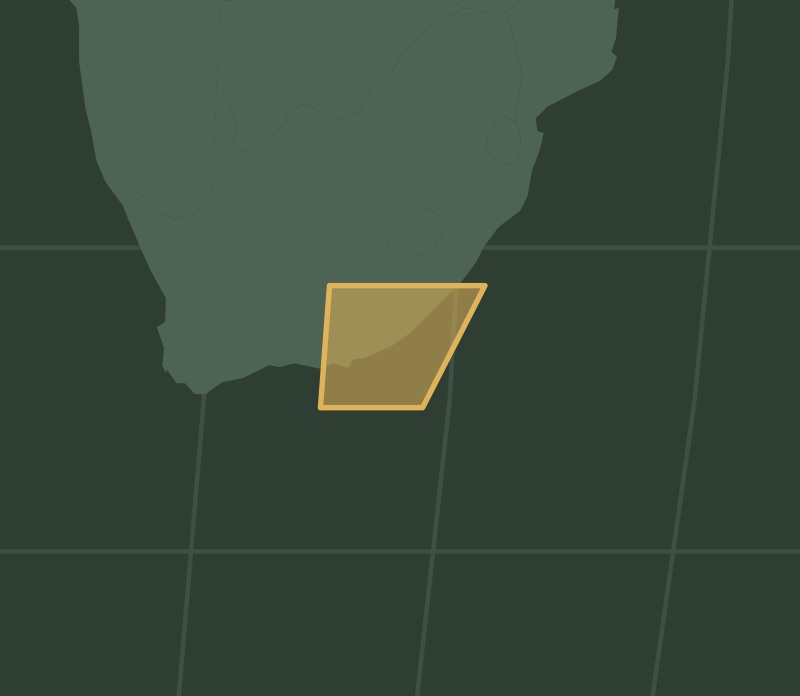
- Eastern Cape, in southern Africa
- Part used
- The root, harvested from the second year
- Active principles
- Triterpenoid saponins, according to the most-cited hypothesis; incomplete data
- Onset and duration
- No reliable data in the sources consulted
- Who keeps its memory
- Xhosa people and sangoma healers
Botany
A sticky herb with night-blooming flowers
Silene undulata, also called Silene capensis, is a glandular, sticky perennial herb growing up to 60 cm, in the Caryophyllaceae family.23
Its fragrant flowers open at night and close by day.4 It is biennial or a short-lived perennial, and the root can be harvested from the second year.4
The name of the genus comes from the Greek sialon, ‘saliva’, because of the sticky stems.1
- Family
- Caryophyllaceae
- Height
- Up to 60 cm
- Flowers
- Fragrant, opening at night
- Part used
- Root
Memory and tradition
The white paths
The Xhosa people regard it as sacred.45 Its root is traditionally used to bring on vivid dreams, prophetic according to the Xhosa, during the initiation of traditional healers.4
The name ubulawu comes from the verb ukulawula, which in everyday use means ‘to give instructions’ and here means to recount the dreams in which instructions have been received.1
In Xhosa it is called iindlela zimhlophe, ‘white paths’.3
It is the most widely used ubulawu plant in the Eastern Cape, where several anthropological studies of it have been carried out.2
Diviners and shamans have used it to bring on prophetic states of lucid dreaming.5
More recently it has been offered internationally as a psychoactive ‘meditation herb’, under the trade name ‘African dream root’.2
Over time
Its names
- ubulawu
- Xhosa name for the dream root
- iindlela zimhlophe
- ‘white paths’
- unozitholana
- another Xhosa name
- African dream root
- English trade name
Silene capensis and Silene undulata are often used as synonyms.36
Territory and care
The Eastern Cape
What helps
- Know it as a sacred plant of the Xhosa.
- Do not treat it as a product.
- Respect the sangoma and the knowledge of initiation.
What it contains
A chemistry that is still unclear
The most-cited hypothesis attributes its dream-related action to the triterpenoid saponins in the root.7
According to a summary on Wikipedia, β-carbolines such as norharmane, harmalol, harmaline and harmine were found, as well as ibogaine, and they were predicted to act as agonists of the serotonin 5-HT2A receptor.4 This information comes from a single secondary source and should be checked against the primary one.
Most-cited hypothesis for the effect on dreaming.[7]
Cited in a secondary source; unconfirmed.[4]
The experience
Sleep more than wakefulness
It is described as an oneirogen, a plant that acts on dreaming, comparable to the Mexican dream herb, Calea zacatechichi.4
According to commercial texts, it barely alters waking consciousness but can change dreaming a great deal.7 This is an unverified claim.
There are no reliable data on onset or duration.
Research
What has been studied
There are anthropological studies of its use in the Eastern Cape.2
There are no clinical studies.
Scope of this evidenceDocumented traditional use; no clinical studies.
With care
What it helps to know beforehand
To follow
Books and related medicines
Sources
Where each piece of information comes from
- Grocott's Mail. Xhosa dream (Silene undulata). pressreader.com/south-africa/grocotts-mail/20161118/281822873386103.
- SANBI. Silene undulata. pza.sanbi.org/node/10962.
- Wikipedia. Silene undulata. en.wikipedia.com/wiki/Silene_undulata.
- Wikiwand. Silene undulata. wikiwand.com/en/articles/Silene_undulata.
- Britannica. African dream root. britannica.com/plant/African-dream-root.
- Wikidoc. Silene capensis. wikidoc.org/index.php/Silene_capensis.
- Kruidwis. Afrikanische Traumwurzel (Silene capensis). sites.google.com/site/kruidwis/kruiden-planten-van-a-tot-z/silene-capensis.
- Map APDER, with data from Natural Earth · public domain
- Molecule drawings APDER
Last reviewed: 24 November 2026. If you spot a mistake, write to us at info@apder.org.