

Molecule · Psychoactive
LSD
lysergic acid diethylamide
LSD is a lysergic acid diethylamide synthesised in 1938 by Albert Hofmann from ergot alkaloids. Its psychoactive effect was discovered in 1943. It is a potent psychedelic that acts on serotonin receptors, and it was researched in psychotherapy in the 1950s and 1960s; today it is being studied again.124
Also known asLSD-25 · acid · Delysid (historical Sandoz trade name)
- What it is
- Semi-synthetic psychedelic
- Territory
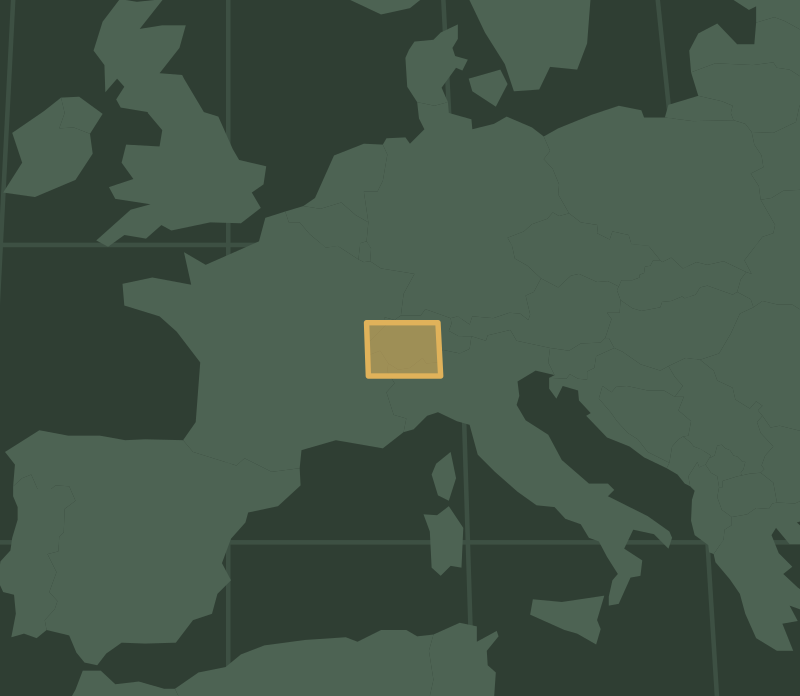
- Basel, Switzerland
- Source
- Synthesis from ergot alkaloids
- Mechanism
- Agonist of 5-HT2A, 5-HT1A and other receptors
- Onset and duration
- Many hours
- Who keeps its memory
- Hofmann, Sandoz and psychedelic research
The substance
An ergot derivative
It was synthesised in 1938 in the Sandoz laboratories in Basel, as the twenty-fifth compound in a series by Hofmann, who was looking for substances with an effect on circulation.35
At first no benefit was seen and it was not researched further for five years.7
It belongs to the alkaloids derived from ergot.5
Descriptive profile: no doses and no synthesis.
- Class
- Lysergamide
- Origin
- Ergot
- Synthesis
- 1938
- Discovery
- 1943
Memory and history
Bicycle Day
Hofmann synthesised LSD-25 in 1938 and its psychoactive properties were not recognised until 1943, after he accidentally ingested a small amount.25
On 16 April 1943 he experienced growing anxiety on his cycle ride home, according to the account that has been publicised.6
In 1947 Sandoz named it Delysid and began distributing it as an experimental psychiatric drug.2
In the 1950s and 1960s it was studied for alcoholism, anxiety and trauma, and was given to more than 40,000 patients.29
Research stopped in the early 1970s under political pressure after its widespread uncontrolled use.8
Hofmann called it "my problem child" in his 1980 book.5
Over time
Synthesis
Discovery of its effects
Sandoz distributes it as Delysid
Research stops
Its names
Context and care
Origin and context
What helps
- Seeking information from reliable sources.
- Telling research, experience and regulated use apart.
- Respecting legal and clinical frameworks.
Chemistry and mechanism
Serotonin, dopamine and adrenergics
It binds potently to serotonin receptors 5-HT1A, 5-HT2A and 5-HT2C, to dopamine D2 receptors and to adrenergic alpha-2 receptors.10
5-HT2A receptors mediate above all its hallucinogenic effects.108
In one study, it increased the sense of closeness to others, openness, trust and suggestibility, and raised global brain entropy.8
The experience
What is described
It increased feelings of closeness, openness and trust, mediated by the 5-HT2A receptor.8
Research
What has been studied
There is recent work with LSD in Europe, and small trials with psilocybin in depression, anxiety and addictions.1
In people with anxiety due to a life-threatening illness, anxiety fell for two months after two doses of LSD.8
It is debated whether the benefits of microdosing come from LSD or from placebo.2
Scope of these dataRecent phase 2 clinical trials; controlled trials are still limited.
With care
What it helps to know beforehand
Large controlled trials are lacking; the results are promising but preliminary.1
The experience depends on preparation, support and integration.
It is debated whether the benefit is pharmacological or placebo.2
To follow
Books and related medicines
Sources
Where each piece of information comes from
- Passie, T. and Halpern, J. H. Historia del LSD, MAPS. bibliography.maps.org/resources/download/16431.
- Berkeley Center for the Science of Psychedelics. LSD. psychedelics.berkeley.edu/substance/lsd/.
- Berkeley Center for the Science of Psychedelics. LSD, history. psychedelics.berkeley.edu/?p=174.
- Hagenbach, D. and Werthmüller, L. Mystic Chemist, review. psychedelics.berkeley.edu/tag/albert-hofmann/.
- EBSCO Research Starters. Hofmann Synthesizes the Potent Psychedelic Drug LSD-25. ebsco.com/research-starters/health-and-medicine/hofmann-synthesizes-potent-psychedelic-drug-lsd-25.
- MAPS. First LSD Hallucination: April 16, 1943. maps.org/news/media/first-lsd-hallucination-april-16-1943/.
- Lucas, K. LSD Throughout Time, Clemson OpenText. opentextbooks.clemson.edu/hlth4000holcombtugman/chapter/lsd-throughout-time/.
- Liechti, M. E. Clinical pharmacology and use of LSD in psychiatry. Neuropsychopharmacology, 2017. nature.com/articles/npp201786.
- MAPS. First LSD Hallucination (research in 1950-1960). maps.org/?p=5783.
- Review of clinical research with LSD, PubMed Central. pmc.ncbi.nlm.nih.gov/articles/PMC5603820.
- Map APDER, with data from Natural Earth · public domain
- Molecule drawings APDER
Last reviewed: 24 November 2026. If you spot a mistake, write to us at info@apder.org.