

Plant · Papaveraceae · Mediterranean and Asia Minor
Opium poppy
Papaver somniferum L.
The opium poppy is the plant of opium, the dried latex of its capsules. It has accompanied the peoples of Europe since the Neolithic and was a sacred symbol in the Bronze Age Aegean. Morphine and codeine, still medicines for pain today, come from it.129
Also calledamapola del opio · opio (the latex) · Papaver somniferum · "the one that brings sleep"
- What it is
- Annual herb of the poppy family
- Territory
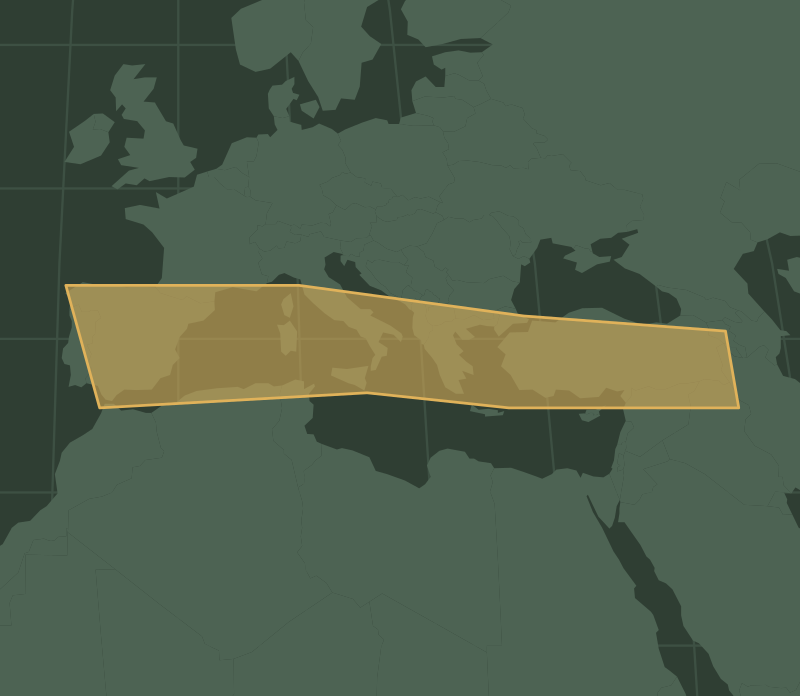
- Mediterranean and Asia Minor; now grown in many countries
- Part used
- Latex of the green capsule; the seeds as food
- Active principles
- Morphine, codeine, thebaine, papaverine and noscapine
- Onset and duration
- Not applicable: botanical and historical entry
- Who keeps its memory
- Neolithic peoples of Europe, the Aegean, Mesopotamia and Asia
The plant
The poppy that brings sleep
It is an annual herb with blue-green leaves, almost always hairless, and white sap. This milky sap, rich in morphine and other opiates, runs through the plant in a system of latex vessels; the seeds contain hardly any morphine and are used as a condiment and for oil.4
Opium is the air-dried latex that comes from the seed capsule.3
Its scientific name means "the one that brings sleep".1
- Family
- Papaveraceae
- Cycle
- Annual
- Sap
- White latex
- Seeds
- Food and oil
Memory and tradition
Seven thousand years alongside humans
It is perhaps the only plant whose domestication began in Neolithic Europe: it is thought to have been first cultivated in the Mediterranean basin from the middle of the sixth millennium BC, where its probable wild ancestor, Papaver somniferum subsp. setigerum, lived.2
Outside the Mediterranean, the most frequent finds come from sites of the Linear Pottery culture (5300–4900 BC), with a spread from south to north.2
At least seventeen finds have been described from Neolithic settlements in Switzerland, Germany and Spain, among them many capsules in a burial in the Cueva de los Murciélagos.3
In the Bronze Age Aegean it appears in Minoan and Mycenaean religious contexts; the museum in Heraklion holds a figure of a goddess from Gazi, in Crete, with her arms raised, which researchers link to the opium poppy.1
It is often read that Sumerian tablets from the fourth millennium BC already speak of its cultivation.2 A 2022 study reviews what is fact and what is "factoid" in this early history, so these dates should be taken with caution.6
Across Eurasia, before anaesthesia, opium was one of the few effective remedies for pain.4 Today the plant is also viewed through the ethnography of its uses as food, medicine and narcotic.5
Over time
First probable cultivation in the western Mediterranean
Present in the Linear Pottery culture
Minoan and Mycenaean sacred contexts
Derosne isolates the "salt of opium"
Sertürner describes morphine
Its names
- adormidera
- Spanish
- opio
- from the Greek opós, juice
- Schlafmohn
- German, "sleep poppy"
- papaver somniferum
- Latin
Territory and care
From the Mediterranean to the world
What helps
- To know it through its history and botany.
- To remember that it is the source of essential medicines.
- To distinguish its medicinal role from uncontrolled use.
- To respect the legal and health frameworks of each country.
What it contains
Five main alkaloids
The plant has five main alkaloids: morphine, noscapine, codeine, thebaine and papaverine. Some act on opioid receptors and others have non-opioid effects.7
In 1803 Derosne isolated a "salt of opium", and in 1817 Sertürner described it in detail and called it morphine, after Morpheus, the Greek god of dreams.7
Opium alkaloids produce analgesic and narcotic effects through opioid receptors, and medicines such as morphine and codeine are derived from them.9
The experience
Sleep and pain relief
Ancient sources associate it with sleep and the relief of pain; its name says as much.14
It is not a psychedelic: its effect is analgesic and narcotic, mediated by opioid receptors.9
Research
What has been studied
Its alkaloids are approved medicines: morphine for moderate or severe pain and codeine as an analgesic and cough suppressant.9
The pharmacological review also describes its mechanism, dependence and withdrawal.7
Scope of these dataApproved medicines derived from the plant; the plant itself is not part of psychedelic therapy.
With care
What it helps to know beforehand
Opium alkaloids cause dependence and tolerance, and continued use is sustained in order to avoid withdrawal.7
Acute toxicity from opioid overdose depresses breathing.8
Morphine adds its effect to that of other respiratory depressants, such as other opiates or barbiturates.10
Historical and botanical entry: not a guide to use.
To follow
Books and related medicines
Sources
Where each piece of information comes from
- Hunt, P. A Selective History of the Sacred Poppy. Electrum Magazine. electrummagazine.com/?p=2980.
- Salavert, A. et al. The opium poppy in Europe: exploring its origin and dispersal during the Neolithic. Antiquity, 2018. cambridge.org/core/journals/antiquity/article/opium-poppy-in-europe-exploring-its-origin-and-dispersal-during-the-neolithic/2EF55CA05436425F48982EF9C405B849.
- Wikipedia. Opium. en.wikipedia.org/wiki/Opium.
- Oxford Botanic Garden and Herbaria. Plants 400: Papaver somniferum. herbaria.plants.ox.ac.uk/bol/plants400/Profiles/OP/Papaver.
- Makovnyka, G. Opium Poppy Agriculture and Consumption. The Arbutus Review 11(2), 2020. journals.uvic.ca/index.php/arbutus/article/view/19609/8794.
- Facts and Factoids in the Early History of the Opium Poppy. The Social History of Alcohol and Drugs 36(1), 2022. journals.uchicago.edu/doi/full/10.1086/718481.
- Review chapter on opium alkaloids. IntechOpen. intechopen.com/online-first/71219.
- Review of the toxicity of morphine, codeine, noscapine and papaverine. Current Issues in Pharmacy and Medical Sciences. czasopisma.umlub.pl/curipms/article/download/2745/3086/8354.
- DrugBank. Opiate Alkaloids. drugbank.ca/categories/DBCAT000692.
- Kapoor, L. D. Chemical and Pharmacological Aspects of Opium Alkaloids, ch. 8. Taylor & Francis. taylorfrancis.com/books/e/9781003075356/chapters/10.1201/9781003075356-8.
- Map APDER, with data from Natural Earth · public domain
- Molecule drawings APDER
Last reviewed: 25 November 2026. If you spot a mistake, write to us at info@apder.org.