

Mushroom · Hymenogastraceae · Europe and the west coast of America
Blue-staining psilocybe
Psilocybe cyanescens Wakef.
A mushroom whose cap becomes wavy as it matures, hence the English name ‘wavy cap’. It grows on wood chips and mulch in parks and gardens, and turns blue when touched because psilocin oxidises. It is known for its potency and is considered a psychedelic species.123
Also calledblue-staining psilocybe · wavy cap · potent psilocybe · caramel-capped psilocybe · Psilocybe cyanescens
- What it is
- Wavy mushroom that grows on wood
- Territory
- Western and central Europe, west coast of North America, New Zealand
- Part used
- Fruiting body
- Active principles
- Psilocybin and psilocin
- Onset and duration
- According to a Canadian poison information centre: 20–30 min and about 6–8 h
- Who keeps its memory
- No documented Indigenous tradition in the sources consulted
Botany
The wood-chip mushroom
Psilocybe cyanescens has a hygrophanous cap, caramel to chestnut brown when moist, that fades to a straw colour as it dries.3 It measures 1.5 to 5 cm and is distinctly wavy at maturity.2
Today it grows mainly on wood chips, at the edges of mulched flower beds in urban areas, and on other lignin-rich substrates.2
It usually fruits in groups or clusters.2 More than 100,000 specimens have been counted in a single patch at an English racecourse.4
It belongs to the so-called ‘P. cyanescens complex’ or ‘caramel-cap’ group; among its relatives are P. allenii (described in 2012), P. azurescens, P. subaeruginosa and P. weraroa.235
This entry is not an identification guide; very toxic mushrooms grow in the same area.
- Family
- Hymenogastraceae
- Cap
- 1.5–5 cm, wavy
- Spore print
- Blackish brown to purple
- Habitat
- Wood chips, mulch
Memory and tradition
A city mushroom
The sources consulted do not record a traditional Indigenous use of this species, unlike the Psilocybe of Mexico.
It is considered one of the best-known and most commonly gathered wood-loving psilocybes; it thrives in mulch beds.5
Over time
Its names
- wavy cap
- English
- potent psilocybe
- English
- caramel-capped psilocybe
- English
It should not be confused with Panaeolus cyanescens (Copelandia): both are abbreviated P. cyanescens.6
Territory and care
Between Europe and the west coast
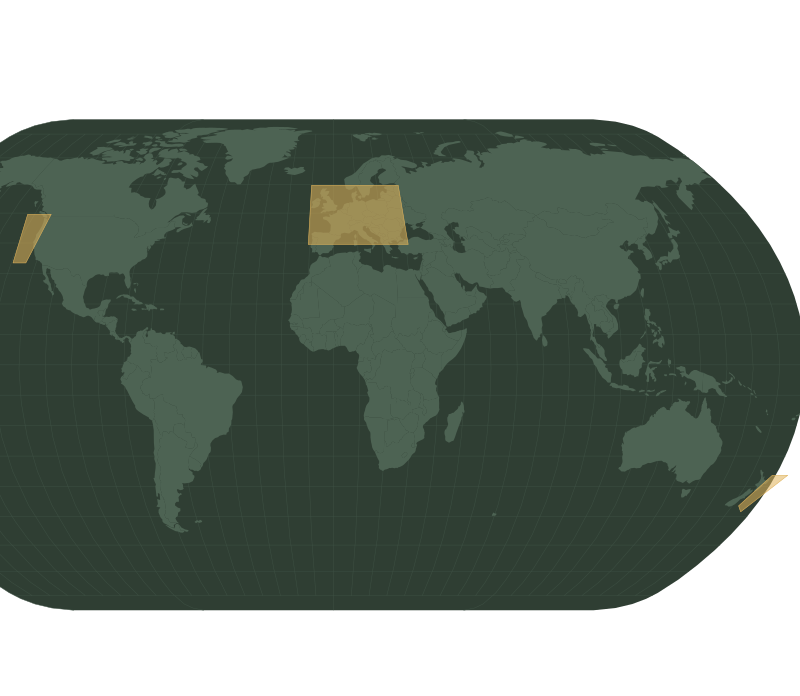
In the United States it appears mainly in the Pacific Northwest, as far as the San Francisco Bay area; also in New Zealand, western and central Europe and parts of western Asia (Iran).1
It was probably introduced to Europe, where it appears mainly in cemeteries, botanical gardens and urban parks.7
In Canada it occurs mainly in the Vancouver area and on the west coast, from southern British Columbia to southern California.8
What helps
- Do not gather it without a local expert.
- Taking care of the gardens and parks where it grows.
- Not mixing it with other mushrooms.
What it contains
Psilocybin and psilocin
The compounds responsible for its psychedelic effects are psilocybin and psilocin.1
Psilocybin is converted into psilocin by enzymatic action in damaged areas, and psilocin, when it oxidises, produces the blue staining, so even specimens with little psilocin tend to turn blue.32
Samples collected in the Czech Republic showed much higher psilocybin levels than others from Europe, according to a popular-science source.9
Main compound; converted into psilocin.[1][3]
Active compound and responsible for the blue staining when it oxidises.[2]
The experience
Described timings
A Canadian poison information centre describes the onset of symptoms 20 to 30 minutes after ingestion, with a usual duration of 6 to 8 hours, and notes that children and dogs may have more severe reactions.8
A popular-science source mentions temporary muscle paralysis associated with this species.9
Research
What has been studied
Potency analyses have been carried out on specimens from the Pacific Northwest and from Europe.9
Clinical research with psilocybin concerns above all the compound, not this species.
Scope of these dataContent analyses; no clinical trials of its own.
With care
What it helps to know beforehand
It grows in the same area as very toxic mushrooms, such as Galerina, which can cause severe liver and kidney damage.8
Its content varies according to origin.9
It is confused with Panaeolus cyanescens because of the abbreviation.6
To follow
Books and related medicines
Sources
Where each piece of information comes from
- Wikipedia. Psilocybe cyanescens. wikipedia.org/wiki/Psilocybe_cyanescens.
- Wikipedia. Psilocybe cyanescens (description and habitat). wikipedia.com/wiki/Psilocybe_cyanescens.
- GBIF. Psilocybe cyanescens Wakefield. gbif.org/species/144094046.
- Wikiwand. Psilocybe cyanescens. wikiwand.com/en/articles/Psilocybe_cyanescens.
- Double Blind Mag. Psilocybe cyanescens: A Mycologist's Guide to Wavy Caps. doubleblindmag.com/psilocybe-cyanescens/.
- Double Blind Mag. Blue meanies (Panaeolus cyanescens). doubleblindmag.com/blue-meanies-mushrooms-panaeolus-cyanescens/.
- ChemEurope. Wavy cap. chemeurope.com/en/encyclopedia/Wavy_cap.html.
- Beaty Biodiversity Museum (UBC). Psilocybe cyanescens — Wavy caps. explore.beatymuseum.ubc.ca/mushroomsup/P_cyanescens.html.
- Tripsitter. The Dark Truth About Wavy Cap Mushrooms. tripsitter.substack.com/p/psilocybe-cyanescens.
- Map APDER, with data from Natural Earth · public domain
- Molecule drawings APDER
Last reviewed: 24 November 2026. If you spot a mistake, write to us at info@apder.org.