

Molecule · Psychoactive
Mescaline
3,4,5-trimethoxyphenethylamine
Mescaline is a psychedelic protoalkaloid of the phenethylamine family, found in peyote and in columnar cacti such as San Pedro. Heffter isolated it in 1897 and Späth synthesised it in 1919. Its effects are compared with those of LSD and psilocybin, and it acts on 5-HT2A serotonin receptors.1247
Also called3,4,5-trimethoxyphenethylamine · TMPEA · mescaline (mescalin)
- What it is
- Natural phenethylamine psychedelic
- Territory
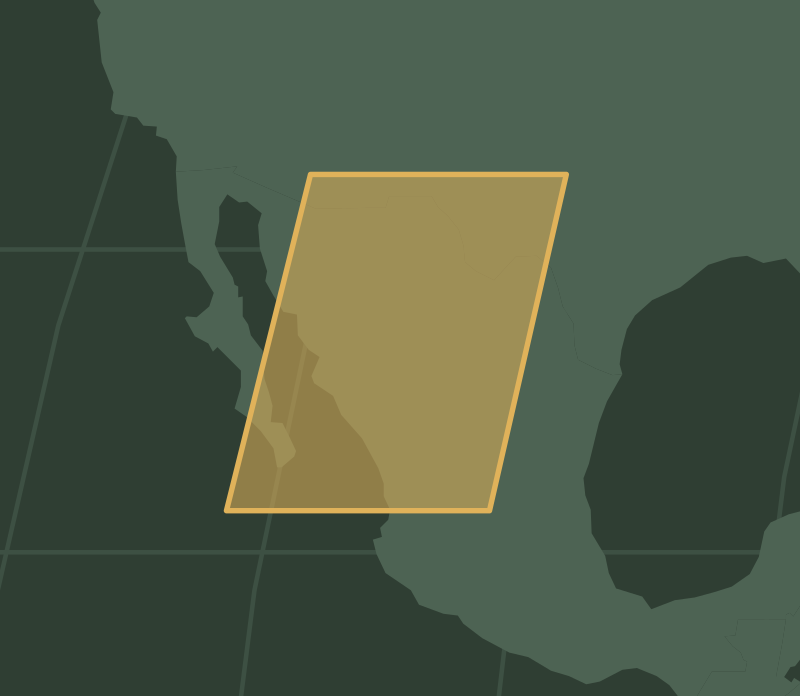
- Mexico, the Andes and the south-west of the United States
- Source
- Peyote, San Pedro and other cacti
- Mechanism
- 5-HT2A agonist; also 5-HT1A and α2A
- Onset and duration
- Many hours
- Who keeps its memory
- Peoples who use peyote and San Pedro
The substance
A cactus protoalkaloid
It is found in peyote (Lophophora williamsii) and in columnar cacti such as Echinopsis pachanoi, E. peruviana and E. lageniformis.1
The concentration varies greatly between specimens of the same species; in columnar cacti it is concentrated in the upper part and in peyote, at the sides.1
Peyote also contains other alkaloids, such as pellotine, anhalonidine and hordenine.6
Descriptive entry: no doses and no extraction.
- Class
- Phenethylamine
- Sources
- Peyote, San Pedro
- Isolation
- 1897
- Synthesis
- 1919
Memory and history
From Heffter to Huxley
Heffter published in 1894 on "pellote" as an intoxicant and medicine in northern Mexico, and had earlier isolated pellotine.8
On 23 November 1897, Arthur Heffter isolated and identified mescaline, which he named after "mescal", another name for peyote.34
Ernst Späth synthesised it in Vienna in 1919 and established its formula, somewhat different from the one Heffter had proposed.35
In 1927 Kurt Beringer published an extensive study with 32 subjects.4
In 1954 Aldous Huxley published The Doors of Perception, about his experience with mescaline in 1953.4
In 1960 Alexander Shulgin tried it for the first time.4
Over time
Heffter isolates mescaline
Späth synthesises it
Huxley publishes his book
Its names
Context and care
Origin and context
Heffter published in 1894 on "pellote" as an intoxicant and medicine in northern Mexico, and had earlier isolated pellotine.8
What helps
- Seeking information from reliable sources.
- Telling research, experience and regulated use apart.
- Respecting legal and clinical frameworks.
Chemistry and mechanism
Serotonin 5-HT2A
The psychoactive effects of peyote are due to activation of the 5-HT2A receptor and the release of calcium.6
It also binds to 5-HT1A and α2A in a similar concentration range, and is excreted mostly unchanged in the urine.8
As a phenethylamine derivative, the signs are consistent with a sympathomimetic effect.9
The experience
What is described
The clinical effects resemble those of LSD and psilocybin and include euphoria, hallucinations and depersonalisation.9
It has been treated as one of the classic psychedelics, with the same frameworks of set and setting.6
Research
What has been studied
Its therapeutic benefit is being assessed today.6
Research slowed in the 1960s and 1970s with prohibition.9
Scope of these dataHistorical pharmacology and a recent review; clinical trials are scarce.
With care
What it helps to know beforehand
Peyote is a sacrament of Indigenous churches and peoples.
Peyote grows slowly; see the peyote entry.
It has sympathomimetic effects.9
To follow
Books and related medicines
Sources
Where each piece of information comes from
- Wikipedia. Mescaline. wikipedia.com/wiki/Mescalin.
- Springer. History of research on peyote. link.springer.com/article/10.1007/s00706-019-02444-0.
- Chacruna. A Century of Mescaline. chacruna.net/century_of_mescaline/.
- Erowid. Mescaline Timeline. erowid.org/mescaline/mescaline_timeline.php.
- Chacruna. A Century of Mescaline (archive). chacruna.net/?p=103022.
- Peyote and mescaline, PubMed Central. pmc.ncbi.nlm.nih.gov/articles/PMC10746114/.
- Wikipedia. Mescaline (synthesis). en.wikipedia.com/wiki/Mescalin.
- Dark Classics in Chemical Neuroscience. repositorio.uchile.cl/bitstream/handle/2250/155746/Dark_Classics_in_Chemical.pdf.
- Pharmacokinetics and toxicity of mescaline, PubMed Central. pmc.ncbi.nlm.nih.gov/articles/PMC6864602.
- Map APDER, with data from Natural Earth · public domain
- Molecule drawings APDER
Last reviewed: 24 November 2026. If you spot a mistake, write to us at info@apder.org.