

Fungus · Strophariaceae · Mexico
Derrumbe
Psilocybe caerulescens Murrill
A mushroom that sprouts on disturbed ground, on slopes and landslips in the Mexican cloud forest, hence its name (“derrumbe” means landslide). The Nahua call it teotlaquilnanácatl, “sacred mushroom that paints or describes”, and it has been proposed as the teonanácatl mentioned by Sahagún in the 16th century.123
Also known asderrumbe · landslide mushroom · black derrumbe · water derrumbe · cañadas · teotlaquilnanácatl · ravine mushroom
- What it is
- Bluing mushroom of disturbed ground
- Territory
- Cloud forest of Mexico (endemic)
- Part used
- Fruiting body
- Active principles
- Psilocybin (according to the genus)
- Onset and duration
- No reliable data in the sources consulted
- Who keeps its memory
- Mazatec, Mixe, Totonac and Nahua peoples
Botany
The mushroom of the landslide
Psilocybe caerulescens grows on disturbed ground and in muddy soils with wood debris; it has a wide range and little specificity for any one type of vegetation.1
It is found in montane cloud forest and is endemic to Mexico.1
Heim identified the species among the mushrooms that the Wassons collected in Huautla in 1953, alongside Psilocybe mexicana and Psilocybe cubensis.4
This profile is not an identification guide.
- Family
- Strophariaceae
- Habitat
- Disturbed ground, soils with wood
- Forest
- Montane cloud forest
- Distribution
- Endemic to Mexico
Memory and tradition
The teotlaquilnanácatl
A work of ethnomycology proposes that Psilocybe caerulescens, today called teotlaquilnanácatl by the Nahua, is the ceremonial mushroom teonanácatl (“flesh of the gods”) mentioned by Sahagún in the 16th century.3 This is a hypothesis.
According to the species table in the Chacruna work, it is used by the Mazatec, Mixe and Totonac.1
In August 1953 the Wassons travelled with the anthropologist Robert Weitlaner to the Mazatec region of Oaxaca; Heim identified this species among their collections.4
Gordon Wasson first experienced the effect of the mushrooms in a ceremony led by the Mazatec wise woman María Sabina.4
Among its names are derrumbe, derrumbe de agua, derrumbe negro, cañadas and hongo de desbarrancadero.1
Over time
Sahagún mentions the teonanácatl
The Wassons travel to Huautla; Heim identifies P. caerulescens
Mazatec use becomes known to the world
Its names
- derrumbe, hongo de derrumbe
- Mexican Spanish
- teotlaquilnanácatl
- Nahuatl
- derrumbe negro, cañadas
- regional variants
“Teonanácatl” is the ancient name; its identification with a particular species remains a hypothesis.3
Territory and care
Cloud forests of Mexico
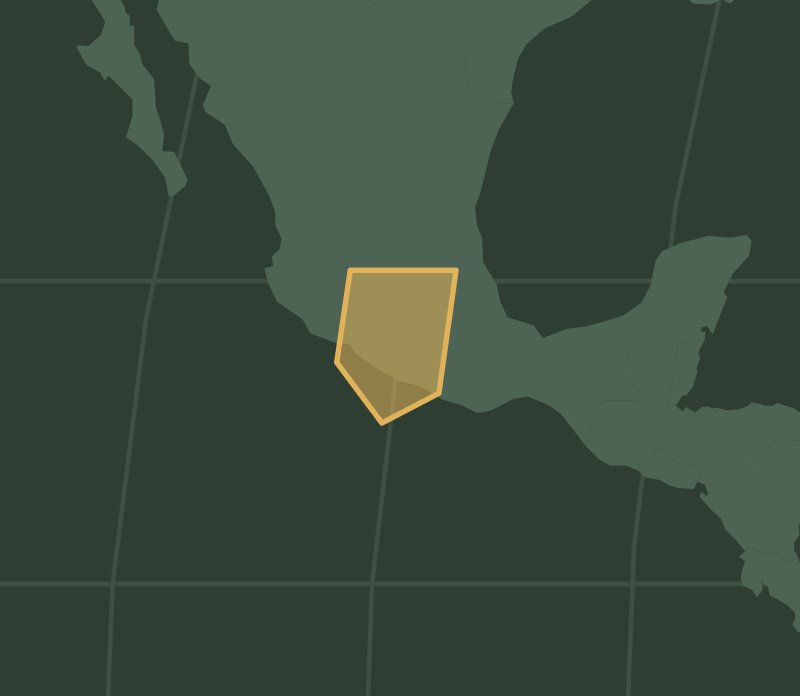
It is endemic to Mexico and lives in montane cloud forest.1
The IUCN lists it as an endangered species and the Mexican standard NOM-059 includes it in the category of special protection (Pr), according to the Chacruna table.1
The Chacruna article points out that one of the species described in “Seeking the Magic Mushroom” (1957) is today in danger of extinction.2
What helps
- Do not gather it in areas where it is used ritually.
- Respect the context of the Mazatec communities.
- Support the conservation of the cloud forest.
What it contains
Yet another Psilocybe
It belongs to the genus Psilocybe, with more than 150 hallucinogenic species in the world, traditionally used only in Mexico and some neighbouring areas.5
The sources consulted offer no chemical analyses specific to this species.
The experience
No data of its own
The sources consulted offer no reliable descriptions of the experience or its duration for this species.
Research
What has been studied
Scope of these dataEthnomycological studies; little specific chemistry.
With care
What it helps to know beforehand
It is endangered and endemic to Mexico.1
The link with the historical teonanácatl is a hypothesis.3
To follow
Books and related medicines
Sources
Where each piece of information comes from
- Chacruna. Table of Psilocybe species of Mexico (Table1). chacruna.net (file Table1_compact.pdf).
- Chacruna. Psilocybin Mushrooms in Mexico in Danger of Extinction. chacruna.net/psilocybin_mushrooms_extinction_mexico/.
- Guzmán, G. Hongos alucinógenos en México: historia, taxonomía, distribución geográfica y uso. bibliography.maps.org/resources/download/13502.
- Chacruna. Psilocybin Mushrooms in Mexico in Danger of Extinction (Wasson and Heim, 1953). chacruna.net/?p=105741.
- Guzmán, G. Revisión de los hongos alucinógenos, sobre todo Psilocybe. bibliography.maps.org/resources/download/13503.
- Etnobiología 5: 108–116 (2007). Los hongos en la cultura mexicana. dialnet.unirioja.es/descarga/articulo/5294469.pdf.
- Map APDER, with data from Natural Earth · public domain
- Molecule drawings APDER
Last reviewed: 24 November 2026. If you spot a mistake, write to us at info@apder.org.